
6 Common Problems With Fall Protection and How to Avoid Them
Common problems with fall protection can expose workers to avoidable hazards when performing elevated work. From incomplete job safety analyses to improper equipment use, gaps in planning and training can affect how safely work is performed at height.
In this video, Kevin Muldoon, Project Manager for Fall Protection at Mazzella Companies, explains six common problems with fall protection that his team encounters on job sites across the country.
He discusses why a job safety analysis should identify and address hazards before work begins, how to select the appropriate fall protection system for the application, and why workers need training before using fall protection equipment. The video also covers pre-use inspections, proper equipment use, and the importance of having a documented rescue plan.
What You’ll Learn:
- Why completing a job safety analysis is an essential starting point for elevated work
- How selecting the wrong fall protection system can leave workers exposed to hazards
- The role of fall protection training before employees work at height
- Why workers should understand how to properly use their fall protection equipment
- What to inspect before each use and why manufacturer specifications matter
- Why every fall protection program needs a clear rescue plan
Who This Is For:
- EHS and safety professionals responsible for working-at-height programs
- Facility, operations, and maintenance managers
- Safety trainers and supervisors
- Workers who use personal fall protection equipment
- Teams completing job safety analyses and working-at-height risk assessments
Need Help Addressing Fall Protection Hazards?
Contact Mazzella’s Fall Protection Division for help evaluating fall hazards, selecting fall protection equipment, developing safety programs, and supporting your working-at-height needs.
Transcript
Intro
Today, I’m going to talk to you about six common problems my team and I see on every job site throughout the country involving fall protection and elevated work.
My name is Kevin Muldoon. I’m a Project Manager for Fall Protection at Mazzella Companies.
I’m here today to talk to you about the six common problems that are on job sites across the country that my team and I uncover daily.
The Importance of Completing a Job Safety Analysis
The first common problem my team and I see is a job site analysis, the lack of one. Basically, what it is, is how you’re going to do what you’re going to do safely.
Now, you may be thinking, “You don’t have one? Ask your boss.” Because if you’re working at height, you need one.
It’s going to identify the hazards that you’re going to come across and how you’re going to either control or eliminate those hazards.
It’s important because if you don’t start your job safe, you’re not going to end safe.
Choosing the Wrong Fall Protection System
The second most common problem with fall protection is the lack of selecting the proper equipment for the job.
Let’s talk about roofing. Roofing is really a common application. There are a lot of guys replacing roofs in the summer and even in the winter.
Basically, what they would require to be six feet from the leading edge is a guardrail system.
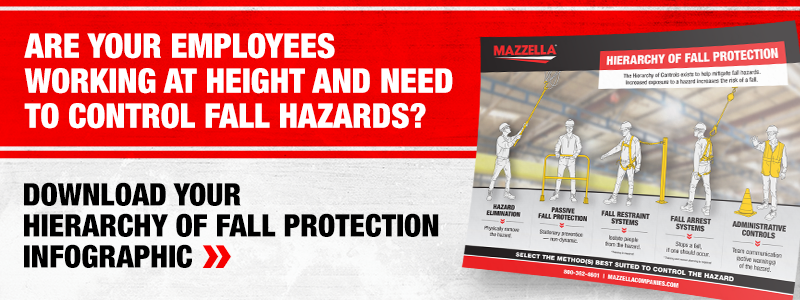
You may or may not know there’s a hierarchy of controls with fall protection. The first is trying to eliminate it.
The second is a passive control or a guardrail system preventing you from going to the hazard.
There’s also fall restraint, which is also a protective measure to prevent you from going to the hazard. Again, if it prevents you from going to the hazard, the hazard doesn’t exist, you eliminated it.
But if you can’t eliminate it, there’s fall arrest. Arrest means that if you fall, the system that you have is going to arrest you from actually hitting the ground or obstructing something else.
And then, if you can’t arrest the fall, there are administrative controls, which are very extensive and need a professional engineer to do.
Failure to Have Fall Protection Training
The third most common problem with fall protection is a lack of training.
In my 30 years, the biggest change has been that OSHA came down in 2017 that you have to have fall protection training. It’s mandated. It’s a must, or you will be cited.
Anyone working at height who has not been trained could be cited today.
Improper Use of Fall Protection Equipment
The fourth most common problem with fall protection is improper use of equipment.
Now, let’s just say that you’re two days on the job, and your employer hands you a harness and says, “Put it on. I need you to work 12 feet in the air.”
You have a decision to make: whether to put the harness on or give it back to him and say, “I haven’t been trained, I don’t know how to put this on, and I really am uncomfortable doing it.”
That would probably be the smartest play. But remember, your safety is your responsibility, no one else’s.
Failure to Inspect Fall Protection Equipment
The fifth most common problem with fall protection is inspections. Inspections are important because you have to do them before each use.
Why? Because you’re responsible for your own safety.
In doing that, you have to follow the manufacturer’s specifications. They will tell you specifically what to look for, whether it is a harness, a rope grab, a lanyard, a body protection device, or any device at all.
That’s what you need to look for.
Failure to Have a Proper Rescue Plan
The sixth most common problem with fall protection is a lack of rescue planning, or even thinking about a rescue at all.
So, you fall. What do you do? Does somebody get you down, or do you get yourself down?
Those are two basic means of getting down. Do you have a plan? Do you know that plan? Has somebody communicated it to you? Has it been written down?
You really need this, or you shouldn’t start work.
Closing
Hopefully, we helped you understand the six common problems with fall protection.
If you have any other questions, please visit our website at MazzellaCompanies.com.
Thank you very much.
FREE Downloads!
- Hierarchy of Fall Protection [Infographic]
- Top 10 Safety Tips for Working at Height [Infographic]
- Job Safety Analysis & Working at Height Risk Assessment [Bundle]
- Fall Safety 101 Infographic [Poster]
<!–[if lte IE 8]><![endif]–>
 hbspt.cta.load(3336966, ‘43336e9f-4baf-453c-841c-394decc4e070’, {“useNewLoader”:”true”,”region”:”na1″});
Learn More! Articles & Videos
- Top Five Myths About Mobile Elevated Work Platforms
- The Best Types of Fall Arrest Systems for Fixed Ladders
- New Fall Safety 101 Poster…Download Today!
- Decoding Fall Protection Safety: Regulations, Anchor Points, and More
- OSHA Inspection Series: The Principles of Fall Protection Safety
- Fall Protection for Roofers: Systems, OSHA Regulations, & Best Fits
Contact Mazzella
- Schedule Remote or In-Person Training
- Contact Mazzella’s Fall Protection Division
In this video
- 0:00 – Intro
- 0:52 – The importance of completing a Job Safety Analysis
- 1:26 – Choosing the wrong fall protection system
- 2:35 – Failure to have fall protection training
- 2:56 – Improper use of fall protection equipment
- 3:27 – Failure to inspect fall protection equipment
- 3:59 – Failure to have a proper rescue plan
- 4:20 – Closing
Disclaimer:
Any advice, graphics, images, and/or information contained herein are presented for general educational and information purposes and to increase overall safety awareness. It is not intended to be legal, medical, or other expert advice or services, and should not be used in place of consultation with appropriate industry professionals. The information herein should not be considered exhaustive and the user should seek the advice of appropriate professionals.