
Flemish Eye vs. Turnback Eye vs. Hand-Tucked Eye: Which Wire Rope Sling Eye Is Right for You?
When purchasing a wire rope lifting sling, how do you choose between a Flemish, Turnback, and a Hand-tucked eye? This article covers the pros and cons of each eye sling type and how to choose the right one for your organization.
Transcript
Intro
– I’ve got two slings here with four different eyes. Now, these are just for display purposes only, but we want to know what’s the difference? We are going to sit down with AWRF board member and Mazzella Regional Sales Manager, Terry Driscoll, to find out.
– Hi, my name’s Terry Driscoll, and I’ve been in the lifting and rigging industry for the past 28 years.
What are the different types of wire rope sling eyes?
If you take a look at this, we actually have an old hand splice taper and conceal eye. You have a very old school burn off-style eye, so again, it has a similar look to the taper and conceal. They just didn’t finish off the concealing aspect of it, and instead burnt off the ends. Then of course, we have a turn back or fold back-style eye, and what you see the majority of the time out in the field, which would be a mechanical splice Flemish eye.
How are hand-sliced wire rope slings made and used?
There’s a different process on how you’re making the eyes, again, the burn off is similar to the taper and conceal, but what you’re actually doing is opening up the strands or the actual wire rope itself, to reveal different strands that are being tucked and tapered and concealed into the body of the sling to make them disappear. A sling like this is traditionally being utilized by a lot of iron workers. Iron workers would tend to utilize a hand splice-style sling because you don’t have a carbon steel sleeve that can get in the way of the sling coming out from underneath a load. So, if you’re in the choke configuration and once you release that sling, you can pull that sling below the actual load. If we had a carbon steel sleeve involved, then it might have a tendency to get hung up.
How are Flemish eye wire rope slings made and used?
The majority of the slings that you would see out on a job site are going to tend to be the Flemish eye mechanical splice finish with this carbon steel sleeve and the process, of course, similar to what the hand splice would entail, we’re actually opening up the individual strands away from the wire and away from the core, feeding them back into themselves, and then we would put the carbon steel sleeve in place. We would put it into a swager that would actually, a hydraulic press, so to speak, and it would swage that into place, depending on what size sling that you’re dealing with, whether it’s going to be a small quarter inch or as large as three-inch plus. That, of course, is going to give you your design factor with five to one built into it.
How are turnback eye wire rope slings made?
On the other end, we happen to have a turn back or a fold back eye. The big difference with this, of course, is speed, the time it’s going to take you to actually make these two. The fold back, of course, it’s as simple as just folding back the wire rope on itself, inserting either a stainless or an aluminum-style sleeve, duplex-style sleeve, and then putting that into the swager and crimping it down.
What are the hazards of turnback eye wire rope slings?
What would happen, of course, is that you can still achieve a five to one design factor, but the largest issue is if you’re not doing a proper inspection on this style of sleeve, it may have a tendency to crack or to wear, if not done properly. Maybe you’re dropping large hardware on it out on the job site, and if that actual sleeve fails, now you actually have a catastrophic failure, to where it’s just going to release the load, compared to a Flemish sling. And the Flemish sling itself, of course, if we had an issue with that carbon steel sleeve and it wasn’t properly inspected before it went out onto a job and if there was any type of failure, the Flemish, itself, is still able to achieve working load limit, not that it should be used in that manner whatsoever. A proper inspection before every use is a must.
What are the hazards of burn-off hand-tucked wire rope slings?
If you’re an iron worker, again, I would not recommend utilizing any of the old burn offs nowadays, just because of the hazard that’s associated with it, but a hand splice sling is still commonly used to this day and it works fantastic in the right application.
Turnback vs. Flemish vs. Hand-Spliced wire rope slings
If you’re looking at a mechanical splice and / or a turnback, you’ll actually see these quite a bit in Europe. You’ll see them coming from various assemblies, going to power plants coming in from Japan. If they are done properly, and they are proof tested prior to use, there’s no issue with it, but you do have to be concerned if you’re not doing a proper inspection beforehand.
Mechanical splice, again, this is what’s more widely used throughout the United States at this time. There are, of course, different types of end fittings that people can put onto these types of slings. Traditionally, you’re not going to be seeing any type of turn back or fold back eye out in the field, unless, of course, it is specific from the OEM with equipment that’s specific to the job.
The hand splice slings can still be utilized in the field, just taking into consideration, they will have less capacity than a traditional mechanical splice sling, based on the fact they’re made with fiber core rope versus the IWRC, or Independent Wire Rope Core.
What are some best practices when using wire rope slings?
When using wire rope slings out in the field, again, you want to make sure that you have, number one, the right sling for the job. You understand what the load of the item that’s about to be lifted. You understand what the capability, or capacity, working load limit of your wire rope sling. You want to do a pre-check inspection before use, and we’re looking first and foremost for a tag. Do I have a proper tag that’s going to match the load that I’m about to lift? Performing a visual inspection, do I have any type of issues, any type of deformation? Do I have any kink, severe bends? Do I have weld splatter on this wire rope sling? Is there a loss of diameter based off of a dog leg? Do I have any broken wires right below that carbon steel sleeve? And if so, that sling of course, is not to be used and should be replaced immediately. Cut it up on the job, get it into a dumpster. Just make sure no one’s going home with it.
Learn how to inspect all types of lifting slings!
– One thing to keep in mind is that all of these slings and their eyes meet the standards of ASME B30.9 Slings. You might want to just put a little extra emphasis on your inspections when using fold back eyes. You want to inspect all of your slings as part of a frequent inspection pre-shift, or more often, anytime you use them. If you want to learn how to inspect your slings, you can download our free ebook or take our sling inspection course linked in the description below. If you found this video useful, informative, entertaining, or you just feel like being friendly, then hit that like button so we can get this information out to anyone who needs it. Subscribe and hit the bell so you never miss a video. If you have a question, drop it in the comments so we can get you an answer. Remember, safe rigging is smart rigging. My name’s Ben, stay safe out there.
Thanks to their immense durability, wire rope slings have become commonplace in any construction, industrial, mining, or manufacturing environment involving overhead lifting.
While wire rope slings appear to be a monolith on the surface, they’re an incredibly diverse tool—ranging in size, type, configurations, and functionality. One of the best examples of this diversity is the three eye sling types: Flemish, Turnback, and Hand-tucked.
Knowing the differences between these eye configurations is important, as each one has its best use cases and weaknesses.
From mom-and-pop construction companies to America’s largest steel mills, Mazzella has provided top-of-the-line wire rope slings to organizations for several decades.
We know it can be confusing to decide what wire rope eye sling type is best for your organization’s needs.
To help you in your decision-making process, this article will answer questions like:
- What is a Flemish, Turnback, and Hand-tucked eye?
- What are the pros and cons of each eye?
- What are the inspection requirements for each eye sling type?
- Which wire rope eye sling is right for you?
What Is a Flemish Eye?
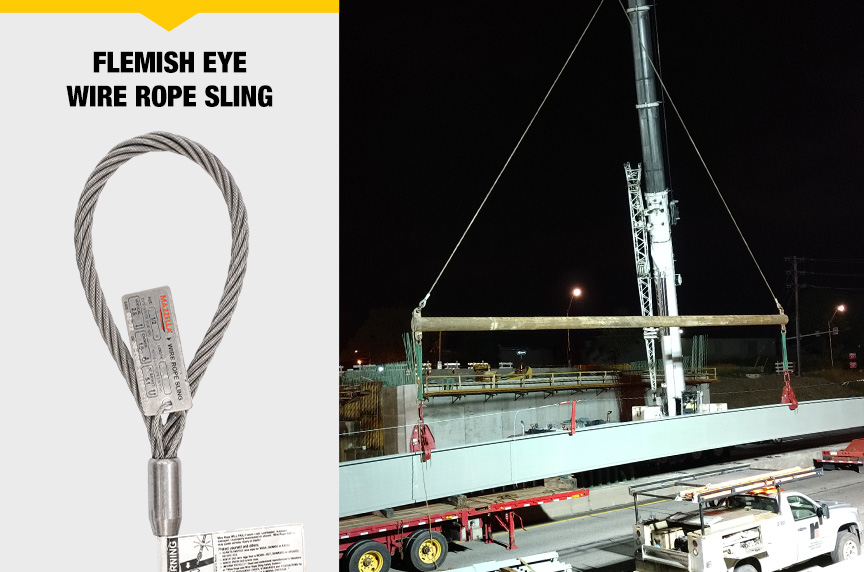
According to our lifting and rigging experts, the most common type of wire rope eye sling in the United States is the Mechanical Splice Flemish eye.
The Flemish eye is made by opening the wire rope’s individual strands into two parts. From there, the two strands are looped in opposite directions and laid back together—creating an eye shape at the end of the wire rope. Mechanical Spliced Flemish Eyes are traditionally preformed with a general purpose 6×19 or 6×37 Independent Wire Rope Core (IWRC).
Once the eye shape is formed, the rope is fitted with a carbon-steel (sometimes aluminum or stainless steel) sleeve. The rope is then fed into a hydraulic machine, called a swager, that helps form and fit the sleeve in place.
What are the Pros of Using a Flemish Eye?
Thanks to its splicing method, the Flemish eye is the most efficient and economical wire rope eye type available.
Additionally, if there were any malfunction or failure with the carbon-steel sleeve, the Flemish eye could potentially be able to reach its working load limit.
While this isn’t ideal—and properly inspecting your lifting slings can prevent this situation—you could still avoid dropping the load. It would also give you enough time to replace the damaged wire rope sling. If a Flemish eye sling is unswaged and not discovered in time, our lifting and rigging experts say you should set the load down immediately.
What are the Cons of Using a Flemish Eye?
Depending on the job application, the sleeve could interfere with the sling coming out from underneath a load.
For example, iron workers usually prefer using a hand-tucked style sling, since they don’t have a sleeve that could interfere with placing a load in a choker hitch.

What Is a Turnback Eye?
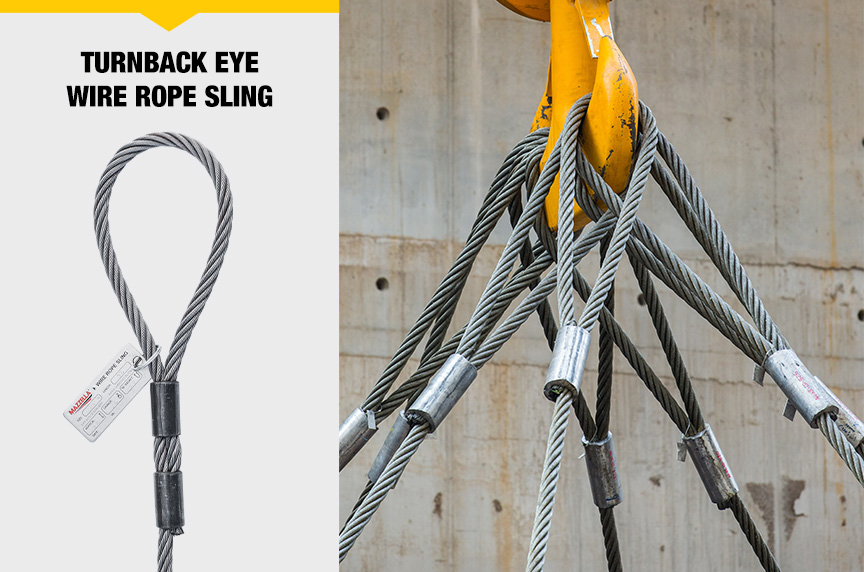
Also referred to as a “fold back loop,” “returned-loop,” or “double-deck eye,” the turnback spliced eye is made by bending the rope against the live portion to the free end by using a steel or stainless steel (drop protective) sleeve.
Like the Flemish eye, this sleeve is crimped with a hydraulic swedger. According to our lifting and rigging experts, Turnback eyes are a popular option in European- and Asian-based industries.
What are the Pros of Using a Turnback Eye?
The Turnback eye is arguably the easiest and fastest sling eye configuration. Since you’re folding one side of the rope to the other, you don’t have to divide the wire rope’s individual strands into two parts. Turnback eyes also have high-efficiency ratings, and they can achieve a 5:1 design factor. While it’s quick to fabricate, strict tolerances need to be met with the sleeve’s finish.
What are the Cons of Using a Turnback Eye?
While turnback eyes have excellent efficiency ratings, the lifting capacity of the sling is entirely dependent on the sleeve’s integrity. If the sleeve fails, the entire load will be dropped, putting your workers at an increased risk of injury or death.
Due to strict requirements around the fabrication process, Turnback eyes are not common on most US job sites when compared to other countries.
What Is a Hand-Tucked Eye?
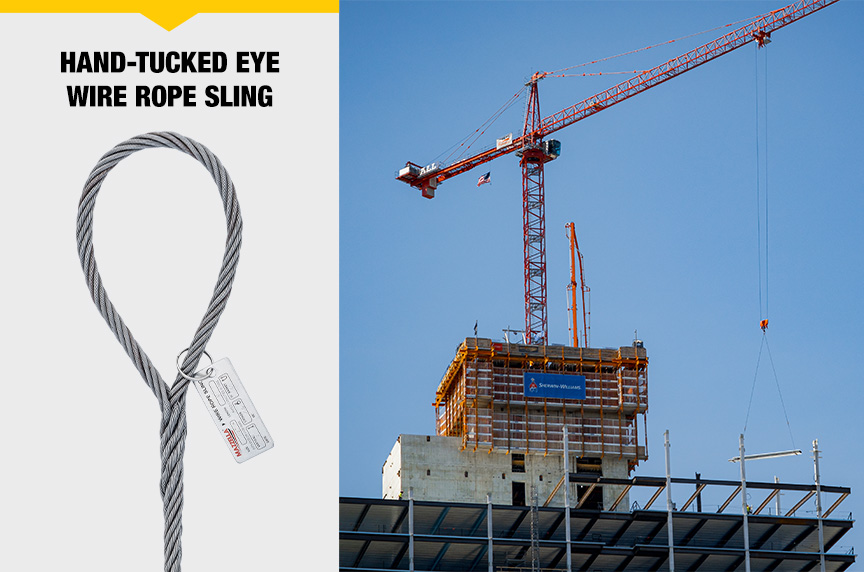
Used in select industries, the Hand-tucked eye is formed when the shorter “dead” end is hand-tucked or taper and concealed into the longer “live” end of the wire rope.
What are the Pros of Using a Hand-Tucked Eye?
Thanks to its design—which doesn’t include a sleeve—hand-tucked eyes allow for an easier inspection of the wire rope and strands. In some applications, not having that sleeve also makes placing a load in a basket hitch easier. This function is why iron workers prefer them over Turnback and Flemish eyes.
If inspected and tested properly, hand-tucked eyes are a great option in the right applications.
What are the Cons of Using a Hand-Tucked Eye?
While they make for easy inspections, Hand-tucked slings lack the versatility offered by other wire rope slings. If a Hand-tucked sling is used in a vertical configuration and does not have a proper tag line, the sling is susceptible to coming undone.
Additionally, Hand-tucked eye slings will have less lifting capacity than a standard mechanical-spliced sling.
What are the Inspection Requirements for Flemish Eye, Turnback, and Hand-Tucked Slings?
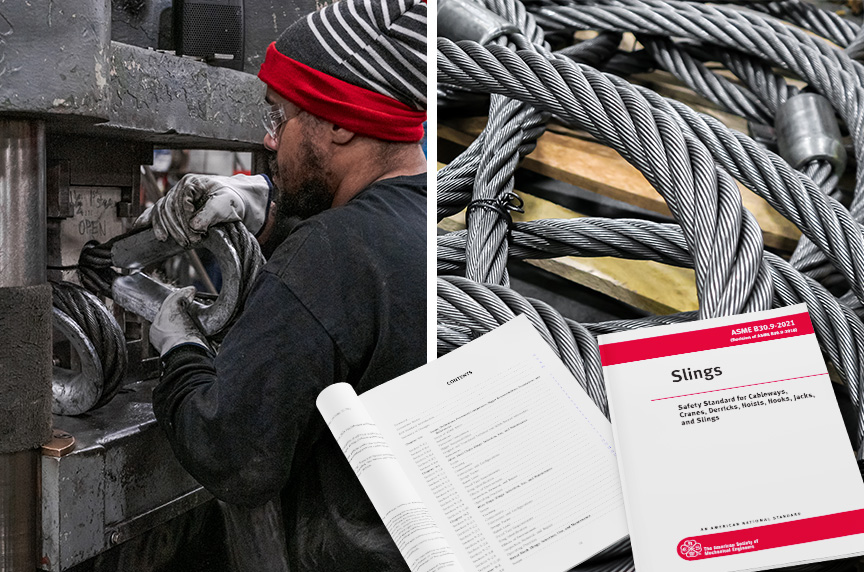
Whether it’s a Flemish, Turnback, or Hand-tucked eye, you will follow the same inspection and safety requirements laid out in ASME’s B30.9 Slings standards.
First, make sure you have the right sling for the job. This means answering important questions, like: will it be exposed to extreme temperatures? How often will you use it? What’s the lifting capacity?
From there, make sure a proper sling tag is attached to every wire rope sling at your job site. This tag will help riggers determine the best application for the sling.
After that, conduct a visual inspection of your sling. While inspecting, look out for deformations, kinks, loss of diameter, severe bends, dog legs, and any broken wires around the sleeve or at the base of the sling (follow the 5-10 rule for standard slings).
If any of these abnormalities are found, remove that sling from the job site.
Which Wire Rope Sling Configuration is Right for You?
Wire rope slings have proven to be an exceptional lifting device, and there’s a good chance you are already using them at your job site. But we understand that wire rope slings are not a one-size-fits-all solution.
Understanding the differences between the three eye sling types will help your organization make the right choice, increasing your productivity and enhancing worker safety.
Mazzella has over 70 years of experience manufacturing and distributing lifting slings to industries nationwide. If you want to learn more about what lifting sling is best for your application, download our Lifting Sling Types & Term Guide for a comprehensive overview.

Copyright 2024. Mazzella.