
What’s Crosby’s Wireless Load Shackle, & How Does It Monitor Lifts?
How can you monitor the weight of a lift without using a load cell? Crosby has developed the Wireless Load Shackle, which provides readings on how much a load weighs as it’s being lifted.
Transcript
Introduction
– Today, we are going to lift this beam. How much do you think it weighs? Go on, put your best guess in the comments. So, if you were here with me on site, how would you figure out how much it weighs? If you had to make this lift safely, what would you do before you rigged it, guess? Well, yeah, probably.
The thing about guessing is that it is rarely a good idea. And if there is one thing you shouldn’t be doing when you rig and lift a load, it would be guessing. So, today we’re going to see how loadshackles take the guesswork out of your lifting and rigging operations. Let’s get into it.
What is a Loadshackle?
– We’ve taken a Crosby, standard Crosby shackle, and actually made it into a load monitoring device and we call it a Loadshackle. This happens to be a radio frequency model. We can also make these in Bluetooth but with the radio frequency model, you would read that data back on this handheld and the range on this is going to be a thousand meters with relative line of sight.
We do make custom load pins that are used in a multitude of applications, but we basically took that technology and applied it to our shackle. And we also are able to control this load pin by applying these anti-rotation brackets, as well as a centering bobbin in the middle to help center the load. And then, we also indicate with this yellow tag on the opposite side to indicate where the nut for the pin must go. Those are three important concepts because that helps keep the pin level and straight when you’re applying a load to it and that’s what’s going to help achieve that 1% accuracy.
It’s powered by four AA batteries. We have 1200 hours of battery life which is industry leading out there in the industry. And then again, we’ve taken a Crosby shackle which is world renowned and turned that into a load cell. We have all the same attributes with a Crosby shackle. So, with that being said, we’re going to incorporate this loadshackle on the crane hook here and lift this beam and we’re going to show you how it works.
Demonstrating the Loadshackle
So, this object that we’re lifting is approximately 3,100 pounds and then the loadshackle is picking up everything below it right now. So, it’s incorporating the 2 35-ton Crosby shackles as well as the synthetic slings here. So, a little bit of movement in the load but you can see that’s kind of stabilized, now. We’re picking up 3,336 pounds approximately. It’s fluctuating a little bit as it moves back.
So, you know, this is one way that you could use a loadshackle. Again, it’s going to pick up the total weight, total load weight, whereas with our Radiolink Pluses, we had those incorporated directly in our sling legs which will give you a more accurate view of the tension in those exact sling legs versus the total load that we have here with the loadshackle.
Comparing to Wireless Load Cells
The biggest difference between a loadshackle and our Radiolink is going to be the accuracy. So, on our Radiolink series, those are accurate at 0.1% to full capacity, whereas a loadshackle is accurate to 1% full capacity.
So, I’ll quickly just break that math down. With a six and a half ton model, that’s 14,300 pounds because it’s metric tons. So with our Radiolink, 14,300 pounds 0.1% of that is going to be approximately 14.3 pounds, plus or minus. With a load shackle at 1% accuracy, it’s going to be 143 pounds accurate.
You’re going to use a load shackle when you have limited headroom applications, typically. Sometimes with a rigging situation, you will not have enough space to incorporate a load cell, a shackle on the top, a shackle on the bottom into the rigging. So you could use a load shackle in that type of application where you have a low headroom situation and you just don’t have the space to put a Radiolink.
I was involved in a marine application where they had a crane that was housed inside a dock area. And again, it was a low headroom situation where they just could not, based on the height of the boats coming in and the crane and on the ceiling, they just didn’t have the space to incorporate a full Radiolink load cell. So they elected to go with the loadshackles, because it helped minimize that space and it still gave them an accuracy that they could live with.
You know, at Crosby we are always continuously looking at how we can better develop our products. We’re working on some technology right now where it could be a cloud-based program that could allow you to monitor any of your load cells, remotely, through a cloud-based software platform. So I mean, really with the technology out there, I mean the sky’s the limit. And you know, we’re continually looking at new ways to improve our products.
Conclusion
– So, the wireless loadshackle’s designed to help keep you safe, give you that knowledge of what the true weight of that load is experiencing and it’s going to prevent accidents and injuries. So, using Straightpoint Load Cells or wireless Loadshackles are going to keep you safe. And as we say at Straightpoint, “Know the load.”
– Combining advanced technology with the most standard and basic, yet integral, pieces of your rigging. The Loadshackles will help you make safer and more efficient lifts. Know the load like never before. If you’re interested in learning more about these solutions, contact Mazzella’s Lifting and Rigging Division today, links below.
If you found this video useful, informative, entertaining, or you just feel like being friendly, then hit that Like button, so we can get this information out to everyone who needs it. Subscribe and hit the bell so you never miss a video. If you have a question, drop it in the comments, so we can get you an answer. Remember, safe rigging is smart rigging. My name is Ben and stay safe out there.
“The safety of the people shall be the highest law.” – Roman statesman Marcus Tullius Cicero
In the lifting and rigging industry, safety is critical. It’s not just to get work done efficiently, but also, to make sure your workers are safe at all times. Safety comes through education, and knowing the weight of your lifts is critical to making efficient AND safe lifts.
The Crosby Group has the mission to find safer ways to conduct overhead lifts through technology. The Crosby Wireless Load Shackle is one of the load-monitoring devices that will help you know how much you’re lifting and how sling angles affect the weight of the load.
As part of the Crosby | Straightpoint line of products, the wireless load shackle was designed to help determine load weights. While the wireless load shackle has a lower accuracy rate than other Straightpoint products, it works well in low-headroom environments.
In this article, we’ll answer the following questions:
- What is the wireless load shackle?
- How do you monitor the results from the wireless load shackle?
- What are the key specifications of the wireless load shackle?
- Where has the wireless load shackle been used in the field?
What Is the Crosby Wireless Load Shackle?
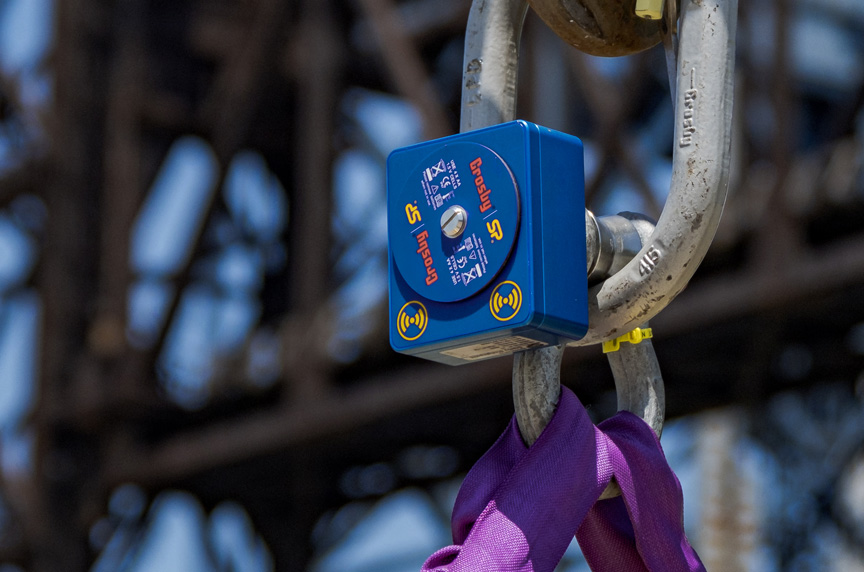
The wireless load shackle utilizes Crosby G2130 and G2140 bolt-type shackles to monitor loads for an efficient solution.
Low-headroom applications, permanent installations, and heavy lifts are areas where a wireless load shackle makes sense to use. Crosby | Straightpoint makes the wireless load shackles in varying capacities up to 1,500 metric tons.
Example:
Say you have a 400-ton Radiolink Plus load cell with a 400-ton shackle on top, and a 400-ton shackle on the bottom. It requires so much headroom and is so heavy with all those components together that it decreases the ease of use.
Solution:
You could use the wireless load shackle at 400 tons, connect it to your rigging and hook, and monitor your lift.

How Do You Monitor the Results from the Crosby Wireless Load Shackle?
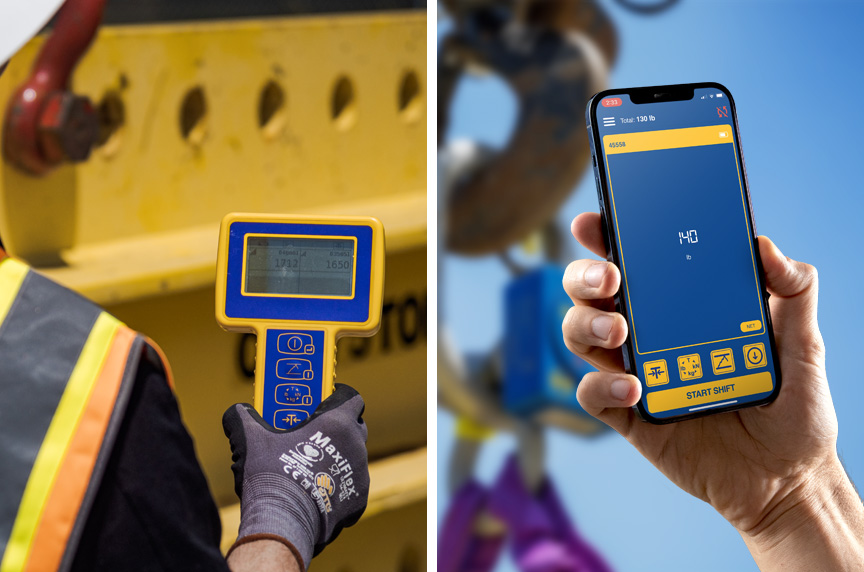
The wireless load shackle offers either a long-distance Radio Frequency (RF) version monitored on a handheld device with Crosby | Straightpoint’s Insight software (designed for Windows-based devices), or a Bluetooth version monitored with its free app. The HHP app is available on Android or iOS platforms.
The Bluetooth version of the wireless load shackle has a communication range of about 100m or 328’. However, the presence of other frequency devices in range of the load cell (including, but not limited to, wireless crane controls), can weaken or easily disrupt the signal.
You can monitor the long-distance RF version of the wireless load shackles from the handheld device, which can display up to four devices at one time. If you have a four-point lift, and you need four wireless load shackles, you only need the one handheld device (or Insight software) to see the individual loads or access another screen that gives you the total weight of the load.
Following the power-on, the handheld device will connect to the wireless load shackles. If there is only one load cell, it will display the reading in a single-screen mode. As the weight of the load increases, the amount on the display will increase. If an overload occurs, the handheld will display “OVERLOAD,” and a 90db alarm on the handheld device will sound.
In addition to the weight, the Crosby | Straightpoint handheld device will monitor each shackle’s signal strength and ID.
What Are the Key Specifications of the Crosby Wireless Load Shackle?
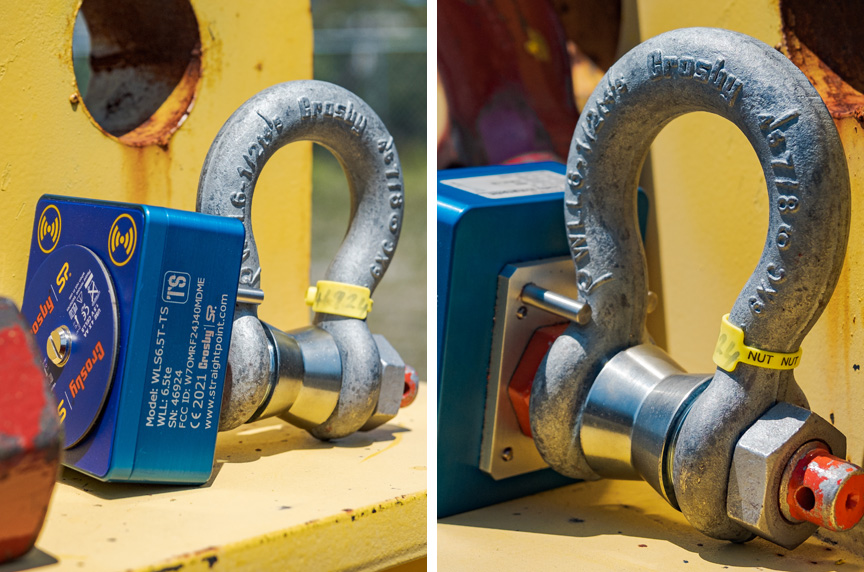
Range
It depends on the type of wireless load shackle you use. If it has a radio frequency, it can cover up to 1,000m (3,280’). If the wireless load shackle has Bluetooth capabilities, it will cover 100m or 328’.
Weight
The smallest of the 10 wireless load shackles weighs 6.16 lbs. (2.8 kg). The heaviest wireless load shackle weigh 1,459 lbs. (662 kg).
Capacity
The smallest wireless load shackle (WLS3.25T) can hold 7,150 lbs. (3.25 metric tons). The heaviest wireless load shackle (WLS400T) can lift loads up to 880,000 lbs. (400 metric tons).
Battery Type / Life
The wireless load shackle requires 4 AA alkaline batteries to function. The batteries can last up to 1,200 hours of continuous use, or 500 hours in Bluetooth functions.
Display Type
Like the Radiolink Plus, certain Crosby Wireless Load Shackles come with a 240×128 multi-line dot matrix with backlight. If used with Bluetooth, the wireless load shackle sends results to your smartphone.
Operating Temperature
The wireless load shackles can operate between 14°F and 122°F (-10°C to +50°C).
Accuracy
Across all 10 models, the wireless load shackles have an accuracy of +/- 1.0% full scale.
Frequency
The wireless load shackles have a 2.4 GHz frequency.
Data Rate
These load shackles have a data rate of three updates per second.
Protection
The wireless load shackles are IP67 rated. They are dust tight and watertight against water immersion between 15cm and 1m for 30 minutes. Additionally, the wireless load shackles are NEMA6 rated, meaning they have the highest level of protection against dust and water intrusion. Also, they are resistant to corrosion.
Where Has the Crosby Wireless Load Shackle Been Used in the Field?

The wireless load shackles have been used in a variety of environments. Some of those uses include, but are not limited to:
- Logging industry
- Overhead cranes
- Auto cranes
Logging Industry
Loggers came to Crosby | Straightpoint and wanted to use the wireless load shackle. They did so to monitor weights when pulling logs up the sides of mountains.
Overhead Cranes
Typically, in a warehouse, headroom can be an issue during a lift. There are thousands of overhead cranes in the United States with no or limited load monitoring. The wireless load shackle is a hook, and Crosby | Straightpoint offers an LED display that’ll show the weight.
They’re four-inch tall letters, so you can clearly see how much you’re lifting.
Auto Cranes
Here, load cells have been used to make sure lifting specialists don’t overload the pedestal crane.
If you’re lifting a load, and you don’t know how much it weighs, that’s a perfect application for a load cell. There’s a multitude of opportunities to rig loads safer than they are right now simply by knowing how much you’re lifting.
What Are the Limitations of the Crosby Wireless Load Shackle?
Crosby | Straightpoint’s Wireless Load Shackles are designed to operate between 14°F (-10°C) and 122°F (50°C).
If you’re making a lift in sub-zero temperatures, it’s probably not a fit for Crosby | Straightpoint’s Wireless Load Shackles.
Conversely, in hot forge foundries, customers will put a load cell on a crane that’s getting up to 150°F, and others have said, “It’ll flash a temperature of 250°F.” Crosby | Straightpoint doesn’t have an effective solution for something that hot.
Crosby | Straightpoint does make custom project load-monitoring solutions, so special applications can be reviewed for capabilities.
If you work in a hazardous environment where you’re using spark-resistant cranes and hoists and explosion-proof equipment, Crosby | Straightpoint has an ATEX (Atmosphere Explosible)-rated load cell that can be used in those hazardous environments. The specialized load cell must be marked by ATEX and has to be ATEX-approved.
***Remember to have conversations with your rigging specialists and reach out to manufacturers to understand what you’re getting into because the equipment / tools business is not a “one-size-fits-all, out-of-the-box” application. Do your research on what you’re about to rig BEFORE you rig it.
How Does the Crosby Wireless Load Shackle Compare to Other Load Monitoring Devices?
If you’re using the Radiolink Plus on a 12-metric ton load, which is 26,000 pounds, you’re going to have a +/- tolerance of only 26 pounds.
The wireless load shackle used on the same 12-metric ton, 26,000-pound lift has a 1.0% +/- tolerance. Now, you’re talking about 260 pounds.
Although the wireless load shackle will not be as accurate as the Radiolink Plus, there are environments and applications where headroom is absolutely critical, and you won’t be able to use a Radiolink Plus.
***When customers go from no load monitoring to 1% +- tolerance, that’s a great improvement.
How Can Mazzella Help with Your Lifting and Rigging Needs?
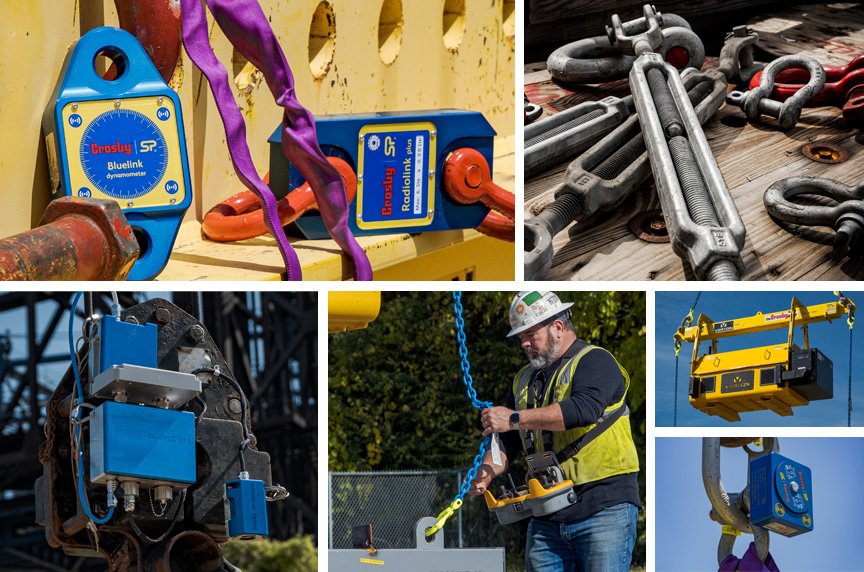
For decades, Crosby has manufactured products designed to make the lifting and rigging industry safer. Similarly, Mazzella has the mission to provide you with quality products that are the right fits to increase your productivity and minimize your safety risks.
Mazzella is a distributor of Crosby products of all types, including but not limited to:
- RadioLink Plus
- BlueLink
- Wireless Load Shackle
- BlokCam
- Verton
- Crosby Gunnebo GrabiQ Chain Slings
- Clamps
- Pipe Grabs
- Sheaves
- Bearings
- Blocks
- Sling saver hardware
- Turnbuckles
- Hooks
- Thimbles
By using the proper equipment, you’re controlling or eliminating hazards in the workplace. That helps reduce the risk of an accident. Think about how quickly the costs of a workplace accident or fatality can add up, including:
- Lost wages
- Workers’ compensation
- Low employee morale
- Decrease in productivity
- Workforce shortages
- Potential legal fees and OSHA fines
Remember, putting safety at the forefront of your lifts will help increase your productivity and minimize your downtime.
Click here to contact a Mazzella Lifting Specialist today for all of your lifting needs!


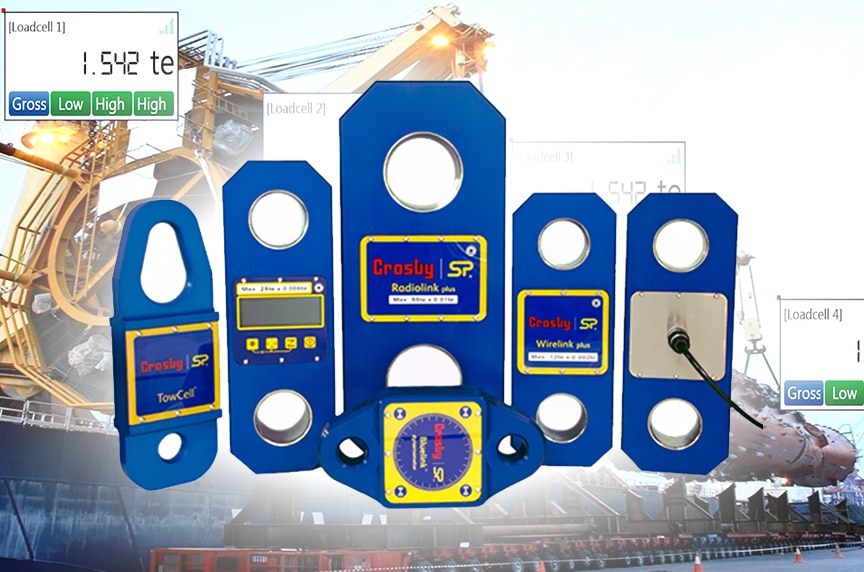
Crosby|Straightpoint Load Cell Dynamometers
Crosby’s Radiolink Plus works with Crosby standard shackles. Straightpoint’s DNV-GL type approved wireless tension load cell is capable of weighing and dynamic load monitoring capacities from 1t to 500t (all in stock).
Copyright 2023. Mazzella.