
How Elebia Automatic Hooks Improve Safety in Steel Mill Rigging
With hands-free environments becoming popular at steel mills, elebia automatic crane hood are becoming increasingly popular. To help you stay on top of industry standards, our article will cover what an elebia hook is, where they're used in steel mills, their role in improving employee safety, and how they speed up your operations.
Transcript
Introduction
As the steel industry moves towards a no-touch environment, increasing safety, and decreasing work-related injuries, Elebia Automated Hooks are becoming progressively more popular. Let’s take a look at how these hooks are making the steel industry safer and more productive.
My name’s Cody Mathis, I’ve been working with the Elebia product for 10 years.
What is the Elebia Hook?
The Elebia hook is a remote-controlled hook that an operator can control from up to 450 foot away.
What dangers in a steel mill do Elebia hooks alleviate?
Some of the dangers in a steel mill are, you know, your pinch points, your overhead loads, swinging loads, actually having to be hands-on with the rigging aspect of rigging a load. No-touch in the steel industry is, you know, is becoming the steel industry wide across the United States, North America, and worldwide. Lost time accidents, lost time injuries. You know, even if it’s just a finger, you know, that’s a lost time accident there.
How does the Elebia evo work?
So the evo line utilizes a magnet, neodymium, to orient the hook to your lift points. If you’re coming in on a shackle or an oblong or a chain, and the hook isn’t lined up perfectly, the magnet will do that for you. These range from 2 1/2 ton to 25 metric ton. These hooks are battery operated, 22-volt lithium ion. That’s good for 5,000 cycles. A cycle is open and close, 200 standby hours. So if the battery is on, it will last 200 hours just on standby mode. Charges from 10% to 100% in about 30 minutes.
How can the Elebia hook be used in electrode handling?
One of our many applications is in steel mills and they use these, Elebia evo and NEO hooks, to move their electrodes.
Another application in the steel mill other than just transporting your electrodes vertically, when an electrode comes into the steel mill, it is laid in a horizontal position. To get it upright, we use our threaded stem Metal Lift Plug along with the Elebia auto hook to stand the electrode vertical.
Where in the mill, and how are Elebia Automatic hooks for steel mill rigging used?
Tundish buckets, scrap buckets, any kind of rigging you can think, you know, especially on down days, we have Elebia auto hooks in the field that they actually remove major components of the furnace along with rigging. In the steel mills, you’ll see melt shop, hot mills, roll mills, pig lines. At this point, we’ve got an Elebia auto hook in about every production line you can think of.
How do Elebia hooks withstand the harsh conditions in steel mills?
The Elebia auto hook, it’s pretty heat resistant. You know, your, main concerns are your battery. The battery’s good for up to 450 degrees Fahrenheit. The body’s made out of Hardox, so it’s very corrosive/heat resistant. In the steel industry, we’ve had some of our units that we’ve supplied over the years, I mean, they’ve been there since 2013. They do get annual service, but they do last.
How do you maintain and care for your Elebia hook?
We at Mazzella, you know, recommend an annual service. So once a year, you would send the hook back. It gets fully disassembled. We check all the moving components, the load components, replace those if necessary, reload test it every annual cert. We have units in the field that have over 3 million cycles on one hook with no mechanical failure. Life expectancy, we’ve not seen any that have ended that, you know, their life expectancy. And just with the proper annual service that we recommend, all around, they’re amazing.
What safety features are built into Elebia hooks?
The main safety feature on the Elebia auto hook is, for one, the remote-control engagement release. And this unit will not release under load. A load over 50 pounds on the hook itself, the hook will not open.
What upgrades and modifications are available for Elebia hooks?
The additional options you can get on the Elebia evo model, a custom shank to fit the hook into your crane block. This hook would become your crane hook. There is a stainless-steel heat shield that you can put around it for open flame. A couple different magnet options. You know, magnets with sensors, magnet with latches built onto them. There’s a marine coating upgrade, submersible. There’s a submersible upgrade. These hooks have the capability of being completely submerged and still operate.
This is the evo2, the smallest size out of the evo line. This unit here is mainly for rigging applications as far as chain slings, wire rope, super sacks. A couple of the added features, which is available throughout the evo line itself, is custom top link, load cell, protective bumper, protective bumper in high temp, with or without LEDs, protective bumper with high-temp LEDs.
LEDs have three stages. Blue is closed, ready to lift. Red is in between stages, do not lift. Green is open, ready to engage. There is an additional light in this feature that is a white LED that will tell you when your battery’s at the low battery percentage set in the eMAX remote. Once the white light comes on, it will open and it will not close, which is an added safety feature. So you do not get up on a lift point and cannot get off.
If your magnet has the sensor installed, it will indicate on your remote that you have a ring attached to your magnet and that you are ready to engage.
What other industries are using Elebia hooks?
Some of the other industries that we’ve supplied over the years would be, you know, your waste control facilities, for nuclear waste. A lot of tool and die applications to where, you know, they’re using a chain sling to pick up a die. Concrete facilities, cement facilities. We have these in the field where they load and unload barges of cement.
Why should you consider the Elebia hook in your mill?
You don’t have to put that guy in that position that, you know, he may pinch his finger or get, you know, smashed. Saves your back. You don’t have to pick your rigging up off the ground to load it onto a hook. Some of the best feedback I’ve gotten is not only the product, but our service. You know, our turnaround times are quick. We usually can try to get your hook sent back out within a week of receiving it. You know, depending. We stock every component in Nashville. We’ve not found an application that the Elebia Auto Hook does not work.
You know, as far from a safety standpoint, you know, it’s starting to kick off to where everybody’s starting to notice, you know, this Elebia product. Word gets out, “Hey, you need to check this out.” But taking, you know, an operator or a man out of harm’s way is, you know, a key part to safety, especially in the steel industry where there are so many hazards. If you can eliminate one hazard with the Elebia auto hook, you know, it’s worth it.
How can you learn more about Elebia Hooks?
Elebia hooks are tough tools that can keep your workers safe. Don’t wait for a near miss or worse. Keep workers out of the drop zone, keep their fingers away from rigging, avoid falls, and let the hook do all the work rather than having workers rig at height. Give your operators security by keeping them away from the steelmaking process. Contact Mazzella’s Lifting and Rigging Division to learn more. If you found this video useful, informative, entertaining, or you just feel like being friendly, then hit that Like button so we can get this information out to everyone who needs it. Subscribe and hit the bell so you never miss a video. If you have a question, drop it in the comments so we can get you an answer. Remember, safe rigging is smart rigging. My name is Ben and stay safe out there.
For much of the twentieth century, steel mills were one of the most dangerous environments a worker could be in. According to reports from the Bureau of Labor Statistics, the fatality rate of steel and iron workers in 1907 was 220 per 100,000 workers.
Fast forward to 2019, and the rate fell to 26.3 per 100,000, a 90% decrease.
The steel industry has dramatically changed, and employee safety is one of the areas that has improved the most.
Even with this progress, workers still encounter many hazards in a steel mill, like high temperatures, falling from heights, contact with machinery, pinch points, swinging loads, and more.
Recently, steel mills have prioritized implementing a no-touch rigging environment at their facilities—where you can make hands-free connections and keep workers out of harm’s way.
At Mazzella, we have decades of experience providing steel mills with state-of-the-art lifting and rigging equipment, and one of our most popular no-touch technology offerings is the Elebia auto hook.
If you’re looking to install no-touch procedures at your steel mill and are curious about Elebia hooks, this article will answer questions you may have, such as:
- What is an Elebia hook?
- How and where are Elebia hooks used in steel mills?
- Can Elebia hooks withstand a steel mill’s harsh environment?
- Are Elebia hooks a good fit for your hot metal applications?
What is an Elebia Hook?
The Elebia auto hook is a lithium ion battery-powered, automatic crane hook that allows for the remote attachment and release of loads.
One of the more unique features of the Elebia hooks is the attached magnet, which eliminates the need for employees to manually line up bales or rings before closing them.
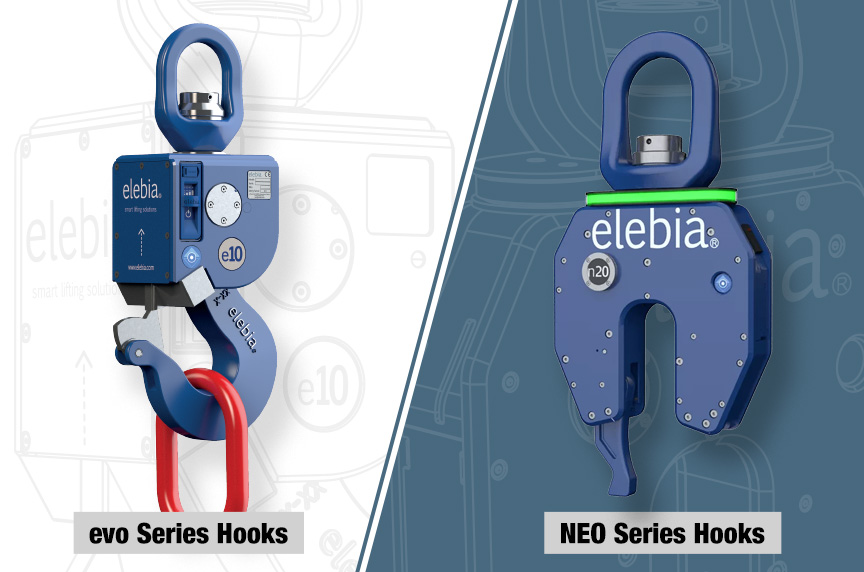
There are two Elebia hook models: the Evo and Neo lines. The Evo model has a lifting capacity ranging from 2.5- to 25-tons. It also utilizes an open swing-style hook with an attached magnet, making it great for lifting chain slings off the ground.
With the Neo model, the lifting capacity range is from 20- to 100-tons, making it ideal for heavy lifting applications, like spreader beams and furnace components. The Neo model also uses a motor-controlled hatch to secure the hook in place.
Historically used in ports and shipyards, Elebia hooks were designed to operate in intense environments, allowing for a seamless transition into steel mills.
How and Where are Elebia Hooks Used in Steel Mills?
Whether it’s the melt shop, hot mills, pickling lines, roll mills, pig lines, or shipping, Elebia hooks are now found in every stage of the steelmaking process.
One of the biggest responsibilities of an Elebia hook is the transportation and handling of graphite electrodes.
These electrodes can weigh several tons, making it impossible for workers to lift them manually. As the conductor for the steel’s furnaces, they’re also incredibly hot, posing a safety risk to workers. And while lifting slings are an affordable and flexible lifting device, they are not designed to withstand the intense environments of a steel mill.
Thanks to their versatility, Elebia hooks make rigging electrodes faster, regardless of whether it’s in a vertical or horizontal position. The hook’s remote control feature eliminates employees needing to climb on top of furnaces to rig them, decreasing their chances of injury.
Another key use of Elebia hooks is along the mill’s pickling line. Before, operators had to crawl into the pickling basket to make a connection for the crane hook, leaving them vulnerable to slip and fall hazards, cuts and abrasions, and exposure to dangerous chemicals. Now, the process can be done completely hands-free.
Furthermore, Elebia hooks can also be used for lifting and rigging:
- Furnace components
- Offloading raw materials
- Tundish and scrap buckets
- Aluminum beams
- Heavy bags
How do Elebia Hooks Deter Danger in Steel Mills?
The Elebia hook was built with safety in mind, and the most significant safety features include:
1. Hands-Free Lifts
Broken hands and feet, soft tissue damage, back pain, and knee and joint issues are some of the most common injuries that can occur when your workers are lifting and moving heavy objects. Thanks to the Elebia hook’s remote control options, operators can now lift loads from over 450 feet away, eliminating repetitive and grueling manual labor.
For example, instead of a worker climbing on top of a hot furnace to hook a graphite electrode, a skilled crane operator can safely do it from the other side of the room.
2. Fail-Safe Technology
Once a hook is loaded with anything weighing 50 pounds or more, the motor’s torque won’t be powerful enough to open it, making it impossible to drop a load when suspended. This feature reduces the chance of damaging your load and protects workers from falling debris.
3. Security Torque Limit (STL)
Built into all Elebia hooks, the Security Torque Limit is a device that detects if a hook is overloaded. If detected, the hook will automatically cancel the operation.
4. Customization Offerings
Elebia offers a variety of customization options for your automatic hook. Some of these include:
- An LED light system with three color stages: blue for “ready to lift,” red for “not prepared to lift,” and green for “ready to engage,” offering operators a better visual line of sight
- A custom shank to fit the hook into your crane block
- A stainless-steel shield for added heat resistance
- Protective bumpers
Can Elebia Hooks Withstand a Steel Mill’s Harsh Environment?
Elebia hooks were designed to function in intense environments. When talking to our lifting and rigging experts, they cited Elebia hooks with three million cycles (which is when the hook opens and closes) without a single mechanical failure. In fact, they haven’t seen one yet that has reached the end of its life cycle.
Furthermore, the batteries have a lifespan of about two years and take less than three hours to fully charge—both exceptional by industry standards. If your Elebia hook has the LED light attachment, a white light will appear when your battery needs to be charged.
Elebia hooks are also made with a trade secret abrasion-resistant steel, allowing the hook to withstand temperatures as high as 482° F. This makes them a great tool to use around the mill’s furnaces. The biggest concern would be your battery, and even then, it can operate in temperatures up to 450° F.
Despite their exceptional durability, ASME B30.20 standards require that all below-the-hook lifting devices, including Elebia hooks, get an annual service check. If you’re working with Mazzella, you would ship the hook back to us. From there, we:
- Fully disassemble the hook
- Check the moving and loading components and make any replacements
- Conduct a reload test before sending it back
With proper maintenance, an Elebia hook can continue operating and withstand a steel mill’s harsh environments for years.
Are Elebia Hooks a Good Fit for Your Hot Metal Application?
Whether it’s removing your workers from dangerous situations, their high durability, or improving productivity levels, Elebia hooks have proven to be a reliable and valuable tool at steel mills nationwide.
With the steel industry moving towards no-touch processes, the Elebia hook is a tool that can make that transition an easy one for your organization.
If you’d like to learn more about Mazzella’s No Touch® technology for steel mills, download this brochure covering our electrode handling systems.
Below-the-Hook Lifting Devices
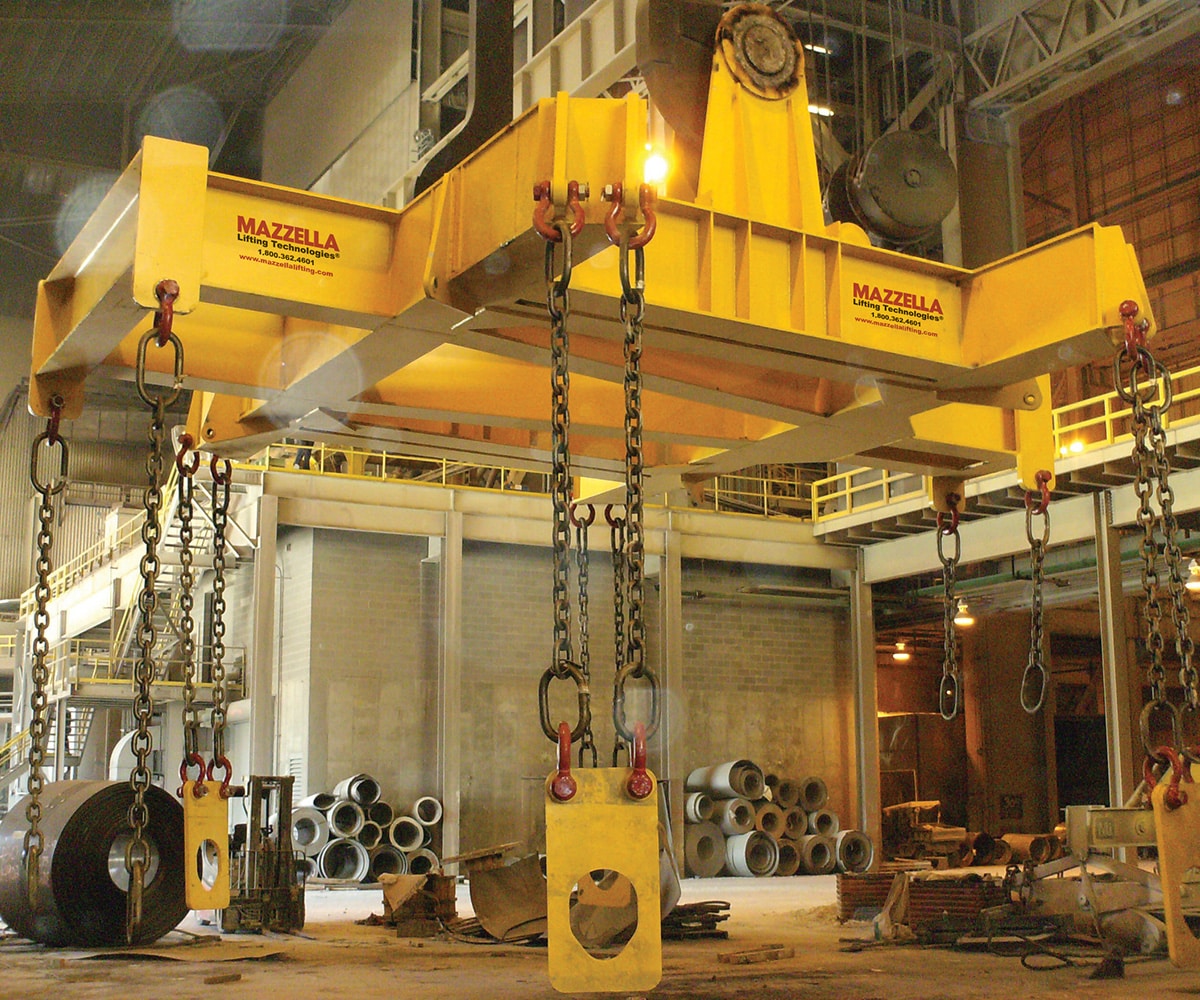
We have more than 65 years of experience in designing and developing custom engineered products, below-the-hook lifting devices, and lifting attachments for use with all types of cranes.
On-staff engineering and our commitment to ISO 9001: 2015 guides us to continued success in quality products and processes.
Copyright 2024. Mazzella Companies.