
A Complete Guide to Jib Cranes: Common Designs and Key Features
This article tells you everything you should know about jib cranes, including different types of systems and the benefits they offer for businesses.
Estimated reading time: 1 minute
Key Takeaways
- Jib cranes enhance production and safety by handling high-volume lifts and provide ergonomics for material movement.
- They vary in design, including freestanding, foundationless, mast type, portable, wall-mounted, and articulating jib cranes.
- Freestanding jib cranes are best for heavy-duty lifting while portable ones offer flexibility in changing layouts.
- Cost-effective options like mast type jib cranes require less installation overhead, while wall-mounted systems save floor space.
- Consider environmental factors like corrosion resistance for outdoor jib crane applications.
Workers are struggling to meet production quotas, and business owners are struggling to improve the production process. If this sounds like your business, you may want to consider a jib crane.
Installing a jib crane, or a series of jib cranes, can increase production and improve workplace safety at your facility, as they are perfectly designed to handle high-volume lifts and provide an ergonomic means of moving material.
Jib cranes, however, come in a variety of designs and components. So, which one is right for your business?
At Mazzella, we have installed hundreds of jib cranes at facilities across the country, and we’ve seen first-hand the benefits they bring to workers. By the end of this article, you will have a better understanding of jib cranes, the different types of systems available, which best fits your needs, and the benefits they can bring to your business.
How are Jib Cranes Different from Other Overhead Crane Models?
Compared to other common overhead crane models, jib systems differ in several ways.
Support Structure
The primary differentiator is the support structure. A standard overhead crane (like a bridge crane) travels along two parallel rails fixed to the building’s walls or a runway. A jib crane uses a horizontal “boom” or “arm” attached to a single fixed point. Depending on the type of jib crane, these booms or arms are either attached to a vertical pillar or attached to a wall.
Simpler, Flexible Design
Jib crane systems have a fairly simple, ergonomic design, which makes them appealing in smaller work cell areas for repetitive and unique lifting tasks. Meanwhile, overhead gantry cranes are better for facility-wide material handling.
They’re also simple to operate and require less maintenance because they have less parts that could potentially break down. Their smaller frame and simple design also make it easier to install them in existing facilities.
More Affordable
A simpler design, fewer components, and quicker installation times make jib cranes some of the most affordable cranes on the market. However, the price can vary based on customization options.
Jib Crane Design and Components
Below are some of the components and terms you’ll see mentioned throughout this article:
- Reach/Boom – the horizontal beam that the trolley travels back and forth on.
- Mast/Pillar – the vertical beam used to support the boom on freestanding and mast systems
- Movable Hoist – the hoist is used to lift, position, and lower a load.
- Trolley – the motion of the trolley can be manual, motorized, or pneumatic. The trolley carries the hoist, wire rope or chain, and the hook along the entire length of the boom.
- Rotation – on free standing and mast type jib cranes, you can achieve 360° of boom rotation. On wall and column-mounted jib cranes, you can achieve 180-200° of rotation.
- Electrification/Pneumatic Power – electric collector rings or pneumatic air lines can be added to the top or bottom of the mast to provide rotation assistance and allow for continuous 360° boom rotation.
- Controls – on motorized or air-powered jib systems, you can use a push button controller to control the rotation of the boom, as well as the motion of the trolley and the lifting and lowering motion of the hoist. Multi-speed or variable speed controls are available for the hoist and trolley.
- Hook Height – How high can you or do you want to go with your lifts? You’ll need to know the lowest overhead obstruction to know how tall your jib crane can be.
- Rotation Stop – if the crane is located close to a wall or other obstruction, a rotation stop will limit the crane’s motion before it collides with a nearby object.
What are the Different Types of Jib Crane Systems?
Jib crane systems have multiple design configurations. Which one you pick will depend on your current facility layout and application…
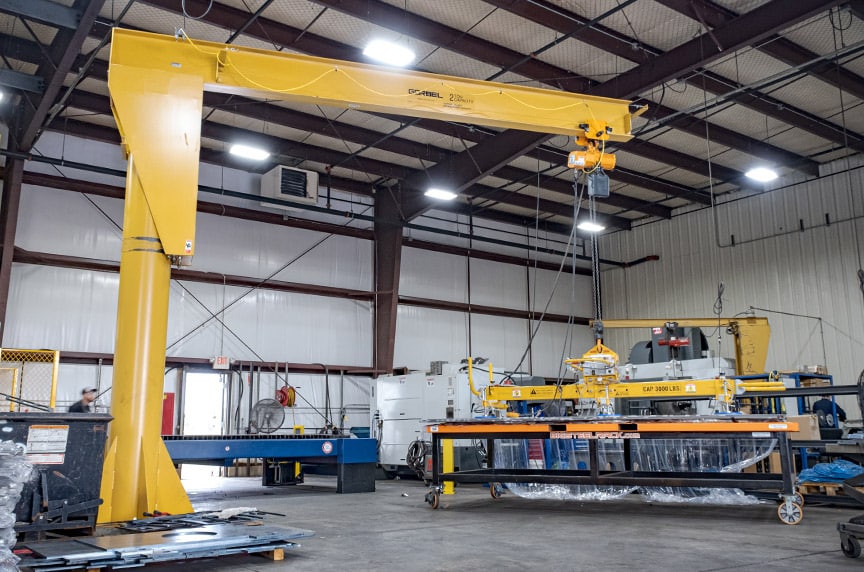
Freestanding Jib Cranes
Freestanding jib cranes are the most common type of jib system. This is mostly because they can be installed and used in virtually any work environment, including indoors and outdoors.
We’ve seen jib systems used:
- Underneath large bridge crane systems
- In open areas to support individual work cells
- Indoors for assembly and machining operations
Typically, freestanding jib crane systems can accommodate:
- Spans up to 50’
- Capacities up to 15 tons
- 360° of rotation
- Boom heights up to 40’
There are three main designs for freestanding jib cranes for how they can be mounted and installed:
Base-Plate Mounted: These are the easiest to install and the most popular design. The mast is secured by bolting a base plate onto a reinforced concrete foundation and then reinforcing the mast with gussets.
Foundation/Insert Mounted: These have a welded steel plate at the bottom of the mast which is anchored during the first-pour concrete footing. A second concrete pour supports the mast—eliminating the need for gussets.
Sleeve-Insert Mounted: A sleeve is welded to a steel plate, which is used to position the sleeve by anchoring it to a first-pour concrete footing. A second pour then supports the sleeve and the mast is inserted into the sleeve, leveled, and then welded in place. This design allows for relocation of the jib system, if necessary, without damaging the mast.
Freestanding systems offer the highest capacities, longest spans, and greatest amount of rotation. However, freestanding jib cranes are among the most expensive systems and the most permanent setup due to the special foundation that is required to anchor and secure the crane and support the load during a lift.
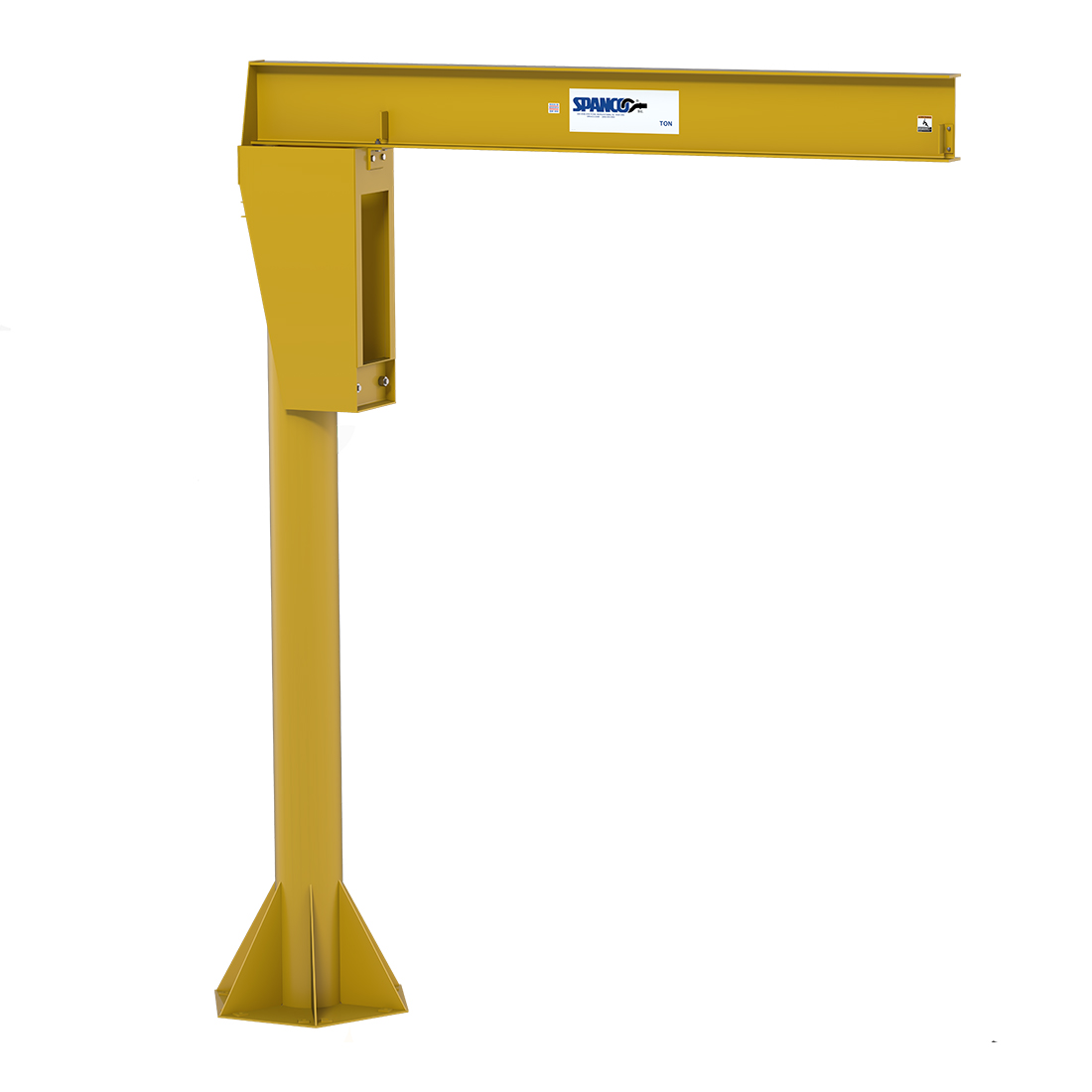
Foundationless Jib Cranes
Foundationless jib cranes are another type of freestanding system that is slab-mounted and bolted to 6″ reinforced concrete for indoor use.
These types of jib crane systems don’t require a special poured foundation and can be installed almost anywhere in a facility as long as the area meets the requirements of the manufacturer.
Because there’s no special foundation required, these jib cranes can be installed faster because you don’t have to wait for a poured concrete foundation to cure. They can also be easily relocated within a facility, if necessary.
Typically, foundationless jib cranes can accommodate:
- 9-16′ spans
- Capacities up to 1,000 lbs.
- 360° rotation
- Boom heights up to 20′
While their ease of installation, cost-effectiveness, and portability make freestanding jibs attractive for certain applications, they do have a much lower capacity than typical freestanding jib cranes with a poured foundation.
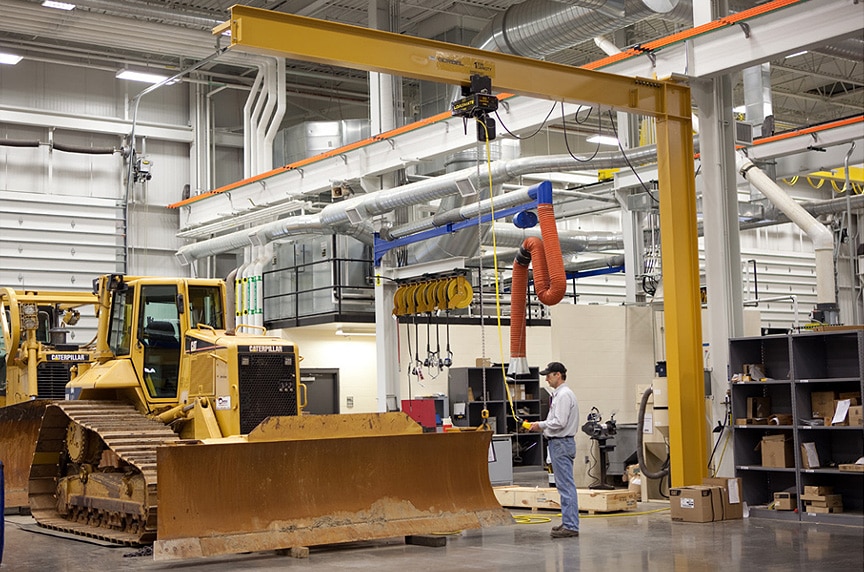
Mast Type Jib Cranes
Mast type jib cranes are a cost-effective alternative to freestanding systems because they don’t require a special foundation. Mast type jib cranes only need 6” of reinforced concrete to support the crane because they require additional support from an existing overhead support beam or structure.
Typically mast type jib cranes can accommodate:
- 10-40’ spans
- Capacities up to 10 tons
- 360° rotation
- Boom heights up to 40’ (distance from floor to overhead top support)
There are two types of cantilever design options depending on the types of overhead obstructions that may or may not be present:
- Full Cantilever: These can be used when there are no overhead obstructions. The boom is mounted to the top of the mast which provides maximum lifting capability and maximum clearance underneath.
- Drop Cantilever: Side-plate connections allow the boom to be “drop mounted” at a specific height to allow for clearance for overhead obstructions located below the top of the mast.
Mast type jib cranes are similar to freestanding systems and can be used for the same type of heavy-duty/high-productivity applications. However, they do require an overhead beam or support structure to provide support in addition to the foundation.
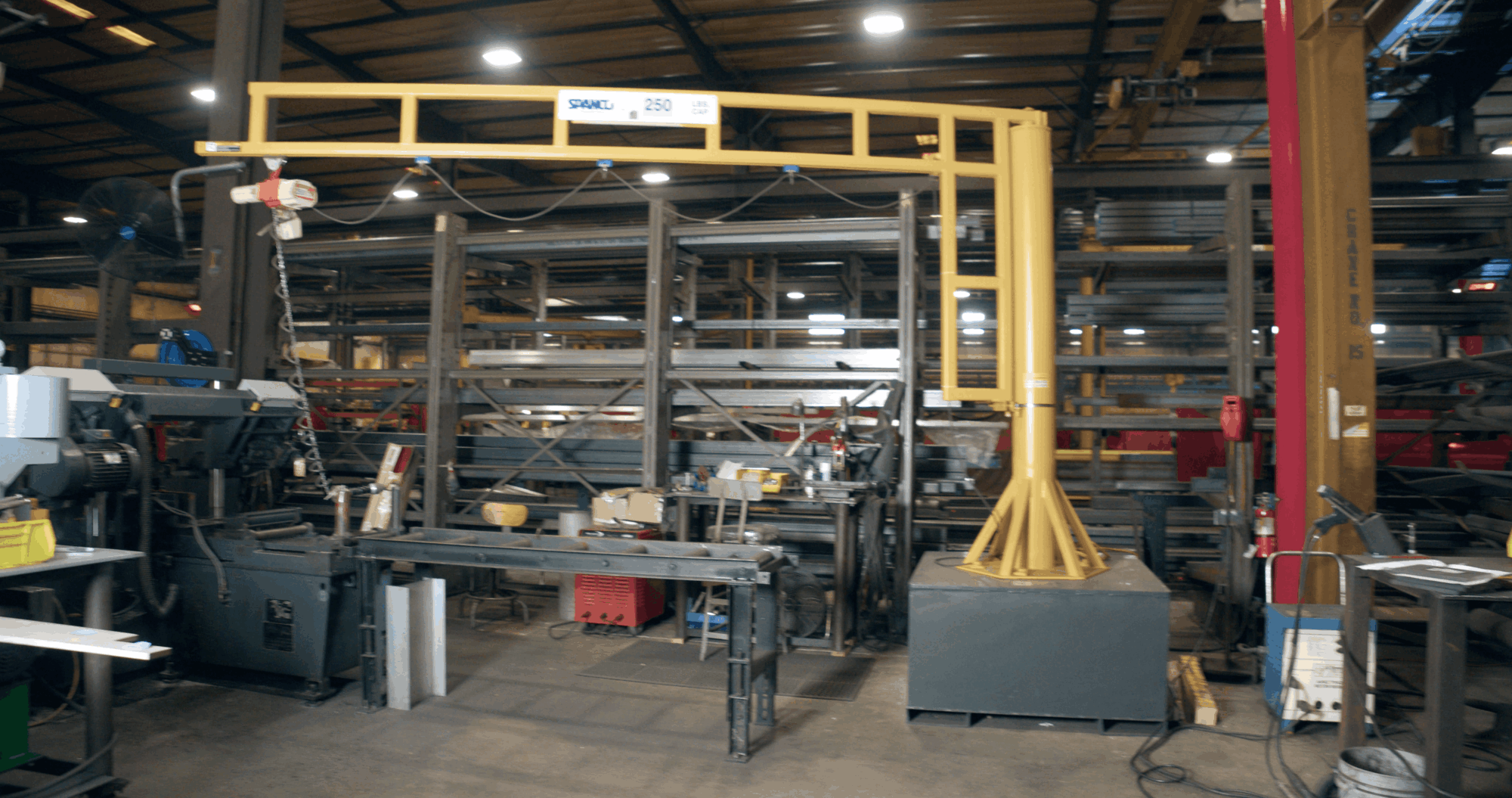
Portable Jib Cranes
Transcript
Intro: Reasons you may need a portable jib crane
— Are your forklifts constantly getting pulled away from production just to handle small routine lifts? Do you need a lifting solution, but your concrete slab won’t support a permanent crane? Or maybe layout changes often enough that bolting something to the floor just doesn’t make sense.
If any of that sounds familiar, there’s a solution many shops don’t realize is an option: the portable jib crane. In this video, we’ll break down what a portable jib crane is, when it makes sense, when it doesn’t, and the real-world advantages and limitations you should consider.
My name is Ben. This is “The Lifting and Rigging Channel”, and today we are at Spanco’s headquarters in Morgantown, PA. Tim Bambrick is joining us. Today we’re gonna be talking about some different Spanco crane systems. What we’re first talking about is a portable jib crane.
What is a portable jib crane?
So, Tim, what is a jib crane? And then, more specifically, what is a portable jib crane?
— So, you have your boom, which is above, and also your mast, which the boom attaches to. Very common in the industry. The jib crane is technically considered to be a very cost-effective solution for overhead material handling.
Well, in this case, we have a portable jib crane behind us, and what makes it portable is the fact that, since the counterweight is full of concrete, you can pick it up with a forklift and move it throughout your plant.
What problems does a portable jib crane solve?
— So, what problems is this solving, having a jib crane that’s portable?
— So, in factories where you don’t have the ability to attach to a wall or actually go into the ground. If I’m leasing a building, right, and I don’t wanna make a huge investment in that building where I gotta put a traditional dig-and-pour foundation, this type of product allows me to set it up and use it without doing any modifications to the building.
How does a portable jib crane stay stable and avoid tipping?
— So, a lot of people probably haven’t heard of a portable jib crane. What are some things that people misunderstand about this product?
— How is it attached? They think somehow this is attached to the ground because you’re not used to the fact that this thing can be moved.
— If I had just heard about this solution, I’d be afraid if I’m lifting something at the end here and it’s pretty heavy, like, it’s gonna tip over, right?
— Yeah, simple physics, if you’re picking something up, you need weight to hold it back down. So, that base is the counteracting force of that hoist picking up that piece of material.
What are the capacity, height, and span limits on Spanco Portable Jib Cranes?
— And then, what are the rated capacities? Like, how high can these go up to?
— Half-ton capacity. On these units we go up to a 12-foot height under the boom, which, again, is that part going across. And then a 16-foot span, which is the full reach.
What applications are best for a portable jib crane?
— What are some applications that would be a best fit for a portable jib crane?
— Number one, I would say a factory floor that’s always changing, a factory floor that has equipment that’s constantly moving through it.
If you have a, you know, a CNC there one day, then maybe a couple years later you have an end mill, you may have to move that crane to different locations to make it work. Where, if you have a traditional crane that has a foundation, you’re pretty much handcuffed to that spot.
So, this crane gives much more versatility for overhead material handling.
— And why would you consider a portable jib versus, like, a portable gantry or something like that?
— The floor space. With a gantry, you’ll have two legs on each side, which, if you have a forklift aisle or some other obstruction, this only has one spot where it’s rooted to.
Forklift requirements for moving a portable jib crane?
— What about considerations that you need for your forklift? Can any forklift pick this up, or do you need some specialized equipment to do that?
— Yes, great question. First of all, portable bases come in different sizes. Like we mentioned, we go up to a half-ton capacity, but we have some other ones, like, this one is 250 pounds.
So, the portable base size is different, meaning you need a different forklift. I would definitely make sure when you’re ordering one of these, you have a forklift on-site that can handle up to 8,000 pounds.
Cost comparison: portable vs wall-mounted and freestanding jib cranes
— So, from a cost standpoint, how does a portable solution compare to a freestanding solution or a wall-mounted solution?
— Wall mount, the product itself may be less expensive than portable. However, you’ll have to get your building verified by a professional engineer to make sure that crane can handle it. If it doesn’t, you may have to reinforce that building.
For a freestanding crane, you’ll have a foundation. We do offer ones that are foundationless; however, you’ll still have to make sure you get the right anchor bolts and things like that. But for a true freestanding one, you’re gonna have to have a dig-and-pour foundation, which can cost up to thousands of dollars.
Enclosed track vs articulating portable jib cranes
— So, you’ve got two different designs of jib cranes. Can you tell me about what’s different between the two and how do you know which one is right for your application?
— Right, Spanco has two different types. We have the enclosed track style, which you see in the background, and then we also have an articulating jib crane for a portable base option.
The difference is, one, deflection, and deflection means how much it’s gonna bounce, the articulating is a little bit stiffer. Another factor is this has a fixed boom, meaning that it does not bend, whereas the articulating, it’ll actually bend in the middle.
So, it gives you more articulation when you’re using it, which is very popular for a CNC loading area where you have to actually be very precise, you can’t have much bounce, and you’re loading, let’s say, a very expensive tool and die set. That’s where you would really see an articulating jib crane being used over, I would say, an enclosed track, fixed-boom style.
— So, real precise movements you’re gonna be using articulating. Let’s say, general lifting, this will work fine.
— Exactly.
— And how does the price compare between those two models?
— Your articulating is gonna be a premium over the enclosed track, fixed-boom style.
How does a portable jib crane improve productivity?
— So, how does a portable jib crane impact productivity? How does it improve a shop?
— Repetitive movement, where you’re constantly doing the same movement back and forth, back and forth. So, that’s where a jib crane is really gonna be ideal.
How Spanco uses portable jib cranes in real shop applications
— So, how exactly do you use these two cranes? So, you’ve got two portable jibs in your shop, they’re part of your production process. What do you use them for?
— So, the one across from us, actually, is a very important one to us because we actually load the CNC machine with it.
So, we’re picking up the same size tube, moving it over to the same amount of area, and putting it into the same machine over and over again. And it’s pretty heavy. So, that’s something that we have to, you know, consider our worker, make sure they don’t get strained throughout their workday.
— And how did you decide that the best solution for these two work cells was a portable solution?
— These two work cells are always changing. We may be doing CNC, or we may be doing some type of, like, very custom fabrication, and we may have different jigs coming in here, different types of tooling.
So, the fact that we can move that jib around the floor is very important to us. Same thing with the CNC machine. We’re always putting different pieces of equipment through the CNC machine; depending what that piece looks like, we may have to move that jib around accordingly.
What makes Spanco portable jib cranes different?
— So, if anyone hops online and they start shopping for portable jib cranes, you’re gonna see a ton of different options. What makes Spanco different than some of the other options on the market?
— Made in USA. Also, our portable bases are actually filled with concrete. They already come that way. Some others, you have to fill the concrete on-site.
So, again, you may pay a little bit more for the freight, but again, you’re not messing with it as the product gets there.
— That’s one big takeaway. You have to assume if you’re pouring the concrete, you’re doing it correctly. What about customization options?
What customization options are available for portable jib cranes?
Are there any customization options that you can give?
— A very common one is custom paint. People will send us an RAL number, and we’ll paint it whatever color you want. Different types of heights; obviously, if they want a special height, we’ll do that.
Different festooning options, if they want air versus, you know, electric, things like that. But very simple product. The unique thing about our portable jib crane is that it’s a plug and play. You can pop it wherever you want on your shop floor. Very easy.
— Boom, you got a jib crane.
— Boom, instant.
— So how do you to get one?
— We work through a whole dealer network, and Mazzella is one of ’em. So, you can contact Mazzella; they’ll be happy to quote you a Spanco portable jib crane.
— Thanks, Tim.
— Yeah, thank you.
Is a portable jib crane the right solution for your facility?
— Hopefully, this video gave you the information you need to decide if a portable jib crane is the right solution for you.
If you need help determining what the best lifting solution is for your facility, reach out to Mazzella. Our crane specialists can walk you through all of your options and help you make that decision. Contact us today, link below.
If you found this video useful, informative, entertaining, or you just feel like being friendly, hit that like button so we can get this information out to everyone who needs it. Remember, safe rigging is smart rigging. My name is Ben. Stay safe out there.
Portable jib cranes are unique from other jib models for their portable base. The base is filled with concrete, and its counterweight base keeps it steady, all while allowing users to pick it up and move it around a facility.
Portable jib cranes can be moved with forklifts, making them ideal where you can’t attach a system to a wall or permanent foundation. This feature is especially useful for companies leasing a building and don’t want to commit or invest in permanent modifications.
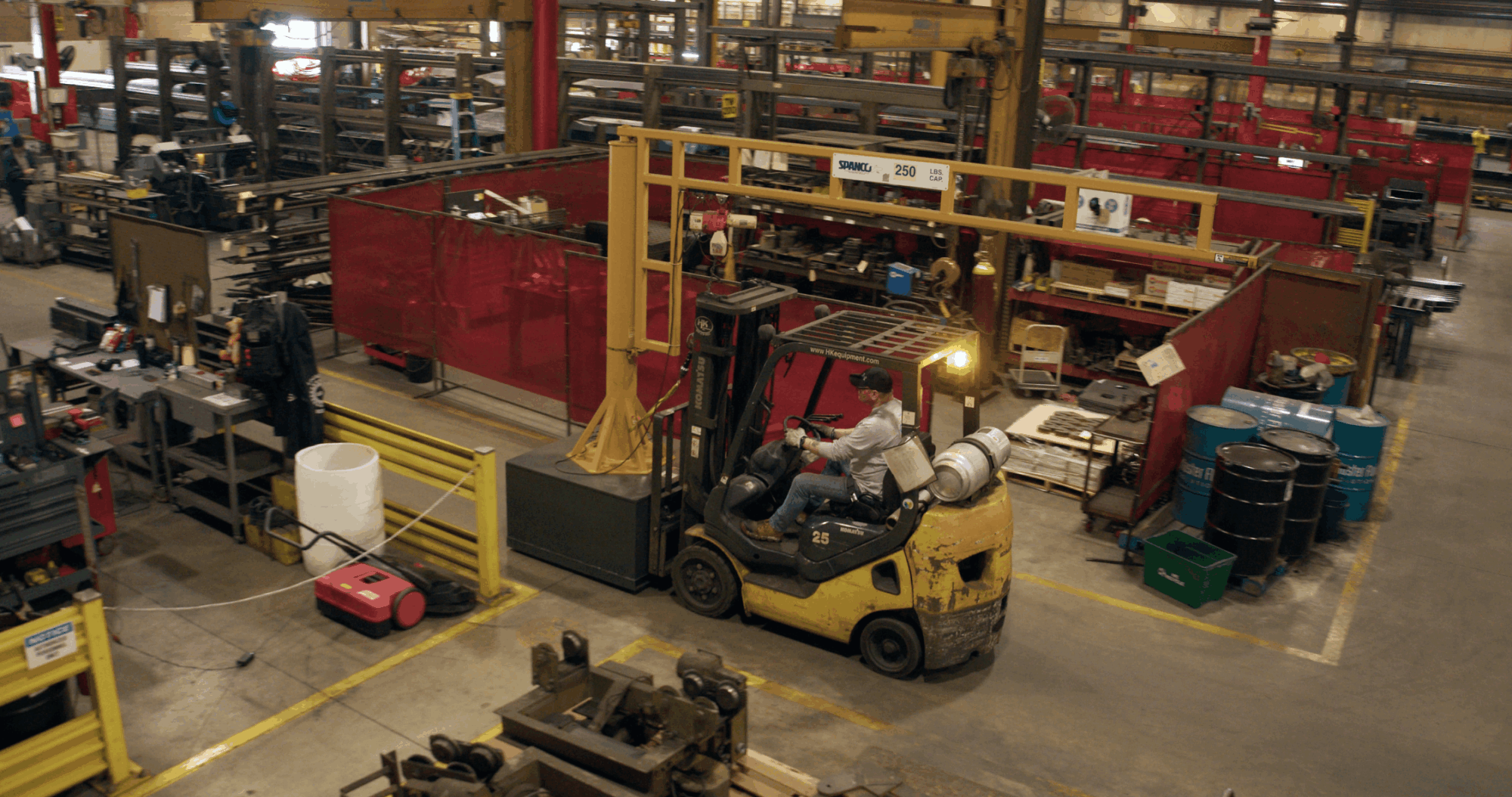
Most people assume the crane is anchored, but that stability comes from the base. Jib cranes generate significant force, especially when lifting loads at the end of the boom, so the base acts as a counterweight to prevent tipping.
One of the biggest benefits of a portable jib crane is they are essentially a “plug-and-play” system; you can position it almost anywhere and start using it immediately.
The flexibility a portable jib crane offers makes them an ideal choice in factories and assembly plants, where layouts, work cells, workflows constantly change; whereas traditional crane models lock you into one location.
While portable jib cranes tend to be more expensive upfront than wall-mounted options, you’re avoiding spending thousands of dollars on a concrete foundation, which saves you money in the long run. You also avoid the extra engineering cost that comes with more complex crane models.
Wall-Mounted Jib Cranes
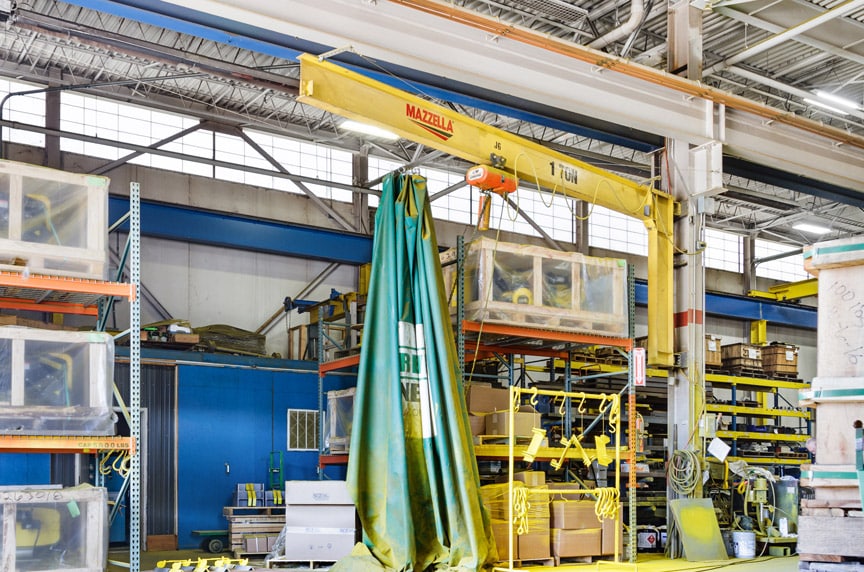
Wall-mounted jib crane systems can be used in individual bays, along structurally adequate walls or building support columns, or as a supplement to an existing monorail or overhead bridge crane.
The main advantage of using a wall-mounted system is the space-savings that it offers. They don’t require any type of floor or foundation support, and they can also be installed very close to the underside of the lowest ceiling obstruction, providing maximum clearance both under and above the boom.
Wall-mounted jib cranes can be designed to mount to a wall or building support column in two ways:
- Cantilever: Wall-mounted cantilever jib cranes offer the greatest amount of clearance, above and below the boom, and have a full-cantilever design
- Tie-Rod Supported: This is the most economical means of providing hoist coverage along walls or building columns. A wall bracket and single tie-rod supports the boom to allow the hoist full travel along the length of the beam.
While these types of jib systems are among the most economical in price and design, the major disadvantage of using a wall-mounted or column-mounted jib crane is that the design does not allow for full 360° of rotation.
They also require a column or support capable of withstanding the loads, which typically requires a structural engineering survey and approval prior to installation.
Articulating Jib Cranes
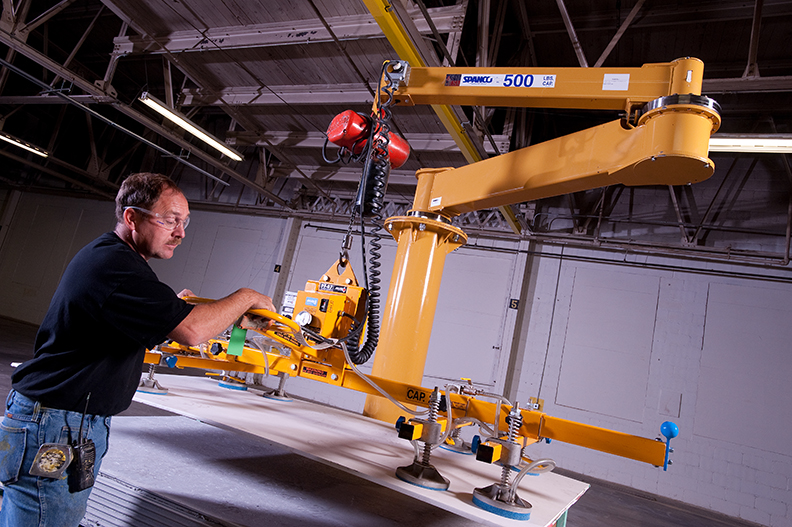
Compared to traditional jib cranes with one boom, articulating jib cranes have two swivel arms that can lift loads around corners and columns and reach into or under machinery and containers.
The primary boom arm allows for 200° swivel and the outer arm allows for up to 360° of rotation—providing a greater coverage area and more flexibility closer to the mast or column.
Articulating jib systems can be floor-mounted, wall-mounted, ceiling-mounted, or mounted on a bridge or track system. The variety of configurations allows for precise load positioning and spotting loads around obstructions, through open doors, or rotating in close to the mast or building column where it can be more difficult to maneuver traditional jibs.
Articulating jib cranes can accommodate:
- Spans up to 16’
- Capacities up to 1 ton
- 360° rotation for freestanding and ceiling-mounted systems
- 180° inner arm/360° outer arm for wall-mounted systems
For heavier duty and more frequent lifts, an articulating jib crane might not be the best choice. Their design won’t allow for higher capacity lifts and their span is somewhat limited.

Jib Crane Types Comparison Table
When comparing jib crane types, the best option depends on your facility layout, required lifting capacity, span, rotation, and whether you need a permanent or portable solution.
| Jib Crane Type | How It Is Supported | Typical Capacity | Typical Span | Rotation | Best For | Key Benefits | Main Limitations |
| Freestanding Jib Crane | Mounted to its own dedicated foundation or base plate | Up to 15 tons | Up to 50 ft. | 360° | Heavy-duty lifting, open work cells, indoor and outdoor use | Highest capacities, longest spans, full rotation, works in many environments | Higher cost and requires a special foundation, making it a more permanent installation |
| Foundationless Jib Crane | Slab-mounted and bolted to 6 in. reinforced concrete | Up to 1,000 lbs. | 9–16 ft. | 360° | Light-duty indoor lifting where fast installation matters | No special foundation required, faster install, easier to relocate, cost-effective | Lower capacity and shorter span than standard freestanding jib cranes |
| Mast Type Jib Crane | Supported by both the floor and an existing overhead beam or structure | Up to 10 tons | 10–40 ft. | 360° | Facilities that want high capacity without pouring a special foundation | Cost-effective alternative to freestanding systems, high capacity, good for heavy-duty applications | Requires adequate overhead structural support |
| Portable Jib Crane | Stabilized by a portable counterweight base filled with concrete | Up to 1 ton | Up to 16 ft. | 360° | Facilities with changing layouts, leased buildings, temporary work areas | Portable, plug-and-play, no wall or permanent foundation required, easy to reposition with a forklift | Can cost more upfront than wall-mounted options and stability depends on the counterweight base |
| Wall-Mounted Jib Crane | Mounted to a structurally adequate wall or building column | Typically 1-2 tons | Up to 40 ft. | 180°–200° | Areas where floor space must be kept clear | Saves floor space, economical, can be installed close to overhead obstructions for maximum clearance | Cannot provide full 360° rotation and requires structural review of the wall or column |
| Articulating Jib Crane | Can be floor-, wall-, ceiling-, bridge-, or track-mounted | Up to 1 ton | Up to 16 ft. | Up to 360° depending on mounting style | Reaching around corners, columns, machinery, containers, and other obstructions | Excellent flexibility, precise load positioning, reaches into tight spaces traditional jibs cannot | Lower capacity and shorter span, not ideal for heavier-duty frequent lifts |
- Best for heavy-duty lifting: Freestanding jib cranes
- Best for fast indoor installation: Foundationless jib cranes
- Best alternative to freestanding systems: Mast type jib cranes
- Best for flexible layouts: Portable jib cranes
- Best for saving floor space: Wall-mounted jib cranes
- Best for reaching around obstructions: Articulating jib cranes
Environmental Considerations for Jib Cranes
If you plan to use a jib crane in outdoor applications, you should consider galvanizing components of the system to resist corrosion. Also, special control enclosures can be designed for explosion proof applications, and other environments where heat, dust and dirt, or moisture may be a factor.
Final Thoughts on Jib Cranes
Jib cranes are perfectly designed to handle high-volume lifts and provide an ergonomic means of moving material within a work cell or in conjunction with an existing overhead crane system. We hope this article gave you the information you need to decide if jib cranes are right for your organization.
If you still have questions about which type of jib crane is right for you, we’re here to help. Mazzella’s in-house team of engineers can help you design and specify a cost-effective gantry jib crane system for your facility, production, or budgetary needs. We also partner with some of the top jib crane manufacturers in the country. Contact us today!
FAQs About Jib Cranes
Copyright 2026. Mazzella.