
How Rigging Gear Supported a U.S. Navy Recovery Project
Selecting the right rigging gear is critical when an organization must perform unfamiliar lifts under tight time constraints. Following an incident in the North Atlantic, three U.S. Navy commands needed a way to offload equipment from a ship and send affected craft for maintenance.
In this video, U.S. Navy personnel explain how J. Henry Holland, a Mazzella company, helped evaluate the lifting challenge. The team needed appropriate rigging configurations and equipment for lifts they had not previously performed, but manufacturing an entirely new system within the available timeframe would have been difficult.
J. Henry Holland worked with the Navy’s port engineer to review the lifting capabilities, materials, and equipment already available across the three commands. This collaborative approach helped the team develop a viable solution without procuring an extensive list of new items.
The video also demonstrates the value of maintaining a relationship with an experienced rigging provider. In addition to supplying shackles, slings, and other rigging gear, J. Henry Holland provided on-site guidance, equipment inspections, and support during the lifts.
What You’ll Learn:
- What created the Navy’s time-sensitive lifting challenge
- Why the commands needed assistance with unfamiliar rigging configurations
- How available lifting equipment was evaluated across three commands
- Why time affected the team’s ability to manufacture a new system
- How on-site guidance supported the equipment offloading process
- Why rigging inspections, repairs, and supplier relationships matter
Who This Is For:
- Military and government operations personnel
- Port engineers and maintenance leaders
- Crane operators and rigging professionals
- Teams responsible for material-handling equipment
- Organizations planning unusual or time-sensitive lifts
- Procurement professionals sourcing rigging gear and lifting equipment
Need Help Selecting Rigging Gear?
Contact Mazzella’s Rigging Division for help evaluating your lift, selecting rigging gear, inspecting equipment, and developing a solution for your application.
Transcript
Intro
No spoken dialogue.
The Obstacle in Front of the United States Navy
Well, the Navy called us the next morning after the incident happened in the North Atlantic to let us know that one of their ships had hit some inclement weather.
So, I got a phone call from three different naval commands before my coffee was done the next morning. And they just wanted to give us a heads-up.
They didn’t know what damage had happened or how much damage had happened, but they knew that they were going to need some help.
It was kind of a team effort between J. Henry Holland and ACB2, and then also through Naval Beach Group and ACU2.
We were offloading equipment we’d never actually offloaded before, so we needed help figuring out rigging configurations and what kind of rigging gear we would need to make those lifts off those crafts to send those crafts off to maintenance so they can get back into service.
And without J. Henry Holland coming out here to help us out with different sling configurations, I mean, a lot of us are pretty new to cranes. You know, we get switched around a lot.
So, you know, having someone that’s been part of cranes for a very long time and knows these different lifts and everything is extremely helpful to get back up to mission capable.
She kind of gave us guidance, and she was out there watching the lifts, which is really cool.
Yeah, she got to see her ideas get put to work.
Mazzella’s Solution
First, I started with their port engineer, who is in charge of making sure of all the repairs for all three commands.
We looked at what they were going to be up against and were trying to figure out what kind of system they would need and how quickly it could be made.
Time was a big factor. It’s very hard to manufacture what would do the job in time.
So, going against that type of problem, we decided to look at what we already had in lifting capabilities within the different commands.
Their port engineer and I got together, and we took a ride around all three commands. I showed him some of the material and equipment that we already had within the commands and told him that maybe we could come up with something to work without having to go out and procure a bunch of items.
Right off the bat, they wanted some ideas on what the best route to get the material off their ships were.
I work really closely with all three commands that had equipment on board this particular ship. And through the years, we’ve developed a lot of their material-handling equipment.
So, we’ve worked as a team with them for many, many years. So, before they left, they called and said, “I’m bringing back pictures. We’re going to need some help.”
Well, we do multiple different styles of lifts, so we have certain rigging gear setups for certain things. And we do inspections on our rigging gear.
It’s a phone call any five days a week; 10 minutes later, she’s here, feet on the ground just like we are, trying to figure out what we need to help us make our job easier.
She knows the stuff almost better than we do anyhow. She’s been here way longer than all of us have together.
You can order shackles and slings all day on the internet through any kind of website. But to actually get to go and see it, see where it’s made, where it’s coming from, and know that if you need repairs and everything—it’s unbeatable.
This is who you need to contact right now. Make a friendship, establish that relationship, and stay in touch. She’s your greatest asset.
Appreciate everything that J. Henry Holland has done for the Navy and for ACU2. We look forward to keep on working with J. Henry Holland.
FREE Downloads!
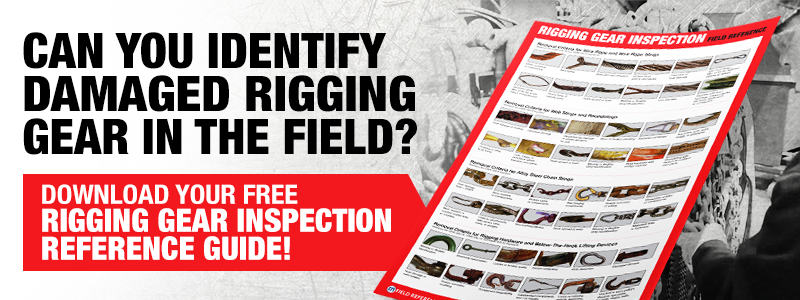
- Rigging Gear Inspection Field Reference [Guide]
- Shackles Types & Terms [Guide]
- Lifting Slings Types & Terms [e-book]
- Lifting and Sling Hook Selection [Guide]
- How to Dispose of Damaged Rigging Gear [Guide]
- Lifting and Rigging Best Practices [Infographic]
<!–[if lte IE 8]><![endif]–>
 hbspt.cta.load(3336966, ’72b9168f-0e22-4ba5-8342-b180f9e3d7fc’, {“useNewLoader”:”true”,”region”:”na1″});
Learn More! Articles, Videos, and Podcasts
- How to Choose the Right Crane Block for Your Lift
- Synthetic Web Sling Damage: Break Tests on Heat, UV, Cuts, Knots, and Weld Splatter
- Rigging Slang Terms: Common Names for Lifting Equipment
- What’s a Tagline, and How Can It Help With Load Control?
- What Are Wire Rope Slings? Terms, Components, & Configurations
- Wire Rope End Terminations: Sockets, Wire Rope Clips, and Splices
Contact Mazzella
- Schedule Remote or In-Person Rigging Training
- Contact Mazzella’s Rigging Division
In this video
0:00 – Intro
0:10 – The obstacle in front of the United States Navy
1:16 – Mazzella’s Solution
Disclaimer:
Any advice, graphics, images, and/or information contained herein are presented for general educational and information purposes and to increase overall safety awareness. It is not intended to be legal, medical, or other expert advice or services, and should not be used in place of consultation with appropriate industry professionals. The information herein should not be considered exhaustive and the user should seek the advice of appropriate professionals.