
Class 1 vs Class 2 SRL: What is the Difference and Which Do You Need?
If you are working at height, understanding the difference between a Class 1 vs Class 2 SRL (self-retracting lifeline) is critical for both safety and compliance. While both devices are designed to arrest a fall, they are tested and rated for very different applications. Using the wrong class of equipment can lead to catastrophic failure, especially in leading edge environments.
In this video, Hillari Frost, Fall Protection Division Manager at Mazzella, breaks down the technical and practical differences between these two classes. You will learn how anchorage location dictates which equipment you must use, how fall clearance requirements change based on your tie-off point, and how to identify the correct markings on your device.
By understanding the specific requirements of a Class 1 vs Class 2 SRL, you can ensure your team is protected while working at height and that your fall protection plan meets current OSHA and ANSI standards.
What You’ll Learn in This Video:
- The primary differences in anchorage requirements for Class 1 and Class 2 devices
- How to identify a Class 1 vs Class 2 SRL by looking at the manufacturer’s label
- Why Class 2 SRLs are required for dorsal level, foot-level tie-offs, and leading edge applications
- How fall clearance requirements increase when moving from an overhead to a foot-level anchorage
- The design differences of Class 1 vs Class 2 SRLs
- How to choose the right self-retracting lifeline to stay compliant and keep your workers safe
Who This Video Is For:
- Safety Directors and EHS Managers developing fall protection work plans
- Construction crews performing work at height
- Facility Managers overseeing maintenance at height in industrial environments
- Competent Persons responsible for inspecting and specifying fall protection equipment
- Procurement specialists looking to understand the cost and application differences of SRLs
Need Help Choosing the Right Self-Retracting Lifeline?
Selecting the correct SRL is a decision that directly impacts the safety of your crew. If you are unsure which class your application requires, or if you need a professional evaluation of your fall clearance and anchorage points, Mazzella is here to help.
Our Fall Protection specialists can provide site-specific risk assessments, equipment recommendations, and OSHA-compliant inspections. We work with you to ensure your fall protection system is engineered for the specific hazards of your job site. Contact a Mazzella Fall Protection Specialist today!
Transcript
Introduction to Class 1 and Class 2 Self-Retracting Lifelines
– What’s the difference between a Class 1
and a Class 2 SRL. How do you know what you should use? By the end of this video, you’ll understand what the difference is, and when and why you should choose one over the other.
My name is Ben and this is The Lifting & Rigging Channel. Today I’m joined by Mazzella Fall Protection Division Manager, Hillari Frost, to help us understand which type of SRL we need. Should we buy a class one or a class two?
What is a Self-Retracting Lifeline (SRL)?
First off, Hillari, what is an SRL?
– An SRL is a self-retracting lifeline. So it’s utilized to connect a worker to a system.
When Should You Use a Class 1 vs. Class 2 SRLs?
– What is the difference between a Class 1 and a Class 2 SRL?
– The most simple explanation of that is a Class 1, it can only be used in overhead anchorage, whereas a Class 2 can be used overhead, at dorsal D-ring, or foot level tie off.
What is a Dorsal D-Ring?
– So what does that mean? So you’ve got overhead anchorage, at dorsal D-ring, at and below that. Like what is a dorsal D-ring?
– Dorsal like a dolphin. Dorsal fin on your back.
All D-rings should be placed, if your harness is fitting properly, you can put your hand straight back and you can grab that D-ring.
– So Class 2 can be at like shoulder height, or it can be even on the ground.
– Correct. Anywhere in that range or above. So anywhere from the top all the way down to the bottom.
How Does Fall Clearance Affect Your SRL Choice?
– Why does it matter if you are connecting overhead, or at dorsal D-ring, or below it?
– You do not necessarily need as great of a fall clearance. Whereas when you are connected anywhere all the way down to your foot level, your fall clearance is almost 40 to 50% more than what it would be if you were tied off overhead.
You have a vertical fall, versus going over a side, going over an edge, and an additional fall after that.
– Why not just always hook up above your head?
– Well, it’s not always possible, right? So you’re on construction sites where there is nothing above your head. Everything is being built from the ground up, so you have to be tied off from a foot level and above.
What Makes a Class 2 SRL Safe for Leading Edges?
– And then what gives a Class 2 the ability to be hooked below, along a leading edge, compared to a Class 1?
– Class 2’s go through additional testing and their wire rope is typically thicker or has been tested on abrasive edges and sharp edges to ensure that it doesn’t snap, bird cage, where you have kinks in the line. They also have additional internal braking systems and typically an external energy pack on them to absorb some of that fall.
Are Class 2 SRLs Available in Cable or Synthetic?
– So both of these are cable SRLs. Is that the only option that’s available for a Class 2 SRL?
– Class 2 and a Class 1 SRL come both in cable and synthetic.
So they use a different synthetic fiber that’s reinforced to be able to handle sharp edges.
How Do You Choose the Right SRL for Your Site?
If you’re shopping for an SRL, how do you know if you need a Class
1 or Class 2?
– So if you know that you’re going to be connecting overhead and only overhead, then you’re fine with a Class 1.
If you’re going to be at your D-ring or below your feet, or you’re unsure of where your actual connection is going to be, Class 2 is the way to go.
If you’re in the construction industry then a Class 2 is always where you want to lean towards, and that’s because your conditions change as you continue to build on that structure. Where it may have had an overhead tie off originally, you may have to go foot level when you go to the next level or the next level. So it’s better to just keep yourself completely covered with the Class 2 versus having to have a Class 1, and then realizing that you need a Class 2.
How Can You Tell if an SRL is Class 1 or Class 2?
– How do you know if you already have an SRL, if it’s Class 1 or Class 2? How can you tell the difference?
– Every SRL is marked on the back with its class. So in this case you’re going to see that it says Class 2, and in the same spot you’re going to see that it’s a Class 1.
So there always has to be a clear indication of class, that’s stamped onto the SRL.
– And if you’re inspecting your SRL before use you should be checking your label and everything should be legible.
– Exactly.
– If it’s not, you need to pull it out from service. Right?
– Absolutely.
– Are there any common misconceptions that people make when they’re shopping for SRLs?
– The most common misconception is not having the knowledge to know that there’s two different classes, and not knowing what those two different classes are used for.
How Do Class 1 and Class 2 SRL Costs Compare?
– Based on what you said, I’m going to take a guess and say a Class 2 is more expensive than a Class 1.
– Your Class 2 is probably between 30 and 50% more.
I think that when you’re starting to look into costs like that, that you also need to take in the factors that if you were to just purchase Class 2, you could utilize it in almost any situation. Whereas if you were to purchase a Class 1 and then later find out, you need to get a Class 2, you’ve now spent far more than you could have if you just got a Class 2.
Are SRL Inspection Requirements Different for Class 1 or 2?
– Do the inspection requirements change based on Class 1 or Class 2?
– There’s no real difference in your inspection. It’s just there’s additional components.
What Are the Dangers of Using the Wrong SRL Class?
– What can happen if you’re using a Class 1, when you should be using a Class 2?
– One of the biggest things that, you know, we talk about when we start talking about Class 1 versus Class 2, is the fall clearance.
On a Class 1, typically you need about seven feet of fall clearance.
On a Class 2, you need about 40% more than that. So you’re talking almost 18 feet.
– So these are just two examples of SRLs. If you’re out shopping for SRLs, whether it’s Class 1 or Class 2,what advice would you give them when they’re shopping for an appropriate SRL?
– If they’re walking into a safety shop, they should talk to an expert within that safety shop.
Let them know the hazards that they are up against. Let them know their distance from where they’re going to be tied off to the ground, so that they can ensure that not only do they get them the right length, but that they also get them the correct class that they need.
How Can You Get Expert Fall Protection Help?
– By now you should understand the difference between these two SRL types, and hopefully you have a good idea
of which is best for you.
If you still need help, contact Mazzella. Links below.
Mazzella’s here to help with all your fall protection needs. Whether you need a custom engineered lifeline system, personal fall protection equipment, a risk evaluation, or a lifeline inspection, we’re here to help and keep you safe.
If you found this video useful, informative, entertaining, or you just feel like being friendly, then hit that like button so we can get this information out to everyone who needs it. If you have a question, drop it in the comments so we can get you an answer. Remember, safe rigging is smart rigging. My name is Ben, stay safe out there.
FREE Downloads!
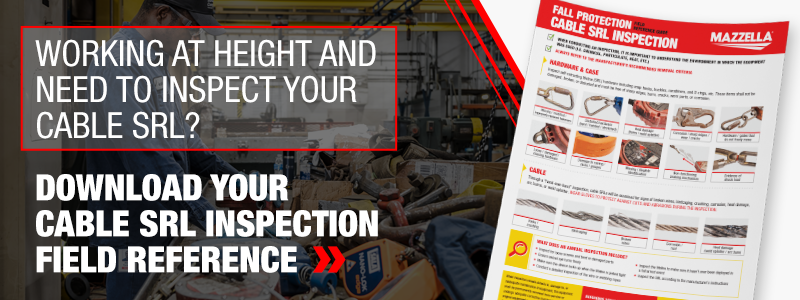
- Mazzella Cable SRL Field Inspection Reference Guide
- Synthetic SRL / Lanyard Inspection Checklist
- Harness Inspection Checklist
- Fall Safety 101 Infographic Poster
- Job Safety Analysis & Working at Height Risk Assessment [Bundle]
- Top 10 Safety Tips for Working at Height Infographic
- Top 5 Fall Protection Hazards On the Jobsite Infographic
Learn More! Articles & Videos
- Class 1 vs. Class 2 Self-Retracting Lifelines (SRLs): What’s the Difference, and Which One Do You Need?
- Web Retractable vs. Cable Retractable Fall Protection: Which Is Best?
- The Basics of Fall Protection in 6 Minutes
- What Is the Inspection Criteria for Fall Protection Wire Rope SRLs?
- What Is the Inspection Criteria for Synthetic Fall Protection Lanyards, SRLs?
- How to Perform a Fall Protection Harness Inspection
- A Dictionary of Fall Protection Terms
- How to Develop a Working at Height Rescue Plan
- Suspension Trauma in Fall Protection: What Safety Managers Must Know
- What Can You Expect From a Working at Height Risk Assessment?
- P.E. vs Standard Lifeline Inspection: What’s the Difference?
- Safety Factor: How To Avoid OSHA Fines While Working at Height
- What Is The XSERIES Mobile Grabber® Mobile Fall Protection Unit?
Contact Mazzella
- Schedule Remote or In-Person Fall Protection Training
- Contact Mazzella’s Fall Protection Division
In this video
0:00 – Introduction to Class 1 and Class 2 Self-Retracting Lifelines
0:29 – What is a Self-Retracting Lifeline (SRL)?
0:39 – When Should You Use a Class 1 vs. Class 2 SRLs?
0:53 – What is a Dorsal D-Ring?
1:19 – How Does Fall Clearance Affect Your SRL Choice?
1:55 – What Makes a Class 2 SRL Safe for Leading Edges?
2:20 – Are Class 2 SRLs Available in Cable or Synthetic?
2:36 – How Do You Choose the Right SRL for Your Site?
3:17 – How Can You Tell if an SRL is Class 1 or Class 2?
4:01 – How Do Class 1 and Class 2 SRL Costs Compare?
4:28 – Are SRL Inspection Requirements Different for Class 1 or 2?
4:38 – What Are the Dangers of Using the Wrong SRL Class?
5:25 – How Can You Get Expert Fall Protection Help?
Disclaimer:
Any advice, graphics, images, and/or information contained herein are presented for general educational and information purposes and to increase overall safety awareness. It is not intended to be legal, medical, or other expert advice or services, and should not be used in place of consultation with appropriate industry professionals. The information herein should not be considered exhaustive and the user should seek the advice of appropriate professionals.