
Web Retractables vs Cable Retractables: Choosing Fall Protection for Your Application
Choosing between web retractables and cable retractables starts with your work environment, not just the lifeline material. Leading-edge exposure, heat, and the distance you need to travel all affect equipment selection. For leading-edge work, check the specific retractable’s manufacturer instructions rather than assuming either webbing or steel cable is suitable.
In this video, we explain how web and cable retractables differ, why cable may be selected for hot work or longer working distances, and why certain retractables should not be used in leading-edge applications. We also discuss IKAR retractables and the speaker’s explanation of how their internal brake mechanisms help manage forces during a fall.
You’ll learn why steel cable isn’t automatically the better choice for every application and why material strength alone doesn’t determine suitability. Whether you’re selecting equipment, purchasing it for a crew, or overseeing jobsite safety, understanding these differences can help you ask the right questions before choosing a retractable.
What You’ll Learn:
- How leading-edge hazards affect the selection of web and cable retractables
- Why cable retractables may be selected for hot work and longer working distances
- Where to check whether a retractable is approved for leading-edge use
- How the internal brake mechanism described in the video helps manage fall-arrest forces
- Why webbing and steel cable should not be compared on material strength alone
Who This Video Is For:
- Construction workers and supervisors using retractable fall protection
- Safety managers and EHS professionals evaluating fall hazards
- Purchasing teams comparing web and cable retractables
- Employers selecting fall protection equipment for their crews
- Anyone reviewing whether their current retractables are suitable for the work being performed
Need Help Choosing Fall Protection?
Not sure whether web retractables or cable retractables are appropriate for your application? Contact Mazzella’s Fall Protection Division to discuss your work environment, leading-edge exposure, and equipment selection needs.
Transcript
Intro
You know, to me, it doesn’t matter whether it’s 40 or 60, you’re going to have a failure. And when you have a failure in this type of a scenario, many times it’s a death.
Web Retractables vs Cable Retractable
So when we’re talking about construction, new construction, in my opinion and in our opinion, most of the hazards, or fall hazards, are exposed to an edge. You’re falling over an edge. You’re falling over the edge of a building or a beam or whatnot. And that’s when you’re subjecting your fall protection equipment to what we refer to as a leading edge. And that can be over a building’s edge, something to a deck like that. And this is an area that specific requirements are needed and tested when it comes to ANSI, and whether the retractables themselves are designed or capable of handling that. We utilize a retractable that’s manufactured in Germany by a company called IKAR. Their retractables have always met the European norm standards, which are very strict and stringent. And in this case, their retractables, whether it’s web or cable, are both approved for leading-edge, sharp-edge applications.
Why Pick a Cable Retractable?
The reason for a cable retractable, we have two specific potential reasons for that. One, someone doing what we refer to as hot work, someone working with a torch. Nylon has a tendency to melt and be damaged very quickly when it comes to heat. In that type of a scenario, a cable retractable would hold up much better. We also get into situations where we have very long spans. We’ve got retractables that run up to 210 feet. In a cable version, you have a tendency to operate reeling and unreeling much better than they do in a web version. That’s the other, that’s why you’ll see, if you’re looking at a retractable that’s, you know, 40, 50, 60 feet long, it’s only going to be available in the cable version.
How Often Are the Wrong Retractables Used?
It’s more along the lines of the operation of the retractables being allowed to be used in the applications that we’re talking about, specifically leading edge. A lot of manufacturers have retractables on the market that will state in their instructions, “Do not use that or expose it to a leading edge.” And that’s where we feel that it’s very important for users to take a look at their instruction manuals. That’s where it’ll state it.
Doesn’t a Web Retractable Add Risk to a Leading Edge Fall?
What a retractable is, is basically a seatbelt mechanism. It’s designed to be able to extend and retract as you’re working. When you fall, it engages. There’s a set of pawls or claws inside there, and they grab the inside of the housing exactly the same way that a seatbelt mechanism works on a car. What makes it different from the seatbelt mechanism in the car is that it also has what we refer to as an internal brake mechanism. So when I engage this retractable, I’m engaging a brake mechanism. I can’t do it right now because it’s going to take about 300 or 400 pounds of force, but this will then additionally deploy the brake mechanism. It’s very similar to that of a fishing reel. It’s a disc brake made out of the same thing as brakes on your car. So it’s going to deploy, and that’s where we get our deceleration and that force. As long as I decelerate enough, correctly and in the right manner, I’m dissipating that force over that leading edge. So whether it’s cable or web, as long as I keep that force down, I’m going to perform correctly. Unfortunately, there are a lot of retractables on the market that have eliminated the internal brake mechanism, and they just are a glorified seatbelt mechanism. And when that happens, folks like the people at Mazzella will tell you that you take, you know, 6,000-pound breaking-strength web or cable and take it over a leading edge, you’re going to reduce that breaking strength anywhere from 40 to 60 percent. And, you know, to me, it doesn’t matter whether it’s 40 or 60, you’re going to have a failure. And when you have a failure in this type of a scenario, many times it’s a death.
Strength of Web Retractables vs Strength of Cable Retractables
In this case, with IKAR, both of their retractables are rated and designed and perform equally in this case. If we were to push this to the limit, the folks at IKAR are telling me that actually the web retractables are stronger than steel in this type of an application. So, oddly enough. We get that a lot, you know, out there in the workplace today. People look at webbing versus the steel cable and just don’t feel that there could be any comparison, that the steel’s actually going to hold up better than the webbing. But in today’s day and age, with materials like Kevlar and Dyneema and Cordura nylon and whatnot, this stuff’s just stronger than steel.
Closing
No spoken dialogue was identified in the closing segment.
FREE Downloads
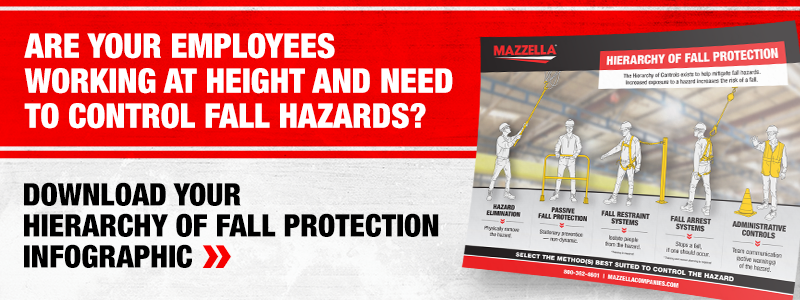
- Hierarchy of Fall Protection [Infographic]
- Top 10 Safety Tips for Working at Height [Infographic]
- Job Safety Analysis & Working at Height Risk Assessment [Bundle]
- Fall Safety 101 Infographic [Poster]
<!–[if lte IE 8]><![endif]–>
 hbspt.cta.load(3336966, ‘43336e9f-4baf-453c-841c-394decc4e070’, {“useNewLoader”:”true”,”region”:”na1″});
Learn More! Articles & Videos
- Confined Space Rescue Stretcher: Why Your Team Needs One On-Site
- What Is a Rigid Rail Fall Protection System? Different Types & Design
- Class 1 vs. Class 2 Self-Retracting Lifelines (SRLs): What’s the Difference, and Which One Do You Need?
- A Dictionary of Fall Protection Terms
- What Is the Uni-Life Track™ Fall Protection System?
- Why Should You Prioritize Fall Protection for Your Workers?
Contact Mazzella
- Schedule Remote or In-Person Training
- Contact Mazzella’s Fall Protection Division
In this video
- 0:00 – Intro
- 0:32 – Web Retractables vs Cable Retractable
- 1:40 – Why Pick a Cable Retractable?
- 2:37 – How Often are the Wrong Retractables used?
- 3:17 – Doesn’t a Web Retractable Add Risk to a Leading Edge Fall?
- 5:11 – Strength of Web Retractables vs Strength of Cable Retractables
- 6:07 – Closing
Disclaimer:
Any advice, graphics, images, and/or information contained herein are presented for general educational and information purposes and to increase overall safety awareness. It is not intended to be legal, medical, or other expert advice or services, and should not be used in place of consultation with appropriate industry professionals. The information herein should not be considered exhaustive and the user should seek the advice of appropriate professionals.