
The Best Types of Fall Arrest Systems for Fixed Ladders
If you have a fixed ladder at your facility, you will need a fall arrest system to pair with it. This article covers the best options for your business.
Estimated reading time: 7 minutes
Key Takeaways
- OSHA phases out ladder cages due to inadequate worker protection, requiring fall arrest systems for fixed ladders over 24′.
- Fall arrest systems include cable vertical lifeline systems, rail ladder safety systems, and SRL anchor posts, each offering unique benefits.
- Cable systems are cost-effective and easy to install while rigid rail systems perform better in harsh environments but have higher upfront costs.
- Consider factors like budget, environment, and traffic volume when selecting a fall arrest system for your facility.
- Proactively upgrade your fall protection measures before the 2036 deadline to ensure worker safety and compliance.
For decades, ladder cages, sometimes called safety cages, were the standard fall protection method on fixed ladders at facilities.
Now, that’s changed. OSHA has updated its standards to phase out cages from job sites. Moving forward, any new or existing fixed ladder over 24′ must have a personal fall arrest system.
While this rule originally applied only to the construction industry, it has expanded to cover general industry environments, too. With cage systems out of the picture, that leaves fall arrest systems as the best option to keep workers safe, so which one should you choose?
This article covers three primary fall arrest options for fixed ladders and provides guidance to help you select the best solution for your operation.
Table of contents
Why are Ladder Cages Being Phased Out?
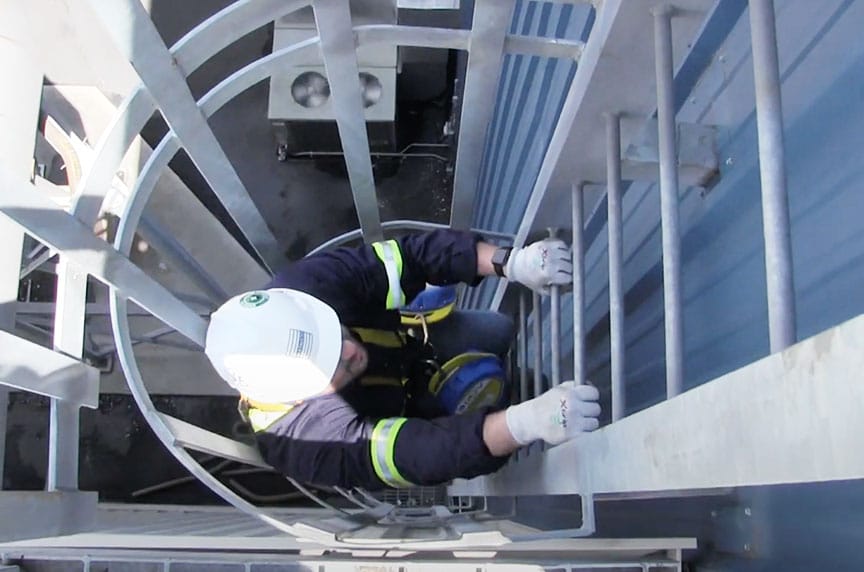
Ladder cages are being phased out for a simple reason: they don’t protect workers.
As we’ve discussed in previous articles, ladder cages do not stop a fall in progress. Instead, cages can actually pose a serious threat to workers if they fall backwards. The cages are made from steel, and if a worker falls backward, their body can get tangled and make the rescue process even more challenging.
Cages also offer no protection from sudden slips or missteps, particularly in wet, icy, or dirty industrial environments.
OSHA has set a compliance deadline of November 18, 2036, for retrofitting existing ladders. Currently as written, and businesses will be responsible for:
- Installing new fall arrest systems
- Removing ladder cages
- Training employees on how to use personal fall arrest systems
- Scheduling annual inspections by a competent person
Cable Vertical Lifeline Systems
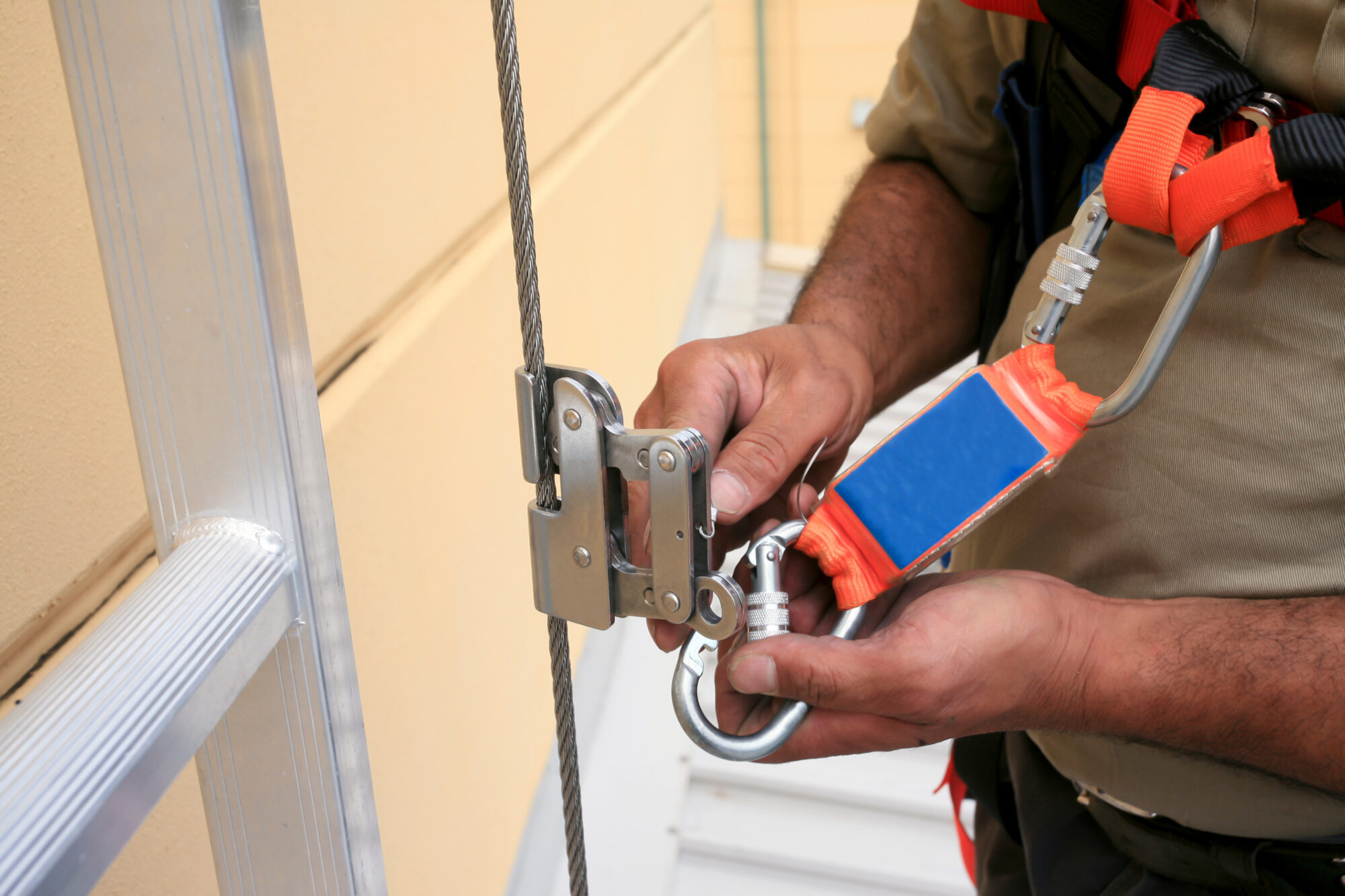
A cable vertical lifeline system is the most widely used solution for retrofitting existing fixed ladders.
A steel cable, typically 3/8-inch galvanized or stainless steel, runs vertically along the full length of the ladder. Workers attach a climbing sleeve to the frontal D-ring of their full-body harness, and this sleeve travels freely along the cable during normal ascent and descent.
In the event of a fall, the sleeve’s internal cam mechanism locks onto the cable instantly, arresting the worker’s descent.
Cable systems are popular because they are cost-effective, easy to install on existing structures, and adaptable to a wide range of ladder configurations. They’re also an excellent choice for standard industrial environments where ladders are used regularly.

Rail Ladder Safety Systems
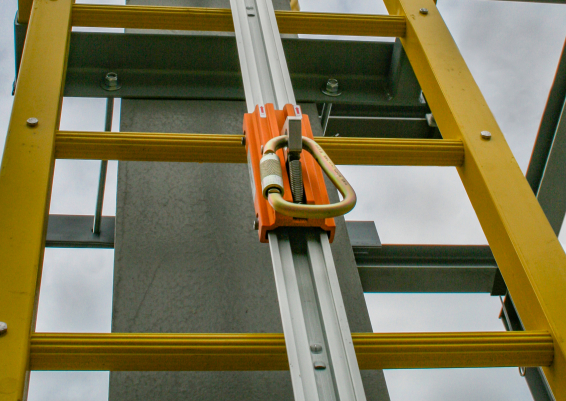
A rigid rail system operates on the same principle as a cable system but replaces the flexible steel cable with a solid aluminum or steel track mounted to the ladder. A guided shuttle connects the worker’s harness to the rail and travels smoothly along the track during climbing. When a fall occurs, the shuttle locks into the rail immediately.
Rigid rail systems offer several advantages over cable systems. Because the rail is solid and fixed, there is virtually no deflection during a fall arrest event, resulting in shorter fall distances.
Rail systems also require less ongoing maintenance since there is no cable to re-tension. They perform exceptionally well in harsh or corrosive environments, on high-traffic ladders, and on curved or angled configurations where cable systems may be less practical.
The tradeoff is a higher upfront cost and more involved installation. For new construction or facilities investing for the long term, rigid rail systems often represent the best value over the life of the equipment.
SRL Anchor Posts
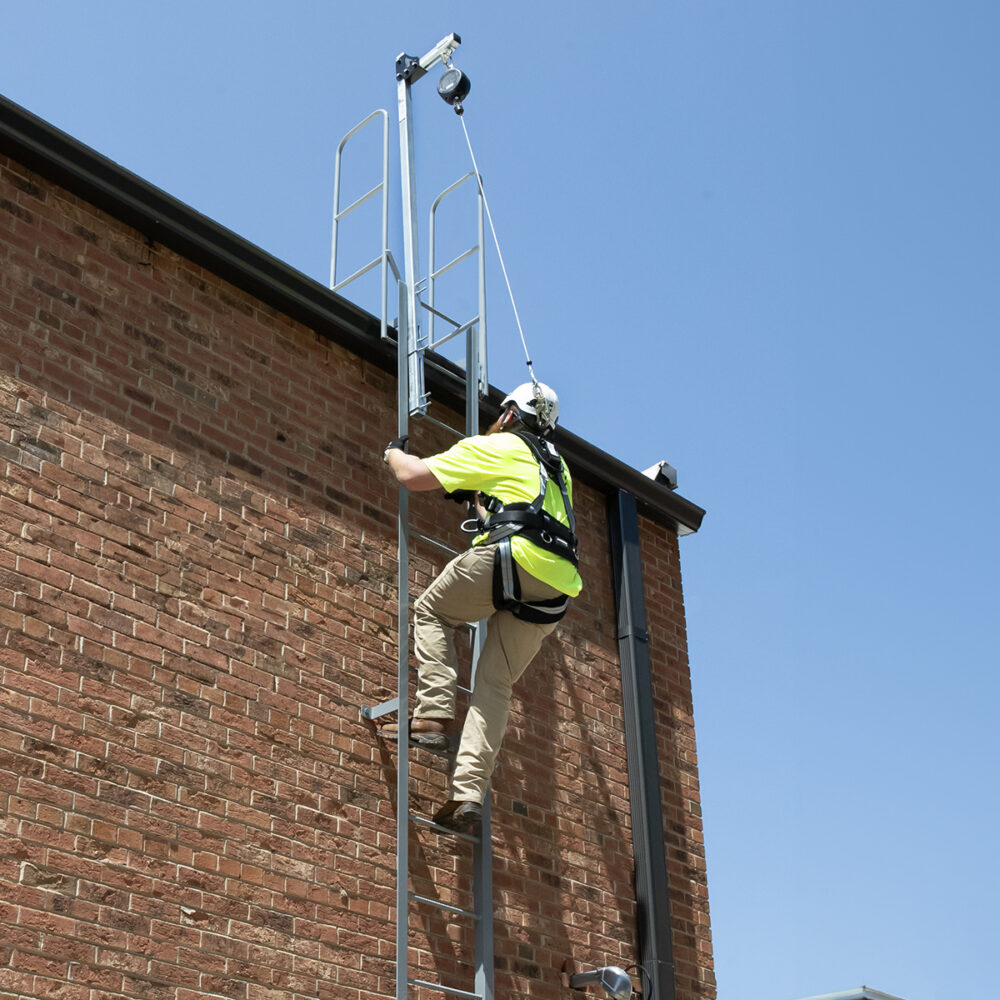
The third major option is a personal fall arrest system (PFAS) using an overhead anchor post and a self-retracting lifeline (SRL). In this configuration, a steel or aluminum post extends above the top of the fixed ladder, creating an overhead anchorage point.
The worker connects an SRL to the dorsal D-ring of their harness before climbing. As the worker ascends, the SRL cable retractst automatically; as the worker descends, it protracts. If a fall occurs, the SRL locks within fractions of a second.
This setup is particularly effective where the transition from ladder to platform poses the greatest risk. Because the SRL remains connected from ground to platform and back, the worker never experiences a gap in fall protection coverage.
Safewaze offers an Adjustable SRL Ladder Anchor System that mounts directly to ladder rungs and can serve as a permanent or temporary solution, allowing safety managers to deploy fall protection quickly without extensive hardware modifications.
How to Choose the Right Fall Arrest System
Selecting the best fall arrest system depends on several factors specific to your facility and operational needs.
- Budget and scale: Cable systems offer the lowest cost per ladder, with typical installations ranging from $2,000 to $5,000 depending on height and configuration.
- Environment: Facilities exposed to corrosive chemicals or extreme weather benefit from rigid rail systems
- Traffic volume: High-traffic ladders are best served by multi-user systems that handle repeated use with minimal wear.
- Transition risk: Where the step-off from ladder to platform is the greatest hazard, an SRL anchor post provides continuous protection.
- Retrofit vs. new construction: Cable systems retrofit fastest onto existing ladders. Rigid rail systems are ideal for new construction.
Final Thoughts on Fall Arrest Systems for Fixed Ladders
Waiting until a cage fails or a citation is issued puts workers at risk and creates unnecessary urgency.
The most effective approach is to audit your fixed ladders now, prioritize the highest-risk installations, and develop a phased upgrade plan. And whether you work on water towers, grain silos, wind turbines, or cell towers, don’t wait until 2036 to invest in these fall arrest systems.
The right system, properly installed and maintained, is one of the most impactful investments an EHS program can make.
From straightforward cable retrofits to heavy-duty rigid rail installations, Mazzella’s Fall Protection team works with the most reputable manufacturers in the industry to make sure you get the right system for your workers.
Beyond installation, Mazzella supports ongoing compliance by offering inspection services, training programs, and guidance on proper equipment use.
Copyright 2026. Mazzella.