
What Is Bridge Speed on an Overhead Crane, and Why Does It Matter?
Learn how bridge speed impacts safety, productivity, cost, and crane system design across industries.
Listen to our Safety Factor Podcast, where our experts discuss crane buying mistakes that cost companies millions
When businesses invest in an overhead crane system, conversations often focus on capacity, span, and lift height. One critical performance factor that is frequently misunderstood or overlooked is bridge speed.
Bridge speed directly affects productivity, safety, and long-term reliability. Choosing the wrong speed can limit output, accelerate component wear, or introduce unnecessary risk for operators and equipment. Understanding how bridge speed works, and how it should be specified for your application, is essential when designing or purchasing an overhead crane system.
This article explains what bridge speed is, why it matters, and how to determine the right speed for your operation.
Table of Contents
- What Is Bridge Speed on an Overhead Crane?
- Why Bridge Speed Matters in Crane Design
- How Bridge Speed Impacts Safety and Reliability
- What Factors Determine the Right Bridge Speed?
- Typical Bridge Speed Ranges by Application
- The Role of Variable Frequency Drives in Bridge Speed Control
- Does Higher Bridge Speed Increase Crane Cost?
- Can You Adjust Bridge Speed After Installation?
- How Does Bridge Speed Vary by Industry?
- Final Thoughts: Don’t Ignore Bridge Speed When Designing Your Crane
- FAQs About Bridge Speed on Overhead Cranes
- Learn More About Overhead Cranes and Overhead Crane Maintenance
What Is Bridge Speed on an Overhead Crane?
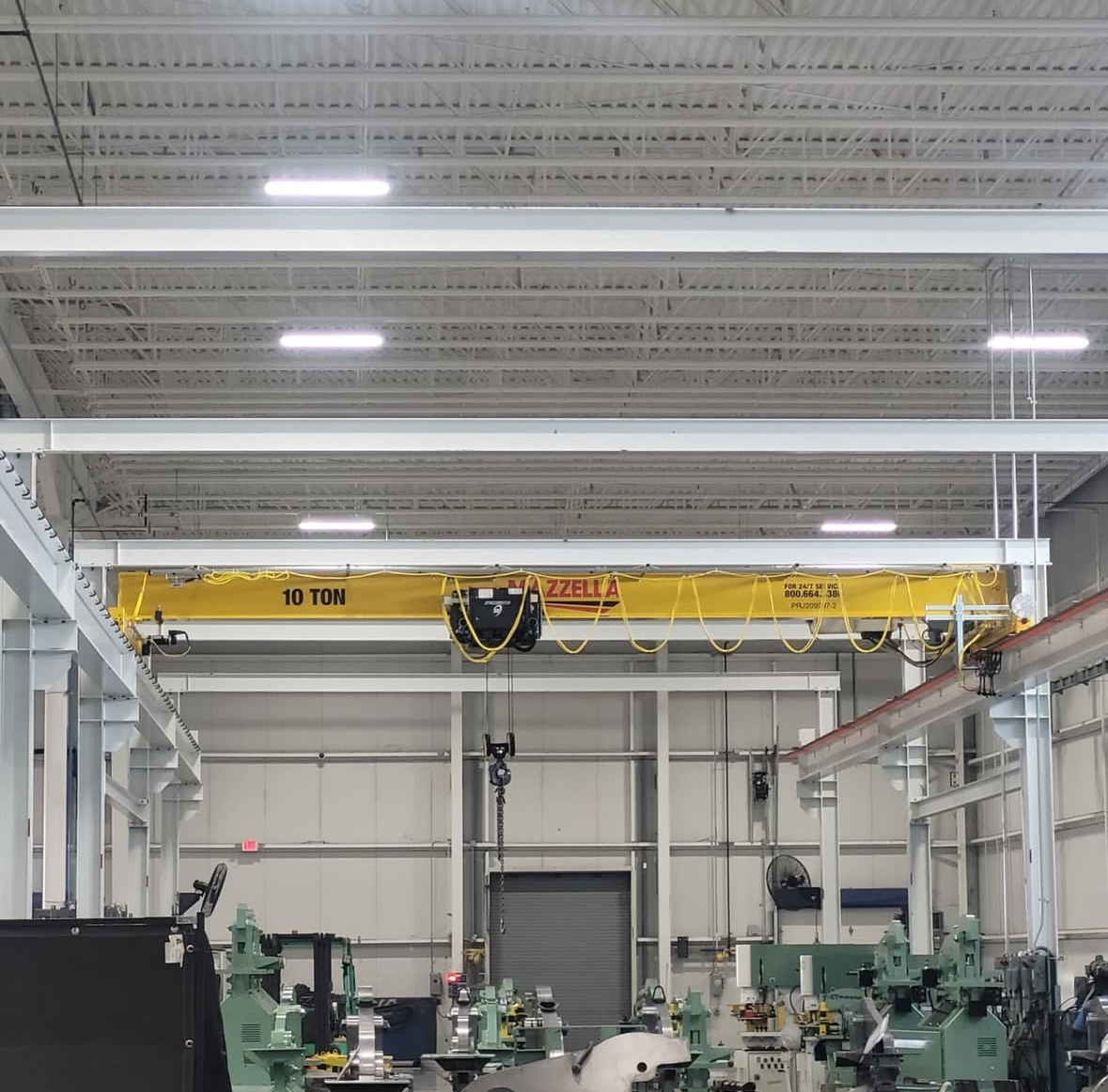
Bridge speed refers to how fast the crane bridge travels along the runway rails, typically measured in feet per minute (fpm). This movement allows the crane to transport loads across the length of a facility.
Bridge speed is separate from:
- Hoist speed, which controls vertical lifting
- Trolley speed, which moves the hoist across the bridge girder
Together, these three motions define how efficiently and safely a crane can move material throughout a workspace.
Why Bridge Speed Matters in Crane Design
Bridge speed plays a significant role in daily crane performance, especially in facilities where a single crane services multiple workstations or production zones.
A properly selected bridge speed helps:
- Reduce non-productive travel time
- Improve output in production environments
- Maintain safe control during load handling
- Minimize wear on brakes, wheels, motors, and gearboxes
In many applications, higher bridge speeds are used primarily without a load, allowing the crane to reposition quickly while slowing down during lifting and placement.
How Bridge Speed Impacts Safety and Reliability
Faster bridge speed is not always better. Bridge speed must be carefully balanced.
If the bridge speed is too fast for the application:
- Operators may struggle to maintain control, especially with pendant operation
- Brakes, wheels, and lifting medium experience accelerated wear
- Risk increases during load travel if speed is not properly controlled
If the bridge speed is too slow:
- Production efficiency suffers
- Operators lose valuable time repositioning the crane
- Bottlenecks may develop in multi-station workflows
Modern crane systems often rely on variable frequency drives (VFDs) to provide smooth acceleration, deceleration, and fine control across a range of speeds, helping mitigate these risks.
What Factors Determine the Right Bridge Speed?
There is no universal bridge speed that works for every overhead crane. The ideal speed depends on several factors evaluated during system design.
Common considerations include:
- Rated crane capacity
- Bridge span and overall crane weight
- Duty cycle and frequency of use
- Application type, such as maintenance versus production
- Operator control method, pendant, radio, cab, or automated
Pendant-operated cranes are typically designed to move at approximately walking speed, while radio-controlled, cab-operated, and automated cranes can safely operate at higher travel speeds.
Typical Bridge Speed Ranges by Application
The table below outlines common bridge speed ranges and where they are typically used.
| Application Type | Typical Bridge Speed Range |
| Maintenance or light-duty cranes | 80 to 100 fpm |
| Standard industrial cranes | 100 to 120 fpm |
| Production and heavy-duty cranes | 120 to 150+ fpm |
| Automated or cab-operated systems | 200 to 300+ fpm |
In highly automated or high-production environments, bridge speeds may exceed these ranges, but only when supported by advanced controls, collision avoidance systems, and engineered safety measures.
The Role of Variable Frequency Drives in Bridge Speed Control
Most modern overhead cranes use variable frequency drives (VFDs) on the bridge motion. These drives allow operators to control speed smoothly from a slow creep to the maximum rated travel speed.
VFDs provide several benefits:
- Smooth acceleration and deceleration
- Reduced load sway
- Improved positioning accuracy
- Less mechanical stress on crane components
This control functions similarly to a vehicle accelerator. The more input applied, the faster the bridge travels, within the limits of the motor and gearbox design.
Does Higher Bridge Speed Increase Crane Cost?
Yes. Increasing bridge speed typically increases system cost due to the need for more robust components.
Higher speeds often require:
- Larger horsepower bridge motors
- Stronger braking systems
- Heavier-duty gearboxes
- Additional controls such as anti-sway or zoning systems
While moderate speed adjustments can sometimes be made through VFD programming, significant increases often require hardware changes. For this reason, it is usually easier and more cost-effective to design for higher potential speed upfront and limit it through controls, rather than attempting to increase speed later.
Can You Adjust Bridge Speed After Installation?
What if you have an existing overhead crane in your facility, and you want to adjust the existing bridge speed? The bridge speed can be adjusted within the limits of the existing motor and drive system. VFD settings allow speed to be reduced easily.
Increasing speed beyond the original design is more complex and may require:
- New motors
- New drives
- Upgraded brakes
- Engineering review of wheels, axles, and structural components
In some cases, these upgrades are not cost-effective. This is why it’s important reinforcing to think about future operational needs early in the design process.
How Does Bridge Speed Vary by Industry?
The right speed always depends on how the crane supports the overall workflow.
Different industries prioritize bridge speed differently based on production demands and risk tolerance.
Steel mills and high-production manufacturing facilities often use faster bridge speeds to support continuous material flow. This is also true for automated waste-to-energy or scrap handling systems, where higher speeds are necessary to keep up with steady streams of garbage and waste.
Maintenance shops, however, will typically use slower speeds for precision handling.
Power generation and heavy component handling may favor slower travel to protect high-value loads.
Common Misunderstandings About Bridge Speed
One of the most common mistakes buyers make is assuming that two cranes with the same rated bridge speed will perform the same.
In reality, motor horsepower and acceleration characteristics matter. A crane with smaller motors may eventually reach the same top speed, but it may take significantly longer to get there. In short travel distances, this difference can have a major impact on efficiency.
Final Thoughts: Don’t Ignore Bridge Speed When Designing Your Crane
Bridge speed is a critical design decision that impacts safety, productivity, and total cost of ownership.
Understanding how your crane will be used today, and how it may be used in the future, helps ensure your system is designed to support your operation rather than limit it.
If you are evaluating an overhead crane system and want to understand how bridge speed fits into your application, Mazzella is here to help. For decades, we’ve established ourselves as one of America’s leading overhead crane manufacturers.
Visit our website to explore crane design considerations, inspections, emergency repair services, and training resources tailored to industrial operations.
FAQs About Bridge Speed on Overhead Cranes
Most standard industrial cranes operate between 100 and 120 feet per minute, depending on application and control method.
No. Excessive speed can reduce safety and increase wear if not properly controlled and engineered for the application.
Yes. Higher speeds increase mechanical stress on brakes, wheels, motors, and gearboxes, especially if the crane is frequently loaded during travel.
Typically, yes. Pendant-controlled cranes are designed to move at or near walking speed so operators can safely keep pace.
Absolutely. Bridge speed is much easier and more cost-effective to design upfront than to modify later. The sooner you can figure out the bridge speed you need, the better.
Learn More About Overhead Cranes and Overhead Crane Maintenance

Copyright 2026. Mazzella.