The Ultimate Rigging Equipment Markings Guide
This article takes a deep dive into the required markings for all major rigging equipment
Estimated reading time: 16 minutes
Every piece of rigging equipment tells a story through its markings. The stamps on a shackle, the tag on a sling, and the nameplate on a hoist offer important information about capacity, material, and manufacturer origin. For riggers, safety professionals, and EHS managers, reading and interpreting these markings is foundational to every safe lift.
OSHA regulations and ASME standards requires rigging equipment to be clearly and permanently marked with its rated capacity. Equipment that lacks legible identification must be removed from service with no exceptions.
This article breaks down the marking requirements for every major category of rigging equipment, from slings and hardware to hoists and below-the-hook lifting devices. It covers what each marking means, where to find it, and why it matters for compliance and jobsite safety.
Table of Contents
Why Do Rigging Equipment Markings Matter?
The markings on rigging equipment serve as the primary safety communication between the manufacturer and the user. They provide the rigger with the information needed to select the right equipment, configure the lift correctly, and stay within the rated capacity.
Without legible markings, workers end up guessing on things like capacity, which can lead to catastrophic failure. If the tag on your sling is missing, damaged, or illegible, that sling must be immediately removed from service.
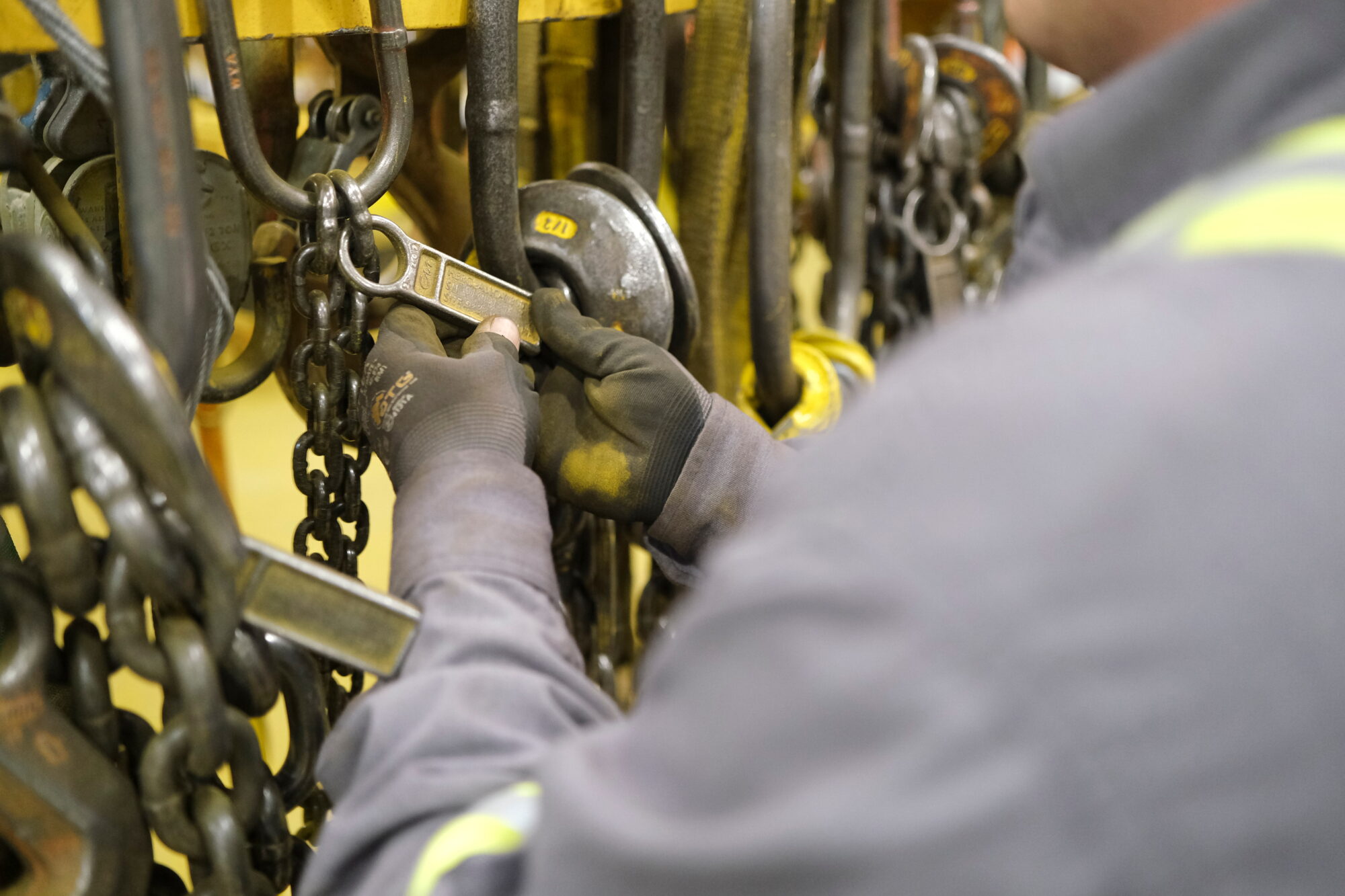
Markings also help with traceability. Sometimes a serial number or identification code links a product to its proof test certificate, inspection history, and manufacturer documentation. This allows safety managers to verify compliance, and, in the event of a defect, quickly isolate and recall affected equipment.
The Regulatory Framework: OSHA and ASME
OSHA and ASME are the two primary regulatory and standards bodies governing rigging equipment markings.
OSHA sets mandatory, legally enforceable rules. The two key standards for rigging are:
- 29 CFR 1910.184 “Slings” for general industry settings such as manufacturing plants and warehouses
- 29 CFR 1926.251 “Rigging equipment for material handling” for construction environments
Both standards share a common principle that rigging equipment must be clearly and permanently marked with its capacity, and it must never be loaded beyond that marked capacity. Equipment without legible markings is prohibited from use.
ASME develops the detailed technical consensus standards that provide the “how-to” for compliance. The ASME B30 Safety Standard is a multi-volume series covering slings (B30.9), hooks (B30.10), below-the-hook devices (B30.20), and rigging hardware (B30.26). OSHA frequently references them, making compliance with ASME the primary path to meeting federal requirements.
OSHA sets the law, while ASME provides the technical blueprint.
What are the Marking Requirements for Lifting Slings?
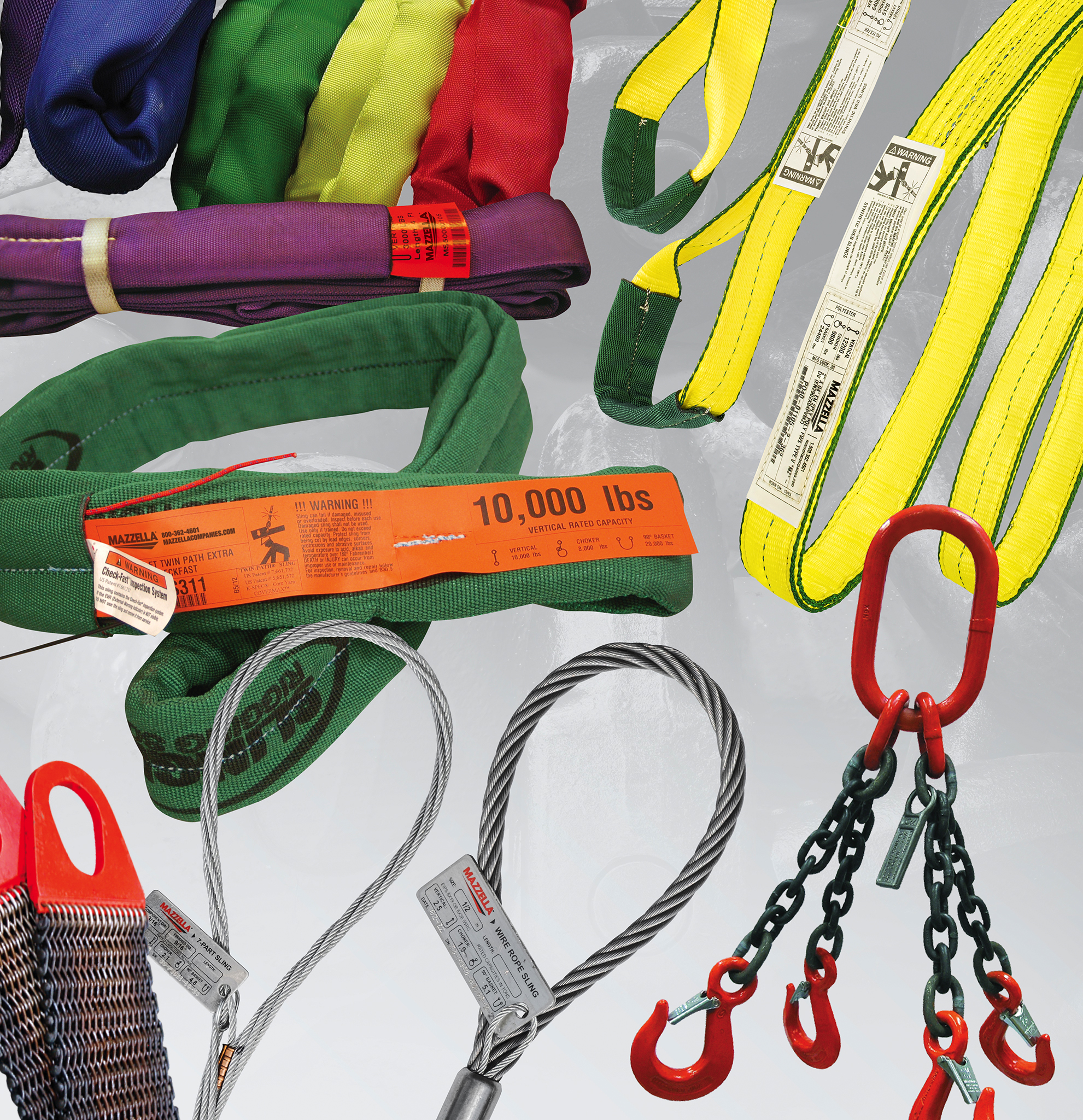
Slings are among the most common pieces of rigging equipment, and their identification tags are their most important safety feature. Both OSHA and ASME B30.9 require specific information on each sling type.
A compliant sling tag displays the manufacturer, serial number, material type, and rated capacities for vertical, choker, and basket hitches.
Alloy Steel Chain Slings
Every alloy steel chain sling must display the following on a permanently affixed, durable tag:
- Name or trademark of manufacturer
- Nominal chain size
- Number of legs
- Rated load (WLL) for hitch type(s) used and the angle upon which it is based
- Length (reach)
- Individual sling identification (serial number)
Wire Rope Slings
Wire rope sling tags must include:
- Name or trademark of manufacturer
- Rated load for the hitch types used and the angle upon which it is based
- Rope diameter or size
- Number of legs (if more than one)
The hitch type and sling angle are especially critical. Like all slings, a wire rope sling capacity in a vertical hitch is significantly higher than its capacity in a choker or angled basket configuration. A sling without a legible tag must be removed from service until it is re-certified and re-tagged by the manufacturer or a qualified person.
Synthetic Web Slings
Synthetic slings have additional marking requirements due to different materials. Each tag must show:
- Name or trademark of manufacturer
- Manufacturer’s code or stock number
- Rated load for hitch type(s) and the angle upon which it is based
- Type of synthetic web material, like nylon or polyester
- Number of legs, if more than one
Material identification is particularly important because nylon and polyester have different stretch characteristics and chemical vulnerabilities. Nylon degrades when exposed to acids, while polyester is vulnerable to certain aldehydes and ethers.
Polyester Roundslings
Polyester roundslings are one of the most common types of slings used for general lifting due to their versatility, strength, and lightweight design.
All polyester roundslings must have a tag that is legible and permanently affixed, containing:
- Name or trademark of the manufacturer
- Rated loads for the three basic hitch types (vertical, choker, basket)
- Material of the sling body
- Core material (if different from the body)
- Sling length
High Performance Roundslings
High-performance roundslings use core yarns made from advanced synthetic fibers like High Modulus Polyethylene (HMPE) to achieve significantly higher capacities at a lower weight and with less stretch than standard polyester roundslings.
The tag on a high-performance roundsling must be present, legible, and include the following information:
- Name or trademark of the manufacturer
- Rated capacities for the various hitch types (e.g., vertical, choker, basket)
- Material composition, including the specific type of high-performance core yarn
- A unique serial number for traceability
- Applicable safety warnings
Metal Mesh Slings
Metal mesh slings are prized in high-temperature or abrasive environments for their durability and resistance to cutting. To ensure their safe use, ASME B30.9 and OSHA 1910.184 mandate that every metal mesh sling has a permanently affixed and legible identification tag with specific information.
The identification for a metal mesh sling must include:
- Name or trademark of the manufacturer
- Rated load for at least one hitch type and the angle upon which it is based
- Individual sling identification, like a serial number
Summary: Required Sling Tag Information by Type
| Marking | Chain | Wire Rope | Synthetic Web | Roundsling | Metal Mesh |
| Manufacturer name/trademark | Yes | Yes | Yes | Yes | Yes |
| Rated load (WLL) by hitch/angle | Yes | Yes | Yes | Yes | Yes |
| Size/diameter | Yes | Yes | — | — | — |
| Grade | Yes | — | — | — | — |
| Material type | — | — | Yes | Yes (core + cover) | — |
| Number of legs | Yes | If >1 | If >1 | If >1 | — |
| Reach (length) | Yes | — | — | — | — |
| Serial number | Yes | — | — | — | Yes |
| Manufacturer code/stock number | — | — | Yes | Yes | — |
Rigging Hardware Markings: Shackles, Hooks, Links, and More
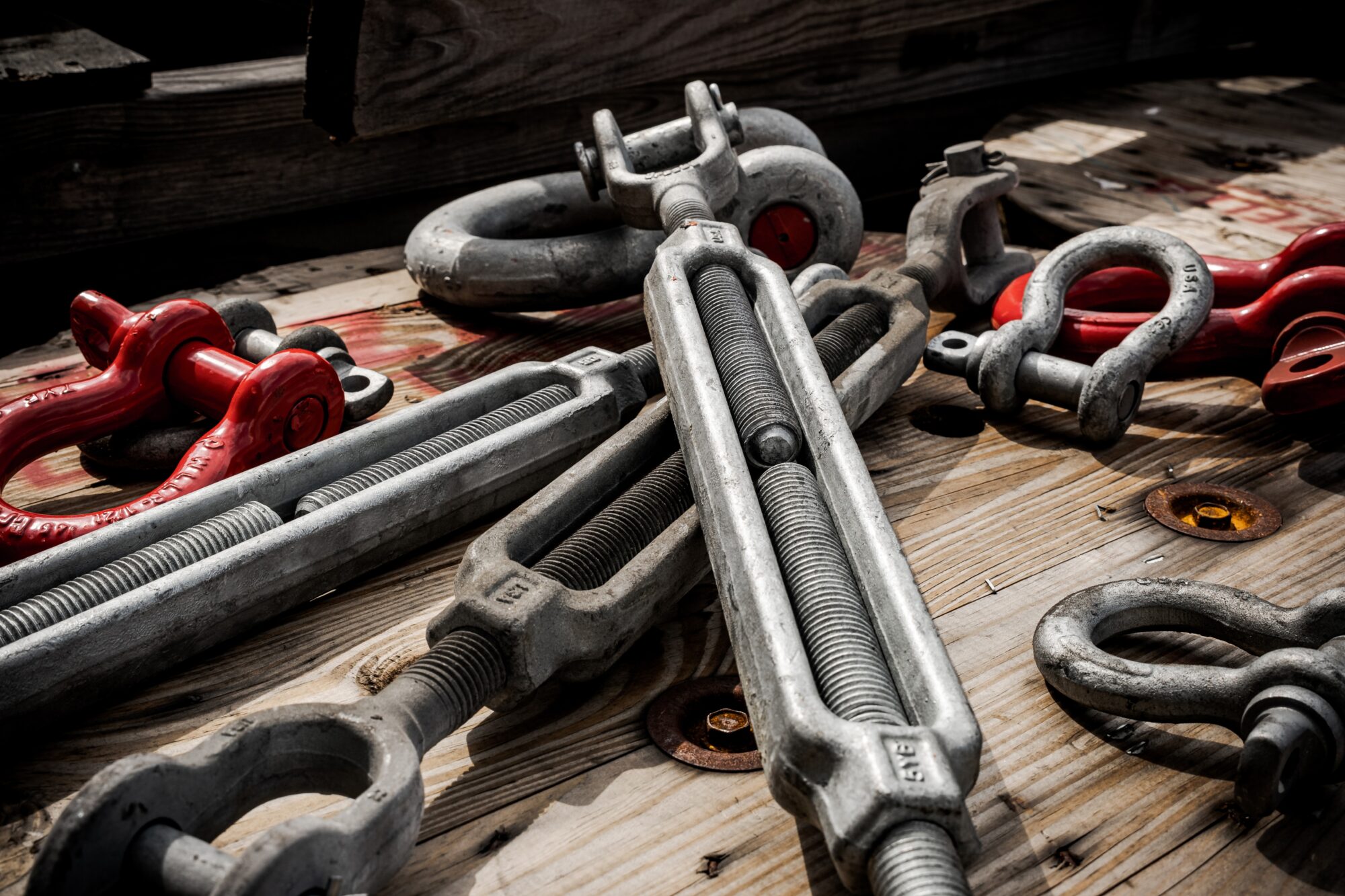
The failure of a single shackle, hook, or link can cause a total system collapse. That’s why ASME B30 mandates permanent markings on items like shackles, hooks, and hoists.
Shackles
Both the shackle body and the pin must be marked. These include:
Shackle body:
- Name or trademark of manufacturer
- Rated load (WLL)
- Size
Shackle pin:
- Name or trademark of manufacturer
- Grade, material type, or load rating
The WLL marked on a shackle applies only to a straight, in-line pull. Side loading reduces capacity significantly.
| Load Angle (from in-line) | Capacity Reduction |
| 0 to 5 degrees | No reduction |
| 6 to 45 degrees | Reduce WLL by 30% |
| 46 to 90 degrees | Reduce WLL by 50% |
| Greater than 90 degrees | Consult manufacturer |
Hooks
Every rigging hook must have the following permanently marked in a low-stress, non-wearing area:
- Manufacturer’s identification
- Rated load (WLL)
Custom-designed hooks, grabs, and clamps fall under an additional OSHA requirement (29 CFR 1926.251(a)(4)): they must be proof-tested to 125% of their intended rated load before being placed into service and then permanently marked with their safe working load.
Hooks must be removed from service if markings are illegible, if the throat opening has increased by 5% or more, or if there are visible cracks, bends, or twists.
Master Links and Connecting Links
Master links are the critical gathering points in multi-leg sling assemblies. Every master link, sub-assembly link, and ring must be marked with:
- Manufacturer’s name or trademark
- Size or rated load (WLL)
- Material grade
- Traceability code (Product Identification Code)
Turnbuckles
Turnbuckles must be marked by the manufacturer with the following:
- Name or trademark of the manufacturer
- Size or rated load
During use, it is critical that the turnbuckle’s end-fitting threads are fully engaged. The markings allow users to select the correct size and capacity for the application and provide a baseline for inspectors to check for wear, deformation, or thread damage.
Eyebolts and Eye Nuts
Eyebolts and eye nuts must be durably marked with
- Name or trademark of the manufacturer
- Size or rated load
- Grade (for alloy eyebolts)
The user is responsible for maintaining the legibility of these markings. According to ASME B30.26, if the identification on a turnbuckle, eyebolt, or other piece of adjustable hardware is missing, it must be removed from service. It can only be returned to use after being approved by a qualified person. Other removal criteria include heat damage, a 10% reduction in dimension from wear, excessive corrosion, or any bends, twists, or deformation.
Hoist Rings
Swivel hoist rings, also known as pivot hoist rings or lifting points, are a form of adjustable rigging hardware designed to pivot and swivel to accommodate angular loads without a reduction in their rated capacity.
Every swivel hoist ring must be permanently marked with the following:
- Name or trademark of manufacturer
- Rated load
Swivels
Every swivel must be durably marked by the manufacturer with the following:
- Name or trademark of manufacturer
- Rated load (WLL)
Some swivels, particularly positioning swivels, are not designed to rotate under load, while others, known as bearing swivels, are.
Wire Rope Clips
As a form of compression hardware, wire rope clips fall under the scope of the standard. Each wire rope clip should be marked with:
- Name or trademark of manufacturer
- Size
The size marking is particularly critical for wire rope clips, as using a clip that is too large or too small for the rope diameter will result in insufficient holding power and can cause the termination to fail under load.
Wedge Sockets
Wedge sockets are a type of compression hardware used to terminate a wire rope, commonly seen on crane hoist lines.
Every wedge socket assembly, including both the socket body and the wedge, must be marked by the manufacturer with the following:
- Name or trademark of manufacturer
- Size of the wire rope for which the socket is designed
- Rated load
Load-Indicating Devices
Load-indicating devices like dynamometers or load cells are crucial for measuring the force or weight of a load during a lift. Their markings require:
- Name or trademark of manufacturer
- Model number
- Serial number
- Rated capacity
Why Are Chain Grade Markings Critical?
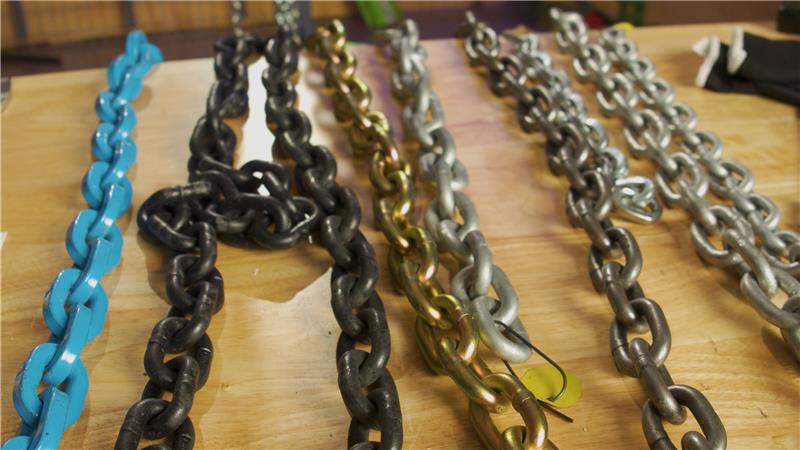
Not all chain is created equal, and using the wrong grade for overhead lifting is one of the most dangerous mistakes a rigger can make. Only heat-treated alloy steel chain is approved for overhead lifting. Carbon steel chain (Grades 30, 43, and 70) is strictly prohibited for this purpose because it is prone to brittle, sudden failure without warning.
Alloy steel chain provides a critical safety feature: controlled elongation. When overloaded, alloy chain will stretch by as much as 20% before fracturing, giving operators a visible warning of impending failure.
Approved Grades for Overhead Lifting
| Grade | Link Marking | WLL vs. Grade 80 | Key Characteristics |
| Grade 80 | “8,” “80,” or “800” + manufacturer symbol | Baseline | Industry standard; excellent high-temperature performance |
| Grade 100 | “10,” “100,” or “1000” + manufacturer symbol | +25% higher | Higher strength-to-weight ratio; most common for general rigging |
| Grade 120 | “12” or “120” + manufacturer symbol | +50% higher | Ultra-high strength; square link profile reduces interlink wear |
Grades NOT Approved for Overhead Lifting
| Grade | Typical Use | Why Not for Lifting |
| Grade 30 (Proof Coil) | Guard rails, agricultural tie-downs | Carbon steel; brittle failure |
| Grade 43 (High-Test) | Towing, logging | Carbon steel; no controlled elongation |
| Grade 70 (Transport) | Load securement on trucks | Heat-treated carbon steel; not rated for overhead loads |
Grade markings are stamped directly into the chain links at intervals of no more than three feet. You should never rely on paint color to identify chain grade. Colors are not standardized across manufacturers and wear off over time.
Hoist Nameplate Markings
Electric hoists carry a nameplate that functions as a condensed specification sheet. Understanding these markings is essential for safe operation, proper installation, and correct electrical protection. According to ASME B30.16 and NEMA standards, the required markings on an electric hoist include:
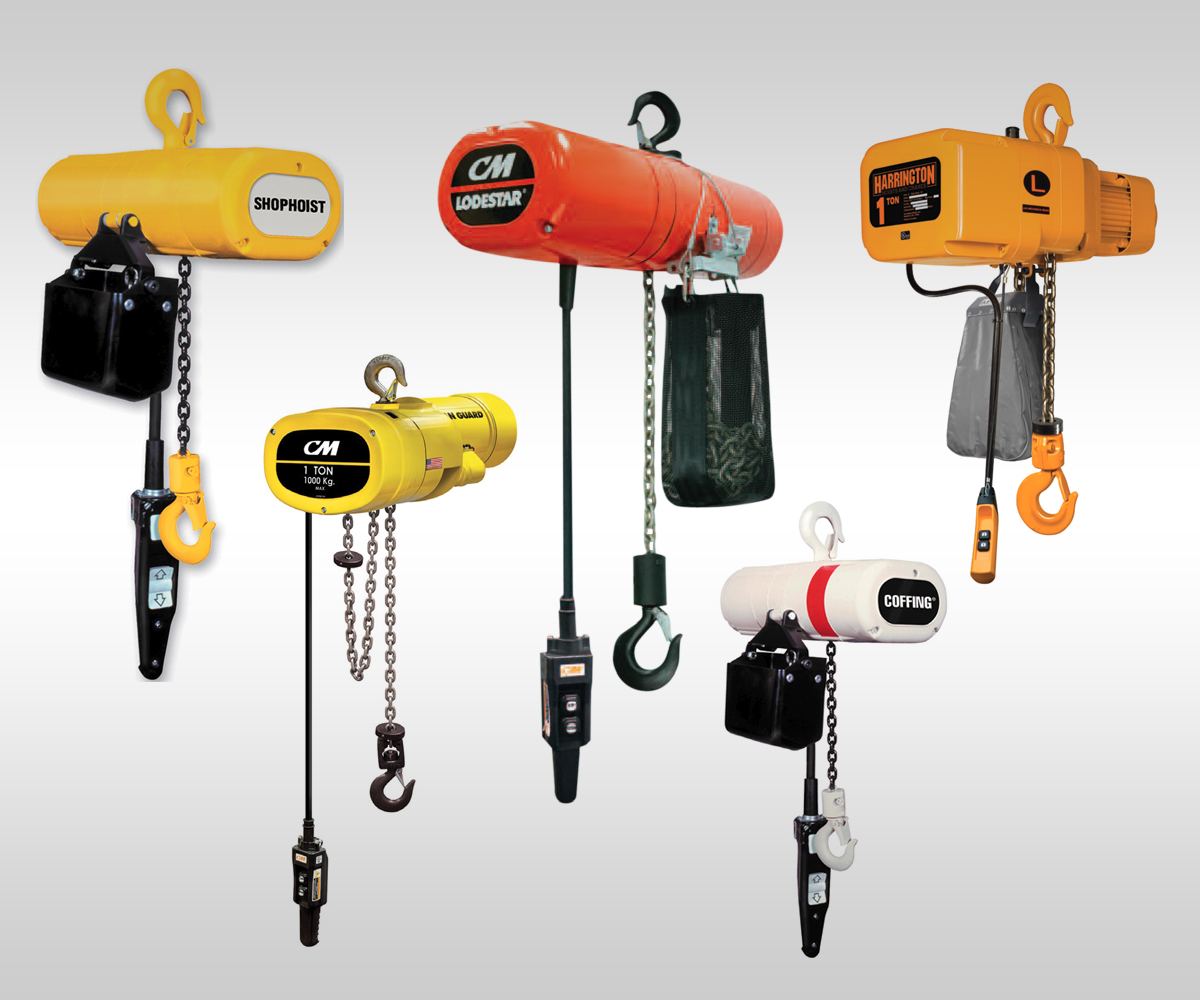
General Identification:
- Manufacturer’s name
- Model or type series
- Serial number
- Rated lifting capacity (must be legible from the ground or floor)
Electrical Data:
- Voltage, phase, and frequency of power supply
- Full Load Amps (FLA)
Mechanical Performance:
- Horsepower (HP) or kilowatt (KW) rating
- Full Load Speed (RPM)
- Service Factor (S.F.) — a value greater than 1.0 (e.g., 1.15) indicates the motor can handle temporary overloads up to 15% above its rated HP
- Duty rating (continuous or intermittent)
Safety and Construction:
- Insulation Class (e.g., Class F, Class H) — defines the motor’s thermal tolerance
- Enclosure type (e.g., TEFC for Totally Enclosed Fan Cooled)
- Third-party safety certifications (UL, CSA)
- Warning labels with cautionary language against overloading, lifting people, or operating damaged equipment
The rated lifting capacity is the single most important marking on a hoist. It must be displayed on both the hoist body and the load block.
Below-the-Hook Lifting Device Markings
Below-the-hook (BTH) lifting devices range from simple spreader beams to complex vacuum lifters and lifting magnets. Their marking requirements are governed by ASME BTH-1 (design criteria) and ASME B30.20 (safety, inspection, and marking).
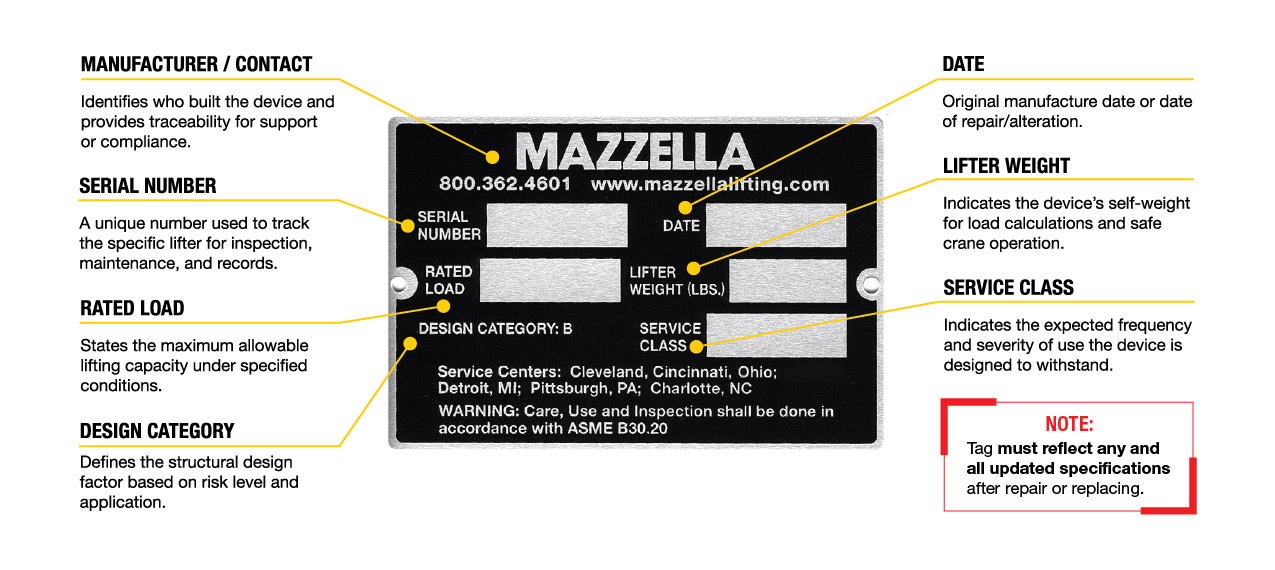
ASME B30.20 requires the following on every new structural or mechanical BTH device:
- Manufacturer’s name and address
- Serial number
- Lifter weight (if over 100 lbs)
- Rated load (capacity)
- Rated voltage and cold current amps (if electrically powered)
- ASME BTH-1 Design Category
- ASME BTH-1 Service Class
BTH-1 Design Classifications
Design Category reflects the severity of the application:
- Category A: Predictable loads, non-severe conditions. Uses a 2:1 design factor to yield strength.
- Category B: Unpredictable loads or severe conditions. Uses a more conservative 3:1 design factor.
Service Class reflects the anticipated lifecycle in load cycles:
| Service Class | Load Cycles |
| 0 | 0 to 20,000 |
| 1 | 20,001 to 100,000 |
| 2 | 100,001 to 500,000 |
| 3 | 500,001 to 2,000,000 |
| 4 | Over 2,000,000 |
A device designed for Service Class 0 (infrequent use) that is operating in a high-cycle production environment (Service Class 3 or 4) is at serious risk of fatigue failure.
Material Traceability: Batch Numbers and Mill Test Reports
Beyond capacity markings, the traceability of rigging hardware back to its raw materials is a fundamental component of quality assurance and risk management.
Lot or batch numbers are a unique tag permanently stamped or etched onto a piece of rigging hardware. This code links the finished product to the specific batch of steel from which it was manufactured.
The heat code unlocks the detailed information in a component’s Mill Test Report (MTR), a certified document issued by the steel mill. The MTR contains the matching heat number, a detailed chemical analysis of the alloy, tested mechanical properties (tensile strength, yield strength, elongation), and any heat treatment processes applied.
For rigging professionals, the MTR confirms that the steel meets the needs for its intended lifting application.
Country of Origin, Manufacturer Markings
Many companies will simply stamp with a country where the tool was manufactured (ex: China). Country of origin is not a manufacturer or trademark. Hardware that requires a name or trademark of manufacturer but only stamped with a country does not meet the requirements for use with overhead lifting.
What are the Inspection, Documentation, and Role of Markings?
A legible identification tag is the starting point for every inspection, whether it is a daily pre-shift check or an annual inspection from a third-party.
Frequent Inspections
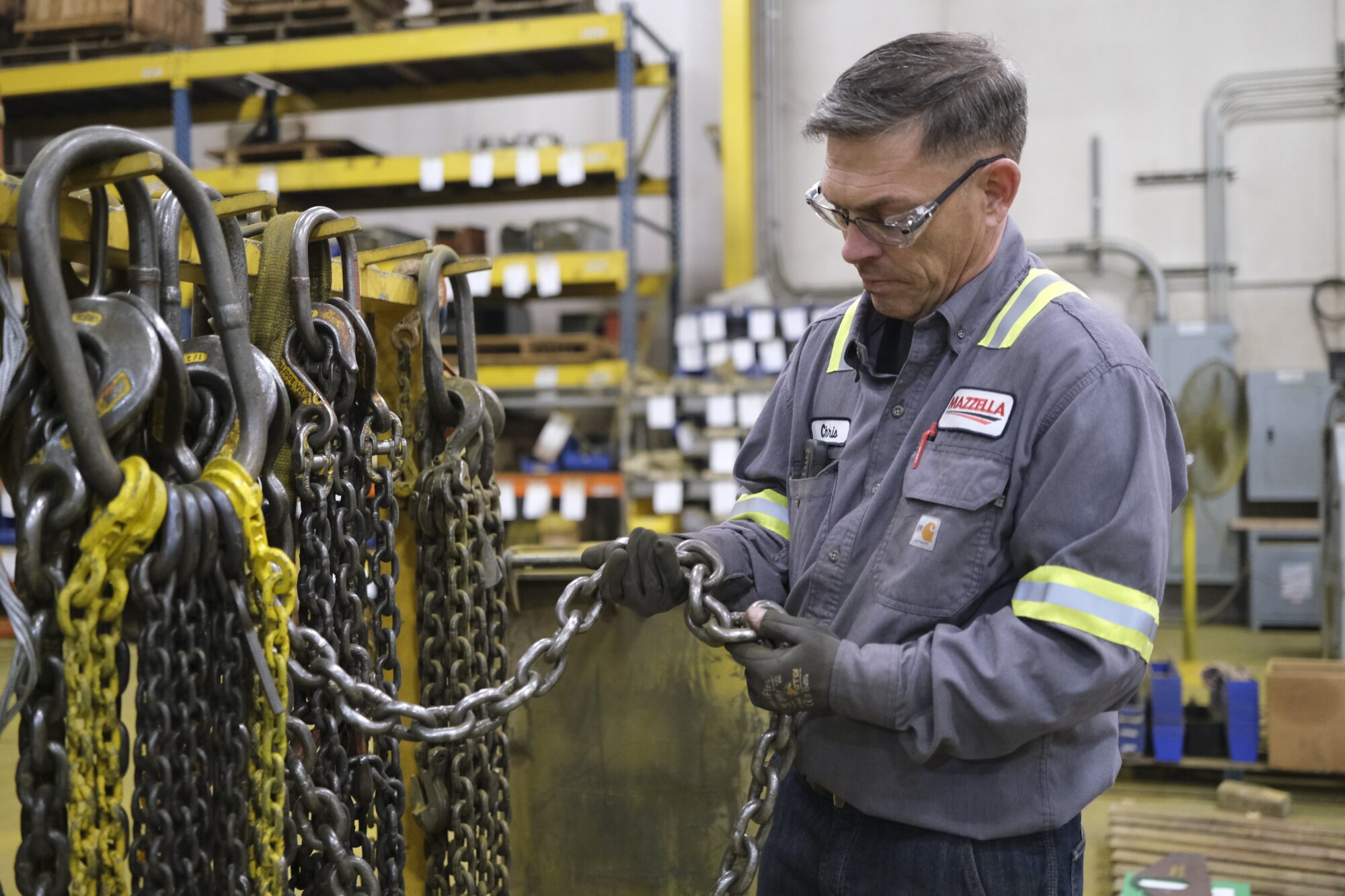
OSHA requires that a competent person perform a visual inspection of rigging equipment before each use or at the start of each shift. A critical part of this check is verifying that the identification tag or marking is present and legible. If it is not, the equipment must be removed from service immediately.
Periodic Inspections
More thorough periodic inspections are required at least annually (or more frequently based on service severity). For certain equipment, such as lifting slings and below-the-hook lifting devices, these inspections must be documented. OSHA requires employers to maintain a record of the most recent month in which each alloy steel chain sling was thoroughly inspected.
When Should You Remove Rigging Equipment from Service?
The following conditions require immediate removal from service across all equipment types:
- Missing or illegible identification markings or tags
- Evidence of heat damage or weld spatter
- Cracks, nicks, or gouges
- Excessive wear (typically a 10% or greater reduction in original dimension)
- Bending, twisting, or other distortion
- Excessive pitting or corrosion
- Unauthorized welding or modification
- For hooks: throat opening increased by 5% or more
- For synthetic slings: cuts, burns, melting, or acid/chemical damage
How Should You Dispose Damaged Rigging Gear?
Permanent disposal of rigging gear is typically left up to the owner or end-user, but there are some best practices to keep in mind.
For rigging hardware, wire rope, or slings, the best practice is to render the items in question as unsalvageable, or in such a condition as to make further use impossible. Cut lifting slings into shorter lengths, destroy the sling’s eye, and remove any tags or labels on the equipment.
You should also communicate with your team on where they should put damaged gear.
Final Thoughts, Takeaways On Rigging Hardware Markings
While this guide may seem daunting, here are a few big takeaways:
- If a piece of rigging equipment has a missing or illegible identification marking, it must be immediately removed from service. Its capacity is unknown, and its use is a direct violation of OSHA regulations.
- Markings are legally required. OSHA prohibits the use of rigging equipment without permanently affixed, legible capacity markings.
- Only alloy steel chain (Grade 80, 100, or 120) is approved for overhead lifting. The grade stamped on the links is the only reliable identifier. Never rely on paint color.
- Serial numbers, heat codes, and Mill Test Reports create a documented chain of custody from the steel mill to the jobsite. This traceability is essential for recalls, defect isolation, and regulatory audits.
- Compliance with ASME is the most effective way to ensure OSHA compliance, as OSHA will often default to ASME standards when citing a company.
- The information on a tag or stamp provides the baseline against which all wear, damage, and deformation must be judged during both frequent and periodic inspections.
At Mazzella, we’re proud to have one of America’s best rigging inspection teams, who have decades of combined industry experience. If you’re due for a rigging inspection, visit our website to get a quote and learn more about our pricing.
You can also download our ASME B30 Markings and Identification Guide.