
Lifting Sling Inspections: Field vs. In-House Inspections
Field and in-house lifting sling inspections serve different purposes. A field inspection identifies conditions that require removing a sling from service. An in-house inspection evaluates the sling more thoroughly to determine the extent of damage and what can be repaired or needs to be replaced.
In this video, Tom Horner, Mazzella’s corporate rigging inspection manager, explains why a sling removed during a field inspection may need another inspection at the shop. Using examples involving alloy chain slings, wire rope slings, and Twin-Path slings, he discusses how shop equipment and fabrication expertise help inspectors evaluate repair options.
You’ll learn why an initial finding, such as a bent chain link, doesn’t necessarily tell the whole repair story. Tom also explains how Mazzella communicates findings and pricing to customers, why detailed repair evaluations take additional time, and how field and in-house inspectors work together.
What You’ll Learn:
- What field inspectors look for when removing lifting slings from service
- How an in-house inspection evaluates damage and potential repairs
- Why a single damaged component may require a more extensive repair
- What field inspectors can recommend before a sling goes to the shop
- How inspection findings, repair options, and replacement quotes are communicated to customers
- How equipment, time constraints, and inspector expertise affect each inspection process
Who This Is For:
- Safety and EHS professionals responsible for lifting and rigging equipment
- Maintenance managers coordinating sling inspections and repairs
- Plant and operations managers reviewing repair or replacement options
- Equipment owners with slings that have been removed from service
- Anyone trying to understand why a field inspection may lead to an additional shop inspection
Need Help With Lifting Sling Inspections or Repairs?
Have a sling that’s been removed from service, or questions about what happens next? Contact Mazzella’s Rigging Division to discuss your inspection findings and next steps for evaluating repair or replacement options.
Transcript
0:00 – Intro
Host: All right, guys, so today we’re actually going to cover a topic that unpacks in-field inspections versus in-house inspections and some of the differences between the two. And today I’m joined by Tom Horner, our corporate rigging inspection manager. Tom, thank you for joining me today.
Tom Horner: Well, no problem.
Host: So today we’re going to talk about two different types of inspections, and really, to me, this is an important topic because obviously there’s a lot of people that we have that come and perform this inspection work, but then also back at our shop, we have people that actually perform like repairs and stuff.
So first, can you kind of unpack the differences between the two inspections and why we do have two inspections? You know, why isn’t the first one enough? Why do we need a second one? And then how are those two different inspections, you know, different in the way that they’re made up?
1:00 – What does a field inspection cover?
Tom Horner: Absolutely. When we’re doing a field inspection, all of our inspectors are trained to find, you know, the failure of an item through the failure criteria. We always ever look for first piece failure.
So if we come up to an alloy chain sling and we notice immediately it doesn’t have an identification tag, boom, we’re basically done. Same thing with a wire rope sling or synthetic sling.
You could even come up to a sling and see a major cut. That type of, that type of failure is what we look for in a field inspection.
1:32 – What does an in-house inspection cover?
Tom Horner: Versus an in-house inspection, what that is, is let’s say somebody sent in that chain sling from the field. Our in-house inspector will go over that entire chain link by link and fitting to end fitting to make sure every inch of that chain sling is in good shape, or he’ll mark down what needs to be replaced on that chain sling.
Also in our shop, we have better lighting, we have access to a crane to lift the chain up and down, an inspection table. We also have a tumbler that we can at times use to clean some chains. We might do the same with some other devices, but just a much more thorough inspection in-house.
Host: Now, is there a difference in like the quoting process between when our inspector’s out in the field actually performing the inspection versus when we get it back to the shop and notice that there might be something that was worse than our, you know, initial inspector pulled it out for?
2:31 – Do in-house inspectors find other issues with lifting slings?
Tom Horner: Absolutely. In the field, our inspector might look it over and, you know, find a bent link. And that doesn’t mean that singular link just needs to be replaced.
Our in-house inspector actually has to lay that chain out, look across multiple legs by chance, and determine: Is it just that one link? Will a body link work, or do they have to replace all four legs, or half of each leg across all four legs to make everything match back up?
And that’s the difference between a field inspector and an in-house inspector: our in-house inspectors are really in tune with the fabrication of every item. Our inspector in-house in Cleveland, he knows how to build all the chain slings; he understands how all the componentry fits and works together.
He can put together those pieces of the puzzle versus our guys in the field who are really just taught to: “Hey, I’m going to inspect it. I can identify the failure criteria. I can ask you to send it in, and then we can continue that process to determine if we actually can repair that item.”
Host: And so like, can the in-field inspector make that call of what can be repaired or what should be replaced? Or are they solely just to, you know, “Hey, if this is looking like it’s going to get failed out for whatever reason,” they’re going to just pull it, move on to the next thing?
3:50 – Can a field inspector tell you what needs to be repaired?
Tom Horner: They’re really just going to pull it and move on to the next item, but they’re going to give you the recommendation, “Hey, we know we can repair wire rope items because there’s a potential we can reuse all the fittings.”
The same thing with an alloy chain sling. With a large Twin-Path, if it’s just a small hole in the covers, they’re going to make the recommendation, “Yeah, send it in because we can cut it open in either direction, make sure all of the internal fibers are okay.”
And then our inspector in-house can make a determination to patch it, or is there damage internal, and then be able to, you know, quote you a new, etcetera.
Host: So how much communication is between like the in-house inspector at the shop and the customer back at home?
You know, if the initial inspector said this, but then the in-house inspector finds something more, is there still a little bit of communication with, “Hey, this is what we found, this is what should be replaced, do you want us to do that?” Or does that change kind of happen automatically and then the customer’s just notified after the change has been made?
4:51 – Does a customer know before any repairs are made?
Tom Horner: When an item comes in, our in-house team, which will be our inspector in the shop and then our salesperson who does quote the repair, they will absolutely relay all that information of what we found per item and give you the best recommendation.
“Hey, this is worth repairing, here’s your price. This is not worth repairing because there’s so much damage, and here’s the damage. Here’s our quote for a replacement.”
And walk you through all the different options, because there really are a lot of different options, depending on how fast they need it back, etcetera.
Host: So how much of a factor is time when it comes to our in-field inspectors doing their work? Because my initial thought was like, well, why not let’s just have the in-field inspectors just perform like an in-house inspection where they just go, you know, hand over hand over every single piece of every single sling?
How much does time impact that if we were to make our in-field inspectors perform that type of work?
5:45 – Why can’t a field inspector perform an in-house style inspection?
Tom Horner: Exponentially. I couldn’t even tell you how much longer an inspection would be if we had to make those determinations in the field. We really want to just be as expedient as possible while on-site at the customer’s facility.
We could go to a location that has literally a thousand pieces of rigging. And if our guys had to stop during that inspection and, let’s say, inspect 50 of them to a full inspection, you could be talking hours, which could turn into extra days on-site, which the customer’s paying for.
We don’t need to go in that direction. We just need to get to first point, and then they can make the determination there to get it in-house. When it does come in-house, that’s just a cost of doing business of the repair.
Host: Well, yeah, that all makes sense to me. Is there anything else that you haven’t touched on that you’d like to touch on specific to in-house versus, you know, in-field inspections?
6:50 – Differences between field and in-house inspectors
Tom Horner: Just to clarify, our in-field inspectors are trained and certified through ITI. This is all that they do every day. And we do want them to get into your facility and be as thorough and as expedient as possible.
And you do want your items to come in-house after an inspection to the professional on the inside, who again has an even deeper level of expertise when it comes to the actual manufacturing and assembly of all of these different types of lifting devices.
Host: All right, well, Tom, thank you very much for joining us today. I really appreciate your time.
If people are kind of struggling with what to do with some of their lifting slings or maybe they’re kind of concerned, can they contact you, or what should they do to get more help from you or from our company?
Tom Horner: Absolutely. They can contact me at any time. They can contact anyone in my inspection business unit, our outside salespeople, or even our inside salespeople. Everyone should be able to get them pointed in the right direction.
Host: Well, thank you very much. I really appreciate your time, and then I hope that you and, you know, your friends, family, and coworkers all stay safe, man.
Tom Horner: Same to you. Much appreciated.
Free Downloads!
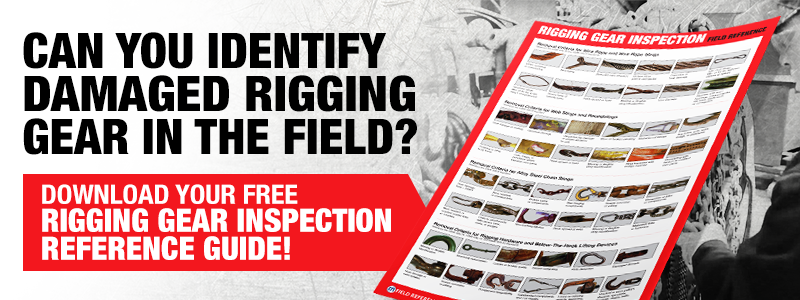
- Rigging Gear Inspection Field Reference [Guide]
- Lifting & Rigging Inspection Frequencies & Records [Guide]
- How to Dispose of Damaged Rigging Gear [Guide]
- Lifting and Rigging Site Assessment [Guide]
<!–[if lte IE 8]><![endif]–>
 hbspt.cta.load(3336966, ’72b9168f-0e22-4ba5-8342-b180f9e3d7fc’, {“useNewLoader”:”true”,”region”:”na1″});
Learn More! Articles & Videos
- Scary Rigging Spooktacular: Unsafe Rigging From Real Inspections
- Common Problems People Make When Using Synthetic Web Slings
- How to Inspect Synthetic Fall Protection Lanyards and Self-Retracting Lifelines (SRLs)
- How to Inspect a Fall Protection Harness
- How to Prepare for a Third-Party Rigging Inspection
- How to Choose a Rigging Inspection Company for OSHA Compliance
- Wire Rope Sling Inspection Criteria
Contact Mazzella
- Schedule Remote or In-Person Training
- Contact Mazzella’s Rigging Division
In this video
- 1:00 What does a field inspection cover?
- 1:32 What does an in-house inspection cover?
- 2:31 Do in-house inspectors find other issues with lifting slings?
- 3:50 Can a field inspector tell you what needs to be repaired?
- 4:51 Does a customer know before any repairs are made?
- 5:45 Why can’t a field inspector perform an in-house style inspection?
- 6:50 Differences between field and in-house inspectors
Disclaimer:
Any advice, graphics, images, and/or information contained herein are presented for general educational and information purposes and to increase overall safety awareness. It is not intended to be legal, medical, or other expert advice or services, and should not be used in place of consultation with appropriate industry professionals. The information herein should not be considered exhaustive and the user should seek the advice of appropriate professionals.