
What is the Cost of an Overhead Crane System [2024]?
In order to help you understand how to budget for an overhead crane project, we’ve developed this article to address the different factors that can influence the cost of a new overhead crane system and then we'll provide price ranges for the most common types, sizes, and configurations of overhead cranes.
Transcript
Intro
– Overhead cranes can be quite expensive. How much are you going to pay for the crane that you need? Today, crane specialist Chris Whitney sits down with us to give us some basic price ranges and help explain the factors that will affect the cost. Hi, Chris, thanks for joining.
– Pleasure to be here.
– So I think right off the bat, people want to know some basic numbers. That’s why they clicked on this video. So I’m just going to run through some cranes and you tell me a basic price range for how much they’re going to cost. I know that not all cranes are going to be the same. Some might be out of this price range, some might be higher, some might be lower. But just give us a starting base of what people can expect.
How has pricing changed for overhead cranes post-pandemic?
– I want to touch a little bit briefly on pricing today versus pricing three to four years ago. What we saw once the pandemic hit is materials’ availability and just the sheer cost of those materials has gone up roughly 25 to 30%.
– Okay.
– We’ve seen even higher than that.
What is the cost of a Jib Crane?
– Jib crane.
– For a typical jib crane, freestanding, you’re probably going to be looking at about $20-$25,000 with the installation. A footer would be required for some of the larger capacities and larger sized jib cranes. So that’s going to add another probably $15-$20,000 on top of that. Column-mounted, wall-mounted, you know, in your one- to two-ton range with a 10-foot span, those are going to run you with installation around $10 to $15.
What is the cost of a Single Girder Bridge Crane?
– How about a single girder bridge crane?
– Okay, single girder bridge crane, again, you’ve got just a single beam with your hoist riding underneath. Nowadays, a five-ton, 40-foot span crane’s going to run you roughly $40,000. Once you get up to like a 10-ton capacity, just to gauge what your price difference is, those are about $65,000 with installation nowadays.
– And does top-running or under-running affect the price?
– It does. The components themselves, not necessarily going to be too much difference from a top-running to a under-running.
What is the cost of a Double Girder Bridge Crane?
– Okay, and how about a double girder bridge crane?
– So a double girder, you tend to see roughly 30 to 35% increase off of a single girder crane. So nowadays, five-ton’s going to run you about $60,000. A 10-ton’s going to be closer to $100.
What is the cost of a Gantry Crane?
– Engineered gantry crane?
– So engineered gantry cranes are kind of a different animal. You’ve got different types. You’ve got a single-leg gantry, where you’ve got one leg that runs out off on the floor and the other side of the crane runs off of a runway that’s attached to the building structure. You also have a double-leg gantry, where you’ve got two legs and it’s not tied to any structure whatsoever. And it runs freely on the rail of the floor. 10-ton single-leg gantry, one that we’ve done in the last couple years was about $130,000. So double-leg, you can expect to see an additional probably $30 to $40,000 due to the structural changes of the system.
What is the cost of a Monorail Crane?
– Okay, and how about like a basic monorail crane?
– A basic monorail, again, similar to an underhung crane system. It’s going to either be mounted off of the building structure or it’s going to be freestanding. One-ton, 25-foot long monorail, you’re going to look at a price of about $15,000 for ceiling-hung. For one that’s mounted on the floor, it’s going to be around $20,000. Again, to gauge you a little bit on the capacity change, if you double to that to a two-ton, ceiling mount’s going to be about $20,000, or the same price as a floor-mounted one-ton system, and about $25,000 for a freestanding.
What is the cost of a Workstation Crane?
– Okay. And then, maybe explain a bit about what a workstation crane is and then give us some prices for those as well.
– Sure. So workstation cranes are ergonomic systems. The track is enclosed, so your bridge and trucks, your trolley runs inside of a track. It is lighter materials, so it doesn’t put as much load into the building because the structure itself is lighter than a rolled steel beam. A system like that, if you look at a one-ton, 20-foot by 25-foot system that’s just supported four time in the corners, a system like that’s going to run you about $30,000. Two-ton system, you’re probably going to be around, I would say $40,000. If you put a freestanding structure into those, you can expect to see probably about a 30% increase in the price, if not a little bit more than that.
What affects the cost of an overhead crane?
– All right, so you just threw out some pretty big numbers.
– I did.
– So maybe some people who haven’t done a lot of research yet or maybe this is one of the first things they’ve clicked on, maybe they got a little bit of sticker shock. So can you tell us a little bit about why they are so expensive?
– Absolutely. So cranes are not just a piece of process equipment. It has a safety function, right? There’s a lot of variables in there that will drive the price of a system up: capacity, speeds, and duty cycle is probably your most paramount piece of that equation.
Understanding the duty cycle for your overhead crane?
– So basically, duty cycle is the percentage of time that the crane’s going to be in use, right?
– Correct, plus the percentage of weight being lifted.
– Got it.
– When you start looking at an overhead crane and putting one into your facility, you want to look at how you’re going to be using it. That is the first thing you should really be addressing when you start looking into purchasing an overhead crane. Look at your process, how many times you’re going to be using it on a regular basis. We have a lot of clients where we go in there and they’re normally using it a couple times an hour. But there’s times where, if they’re unloading a truck, it’s being used, you know, 16 to 20 times an hour. So you’ve got to balance all that out, and we’ve got to figure out what the true duty cycle of that crane is.
So a class C crane, you typically will see about 50% of the capacity of the crane. So a five-ton crane is typically going to see a 2 1/2-ton or less load on the hook on a normal basis. Once you get beyond that 50% of the crane capacity, that’s when you start looking at the higher duty cycle cranes. The other part of that, again, is how often you’re using it. The class C crane can do five to 10 moves per hour as a normal baseline when determining your duty cycle. Once you get beyond that, if you get to 10, 20, 10 to 20 picks, you’ve got to look at your bearing life and your motors to make sure they can handle that additional duty.
How does the environment affect the cost of an overhead crane?
– What about environmental factors? Do they play a role in the price of the overhead crane?
– Absolutely. A standard set of crane components can work in a temperature-controlled facility. 10 to 15 degrees up to 140 degrees is normal operating temperature, especially a crane with drives on it. So once you get beyond that, you need to start looking at it. If it’s outside, well, what part of the country that that crane is going to be outside? If we’re putting a crane in Wisconsin versus a crane down in Louisiana, completely different climates. So you need to look at air conditioning. You need to look at heaters, depending on where that crane’s going to be located. The other side of that is the weather that it’s going to see. Rain, snow, or even just a lot of sun. We’ve got to put the components on that crane that are going to withstand that environment. The other side with regards to our environmental concerns would be: Is it food-grade? Is it going in an area where we can’t have sparks? Those are two major concerns that are going to drastically change the price of an overhead crane.
How does the building structure affect the cost of an overhead crane?
– And what about the building?
– If you’re putting a system into a building that is already in place, so you’ve acquired a building, you know, you’re renting from a new facility, you need to either look at whether the building can handle the load that you’re going to put into it or keep the building independent. A lot of customers that we deal with, the landlord will not allow them to mount a crane off of the building, because you’re drastically changing the structure. So what we typically do there is we will need to provide a runway system with that crane. So you’re not just buying a crane. You’re also buying the support structure that goes along with it, which will, again, drastically increase the price of the system.
How does an overhead crane’s application affect the cost?
– Does the job that the crane is performing, does that affect the price in any way?
– When we come in to look at an overhead crane system that you’re looking to purchase, we’re going to dive into what the application is. What are you going to be lifting? Are there any attachments that you need? Vacuum lifters, below-the-hook lifters, any sort of componentry that we need to also include with the crane system. In addition, you’re talking about radio controls versus a push button. Again, those are all factors that can change the pricing that we’ve discussed already.
How does overhead crane installation affect the total cost?
– Now, what about installation? How does that affect the price?
– Ideally, we would love to have free and clear access and a blank canvas to work with. Any artist would, right? We have to bring in mobile equipment. It needs to be able to pick a crane off of a flatbed truck and mount it in the air. That requires a lot of space. These systems here, depending on the size, are also going to need overhead clearance for the boom of the mobile crane to be able to pick the crane and set it on top of a runway. If we can’t do that from underneath, you know, if it’s too high or there just isn’t enough space to do that, we’ve got to be able to pick from above. There’s been times where we’ve actually had to have the customer give us a new skylight that they weren’t intending so that we can actually make a pick from outside the building through the skylight to actually lift the crane, because we didn’t have enough space. There’s obviously equipment out there for the installation that we can use in tight spaces. Those also come with a price tag as well.
What additional costs come with an overhead crane purchase?
– Once the crane’s up there, are any extra costs going to come with that?
– You have crane suppliers that will provide a full turnkey price, with startup and load tests. That is all part of a package that you want with the installation of your crane system. Once you have your crane in, you’re required as a owner to load test your crane. A common misconception there is that the crane supplier has to load test it. It’s actually on the ownership of the crane. We will typically include that as part of our package, unless we’re told otherwise.
So what you want to think about there is, a standard crane nowadays has variable speed drives on it. So you want to set those drives. That’s something you want to do while the crane installer is there on-site with you.
So once you have the drive set, you also need to set the limit switches on your hoist. So you don’t want the block running up into the hoist frame and damaging the components of the hoist. You also don’t want that hoist to be laying on the floor. So setting that limit switch keeps that hook from going all the way to the floor and laying down and also up to the hoist frame. You also will have limit switches on your bridge and trolley travels that you need to set so that you’re not ramming into end stops at full speed.
The other side of that, once you’ve got all that done, is getting the crane load tested. You’re going to need weights. So at minimum, you need 100% of the crane’s capacity up to 125% of the crane’s capacity to do a proper load test. But that’s something you want to make sure that you have accounted for, either having the crane manufacturer do it for you or you’ve got it lined up once the crane is installed.
– So is that going to be included in the quote?
– If we’re performing an installation, we’re including the load test in there. You can either provide the weight for us or we can include that in our proposal to have certified weights brought in to perform the load test.
How does automation affect the cost of an overhead crane?
– So how does automation and things like that affect the price?
– So automation is kind of an interesting one. We are well versed in that arena nowadays. What I would say is, it is going to be completely customized by application. I know it’s kind of sidestepping the question, but there is technology out there these days for basically anything we would need a crane to do and also allow it to talk to some of the other machinery that somebody has in their facility. So again, I sidestepped the question a little bit, but it all depends on the application when it comes to automation.
How do safety upgrades affect the cost of an overhead crane?
– Okay, and then, maybe what about basic safety features or upgrades that people can get? How does that affect the price? Is that a big increase, a small increase?
– To be honest with you, when there are other features that we want to add, let’s say collision avoidance, you’ve got a crane on a runway or multiple cranes on a runway and we’re going to add another one. We can look at the capacity of the runway to see if it can take the additional load and have those cranes bumper to bumper. Or we need to keep them separated with collision avoidance. The basic system is going to add somewhere between $1,200 to $1,500 for a collision avoidance system, but some of those more specialized systems can run you upwards of $40 to $50,000 too, depending on how intricate and safe we need to make it.
How do you compare overhead crane pricing proposals?
– Okay, so this might be people’s first stop on their shopping journey looking for an overhead crane. So is Mazzella the most inexpensive option for an overhead crane? Why or why not?
– I would say not always. We have times where we are the least expensive. What I always caution to our customers is, as you’re reviewing proposals, take a look at the scopes of work. When you see price differences, I always tell customers, set them side by side and make a checklist of the features and scope of work for installation, startup, and load testing that each crane manufacturer’s giving you. You’re actually checking to make sure that the scopes of work are apples to apples, ’cause the pricing isn’t always going to be the same. With Mazzella, we have a complete lifting package. We can provide training. We can provide rigging. We can provide below-the-hook attachments, service, inspections, fall protection. Anything that you would need for that crane pre-purchase and post-purchase, we can provide. So we do like to put in a full package for our customers so that they can see what the entire purchase price entails.
What payment options are available when purchasing an overhead crane?
– Once you make the decision, what are some of the payment options that you have available?
– We have our standard progress payment terms. They are pretty much industry standard. The other option is financing. We actually work with a financing company that we can have our customers touch base with and work their financing through. It’s kind of up to our customer what they want to do with that purchase.
Learn everything about purchasing an overhead crane!
– Hopefully you now have a better idea of how much your overhead crane is going to cost you and what factors are going to affect the price. If you’re looking for more information, check out our free e-book: “Overhead Cranes From Top to Bottom.” We also have a buyer’s course, Cranes 101, and we have a free Overhead Bridge Crane Quote Comparison Tool that you can use as you gather quotes. All of these are linked in the description below.
If you found this video useful, informative, entertaining, or you just feel like being friendly, then hit that like button so we can get this information out to everyone who needs it. Subscribe and hit the bell so you never miss a video. If you have a question, drop it in the comments so we can get you an answer. Remember, safe rigging is smart rigging. My name is Ben, stay safe out there.
Editor’s note: This post has been updated to reflect current market pricing.
There’s more to buying overhead cranes than just the crane. Every day, we hear from customers nationwide about their research struggles. And we understand—an overhead crane is a complex machine with a complex pricing system. Not only are there so many types of overhead cranes, factors like your geographic location, how frequently it’ll be used, and the dimensions of your system can increase your investment by tens of thousands of dollars.
At Mazzella, we have over 70 years of experience quoting, designing, and installing overhead crane projects for customers in all types of industries. If you’re just starting your research, we understand that the process of buying and installing an overhead crane in your facility can be overwhelming.
First, we’ll discuss the factors that affect the cost of any overhead crane. Then, we’ll dive into the prices of common types, sizes, and configurations of overhead cranes.
What Affects the Price of an Overhead Crane?
To ensure you get the right type of overhead crane for your business, you should be ready to address the following information when you contact an overhead crane manufacturer to bid on your project:
- The job your crane needs to perform
- Business expansion needs that you’ll need to fulfill
- The capacity, or maximum rated load, that you need your crane to lift
- The span you need to cover under the crane, or horizontal distance, center-to-center, of the runway rails
- The capacity, or maximum rated load, that you need your crane to lift
- How often you will use your crane
- The estimated height of your crane, or required lift
- If you need a runway, the length of your bay that the crane will need to traverse
- Any special building or structural requirements for operation or installation
What Type of Overhead Crane do You need?
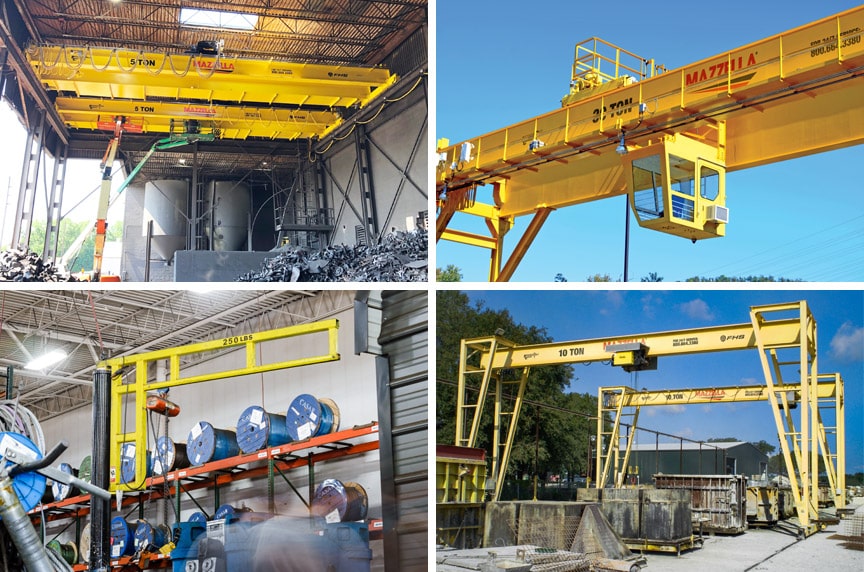
An overhead crane is a complex piece of equipment, and there are many different types of overhead cranes to choose from. The complexity of the overhead crane components required to operate the crane, the engineering required to design the crane, and the application (industry or materials being lifted) will determine what type of crane you’ll need.
For example, an 80 foot, 20-ton double girder bridge crane will cost significantly more than a 40 foot, 10-ton double girder bridge crane.
What is the Span of the Overhead Crane?
The span of an overhead crane, or distance between the centerline of the runway rails, is one of the biggest contributing factors to the cost of an overhead crane. The longer the crane’s span, the more material is required to build the crane girders. This added material increases the crane’s weight, which will also increase the cost of the runway, if required.
What is the Capacity or Maximum Rated Load?
An overhead crane’s capacity is the maximum load which may be applied to the crane in a particular working configuration, and under a particular condition of use.
When the manufacturer comes on-site to provide a consultation, they can calculate the capacity based on their understanding of:
- The size and weight of the material that you’ll be lifting
- Below-the-hook lifting devices that may need to be used
- Single hoist or double hoist configuration
- Any other considerations for future crane usage or capabilities
A crane that requires a large capacity, a large span, or severe service classification, may require a double girder design—meaning two beams make up the bridge and the hoist rides on top of the beams. These girders can be designed in a rigid welded steel box girder for added reinforcement. This type of setup will be the most expensive, as there are significant increases in labor and material charges to weld and fabricate the girders.
What is the Service Classification or Duty Cycle?
There are six different classifications of overhead cranes, specified by the Crane Manufacturers Association of America (CMAA). An overhead crane manufacturer will determine what type of crane classification they’ll need to build for your specific lifting application, using the following criteria:
- How frequently will the crane be used?
- How quickly will the crane need to transfer equipment or materials?
- How many lifts per hour will the crane need to perform?
- Will the crane be needed for regular or frequent service?
- How far does the crane need to move material in your facility?
- What is the average rated load of the materials that will be moving?
- How often will the crane be making lifts at full capacity?
- What environment will the crane operate in?
Class A and Class B cranes will be your least expensive option because they’ll be used mostly for maintenance or the initial installation of equipment. They’re used infrequently, and there are long periods of idle time between lifts.
Class C cranes will be a middle-of-the-road type crane. There may be some additional engineering built-in to the project for a specific need, but they typically utilize a basic hoist, trolley, and bridge design. They’re used moderately to handle loads at or around 50% capacity and are in service for about 5 to 10 lifts per hour.
Class D and Class E cranes, often referred to as process cranes, are built for a specific need and are more heavy-duty. They may consistently run over 50% of the rated capacity and make 15 or more lifts per hour. They have more engineering or customized solutions built into the design for the specific lifting application—which increases initial design and engineering costs for the project.
Class F cranes must be capable of handling loads approaching rated capacity continuously, under severe service conditions, throughout their lifetime. They’ll be extremely expensive due to additional costs related to design and engineering, sourcing of heavy-duty components, materials and labor, and installation.
What is the Operating Environment?
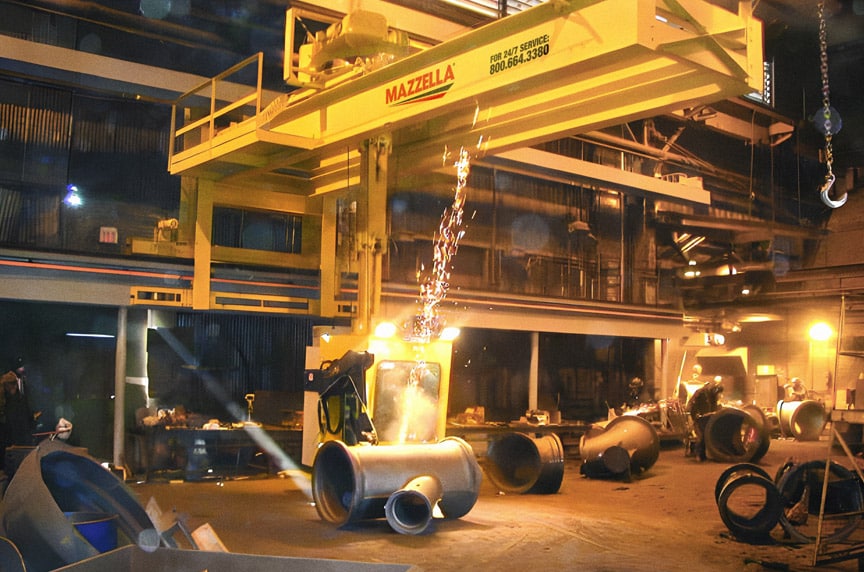
A severe, obstructed, or dangerous operating environment where the crane will be installed and running, will affect the cost of an overhead crane in several ways.
Environmental factors such as high heat, the presence of chemicals or fumes, steam, dust, or excess moisture can require special metal coatings to protect and enhance the operating life of the crane. The individual components of the crane will also need to be sourced to ensure that they can hold up and withstand the operating environment.
We get consultation calls from all over the country, and how we install cranes in Wisconsin is different from how we’d install one in Louisiana. In geographic regions like the Southeastern United States, hot, humid summers mixed with rainy winters increase corrosion on cranes. To prevent this, additional coatings and weather sealings are needed. Also, AC or heating will increase the price.
Facilities like wastewater treatment plants, fertilizer plants, and oil and gas processing facilities require explosion-proof cranes, meaning the equipment can’t generate any spark. These cranes can utilize a specific pneumatic air-powered system or a specially designed electrical system to make them explosion-proof. However, these can be expensive to design and install.
Cranes used outdoors will need additional protective coatings to prevent corrosion and will require weatherproofing to seal out moisture, dust, or dirt. Also, stainless steel or galvanized components need to be sourced to ensure they handle exposure to the elements and don’t rust.
A dangerous operating environment will also require special equipment and protection (PPE) for the installers during an overhead crane installation. Any obstructions to the installation area can add to the cost if the installers don’t have clear access to the area to remove an existing structure or install a new one.
What is the Length of the Runway?
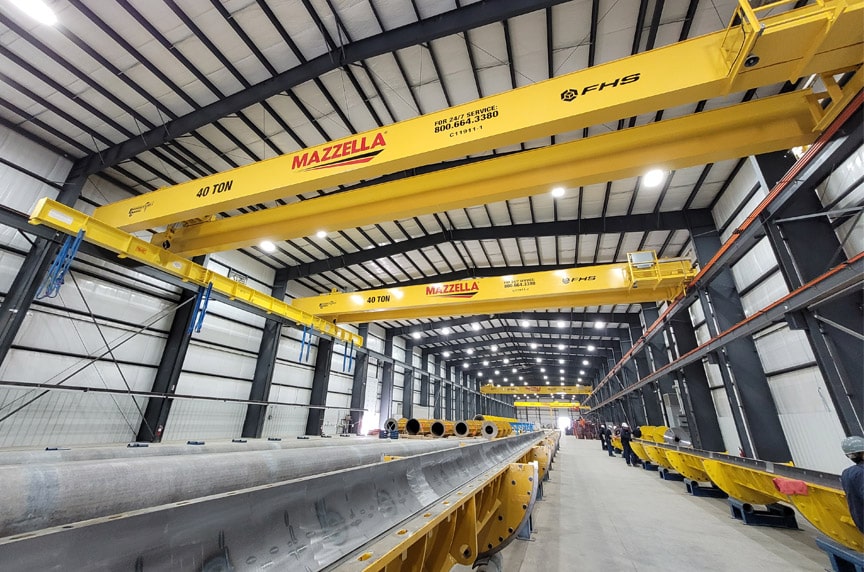
The runway length is the largest contributor to the runway cost itself. This length can also play into the cost of the crane. If you need to make multiple picks per hour and have a long runway, then you may need a faster bridge to move quickly up and down the runway. The additional speed may require the crane components to be sized with larger motors.
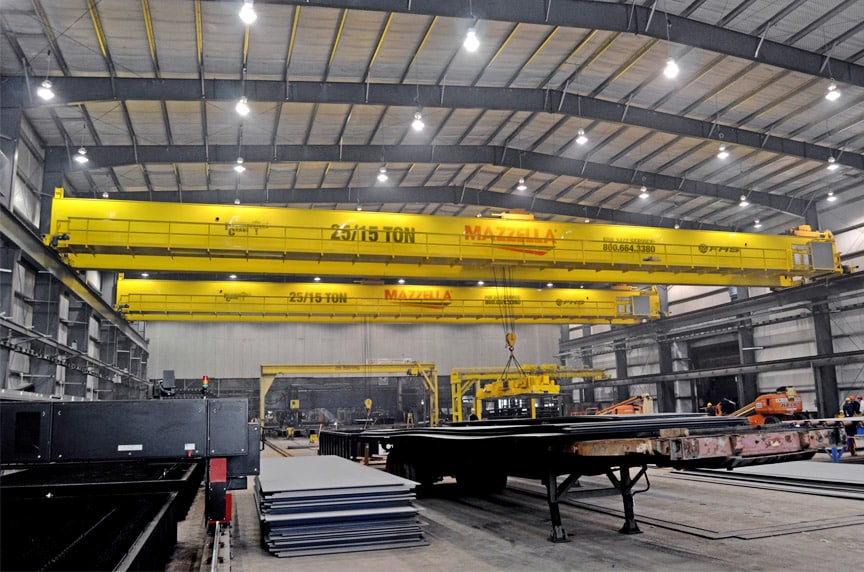
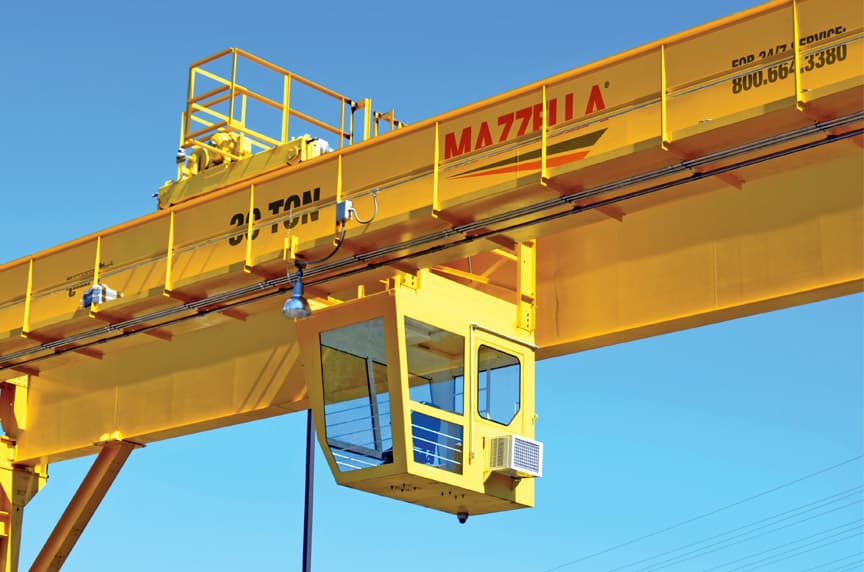
A faster crane that travels the length of the building may also require the operator to work from within an exposed or enclosed cab—which is more expensive than radio or pendant controls.
What are the Building or Structural Requirements for Operation or Installation?
When installing an overhead crane in a new construction facility, typically the runway beams will be installed during the construction process, and the crane manufacturer won’t need to include the runway structure in the quotation process.
Care must be taken with your construction contractor, as crane runway tolerances are much tighter than standard construction codes. Repairing a runway that’s out of tolerance can add significant cost to the installation. It is recommended to have the crane manufacturer also bid the runway portion of the project, as the installer will be more in-tune with CMAA standards for runways. The crane manufacturer should work with the building designer to make sure the building is designed to support the system properly.
If a crane is being retrofitted into an existing building, there will be added costs for the design, fabrication, delivery, and installation of the crane’s runway system.
Most crane manufacturers don’t offer in-house structural repair or certification services, so you’ll also have to consider any additional costs related to having concrete contractors or structural engineers provide a consultation of your facility. They’ll need to determine if the existing building structure and foundation can handle the additional loads generated by an overhead crane system.
What is the Quotation Process for an Overhead Crane?
The overhead crane quotation process can take anywhere from 3-30 business days, depending on the number of cranes being quoted, the complexity of the project, and the sourcing of crane components. Once they’ve completed this process, they’ll contact you to submit their official bid for the project.
Once you’ve gone through the consultation process, a group of estimators, engineers, draftsmen, and project managers all get together and begin putting together a comprehensive proposal.
Now that you understand all the different considerations and factors involved in determining the cost of an overhead crane, here’s what you can expect to pay, on average, for the most common sizes and configurations.
What is the Cost of an Overhead Crane?
NOTE: These prices DO NOT include installation costs, unless otherwise specified. Based on the points raised, some cranes could fall outside this price range.
Bridge Crane: $40,000–$100,000
Single Girder Crane: $40,000
- 5-ton capacity
- Span of 40 feet or less
- Base design trolley, hoist, and bridge
- 30% higher than it was three or four years ago
Double Girder Crane: $65,000–$100,000
- Recommended for heavy-duty applications
- There’s no limit to maximum span or capacity
- Cost includes installation
Semi-Gantry Crane: $130,000
- 5-ton capacity
- 40-foot span
- Includes hoist
- Typically, 1.5 to 2 times the cost of an equivalent bridge crane
- Hoist, trolley, railway included
Full Gantry Crane: $160,000–$170,000
- Additional charges due to structural system changes
Monorail Crane: $15,000–$25,000
- 2-ton capacity
- 20-foot span
- Includes hoist
- Cost is most dependent on length of the track and support structure. Will it be floor mounted or hung from ceiling?
Workstation Crane: Anywhere from $2,000–$80,000
- Capacities from 150 lbs. to 2-tons
- Coverage with up to 34-foot bridge span and unlimited runway length
- Up to 17 feet high clearance for free-standing design
- Free-standing or ceiling-mounted can affect price
- Wide price range is very dependent on span and length of runways
- 1-ton capacity with a 20-25 foot system will cost about $30,000
- 2-ton capacity will be about $40,000
- A freestanding structure would increase the price by about 30%
Jib Crane: Anywhere from $500–$25,000
- Capacities from 150 lbs. to 5-tons
- 4-foot to 30-foot spans
- Height under boom from 8 feet to 30 feet
- There are many different types of jib cranes, including:
- Free-standing
- Workstation (typically lighter capacity)
- Structural (can be designed up to 10-ton capacity)
- Mast-Type / Floor-to-Ceiling
- Tool jibs (typically lighter capacity)
- Structural (can be designed up to 10-ton capacity)
- Installation can add another $15,000–$25,000
- You may need to pour a foundation footer if your concrete isn’t strong enough, increasing the price.
Important questions to ask:
- Do you need a motorized crane, or will it be manually powered?
- What is the degree of rotation required?
Remember, these aren’t necessarily base-level prices, but instead are prices or ranges that we’ve seen for the most common configurations of each type of crane. The type of crane, the span, the capacity, the duty cycle, operating environment, and any additional building or structural considerations can all add to or lessen the cost of an overhead crane.
Wrapping it Up
There are so many factors affecting the price for an overhead crane system. The two most important aspects are span and capacity. These will determine how much labor and material will be required for the project and will also dictate the complexity and design of the hoist, trolley, bridge, controls, and power system—all major players in how much a crane will cost you.
At Mazzella, we have over 70 years of experience designing and building world-class overhead crane systems, ranging from light-duty economical cranes to large-capacity, high-duty cycle cranes.
Our expert team of Engineers, Estimators, Crane Specialists, and Project Managers can help you design and specify a cost-effective crane system for your facility, production or budgetary needs. Since every business is unique, and no two cranes are alike, we offer free quotes and consultations for overhead and material lifting projects. Want to schedule a consultation with a Crane Specialist? Contact us today.

Copyright 2024. Mazzella.