
Tractel TravSafe Lifeline System: 5 Key Benefits for Working at Height
The Tractel TravSafe lifeline system is designed to help users move and work at height while remaining connected to a fall protection system. For facilities evaluating horizontal lifeline options, system design, user mobility, installation requirements, and engineering support are important considerations.
In this video, Wayne Garrett of Mazzella Lifting Technologies explains five key benefits of the Tractel TravSafe lifeline system. He covers how the dual-line system supports hands-free operation, allows users to move past anchorage points without pausing to disconnect, and can accommodate up to five users at one time.
The video also explains how the system helps users move smoothly over cables, anchorage points, and integrated shock absorbers. In addition, it outlines Tractel’s requirement for factory-trained installers and Mazzella’s engineering support for pre-engineered lifeline systems.
What You’ll Learn:
- What the A, B, and C in the ABCs of fall protection represent
- The purpose of an anchor point in a personal fall protection system
- How a body harness supports the worker
- How a connecting device joins the dorsal D-ring to the anchor point
Who This Is For:
- Safety and EHS professionals
- Plant and facility managers
- Construction and industrial workers
- Anyone responsible for selecting or using fall protection equipment
- Anyone learning the basics of personal fall protection systems
Need Help With Fall Protection?
Contact Mazzella’s Fall Protection Division for assistance with fall protection equipment or systems.
Transcript
Intro
My name is Wayne Garrett with Mazzella Lifting Technologies, and today I’m going to teach you about Tractel’s TravSafe lifeline system, which gives the user five key benefits.
Five Key Benefits of the TravSafe System
Number one is that it allows 100% hands-free operation.
Number two, you are able to maneuver over anchorage points, also known as intermediates, without pausing and disconnecting.
Number three, this system is able to get five users at one time.
Number four, because of the dual-line system, you have a shorter fall deflection in case of a fall.
Number five, the user can move over the cables and anchorage points smoothly, no friction, no jerking.
Also, the shock-absorbing unit is incorporated directly into the dual-line system, meaning that the user can go right over the shock absorbers without even knowing that they’re there.
Installation Requirements and Engineering Support
It is mandatory from Tractel that all of their lifeline systems are installed by factory-trained installers.
And Mazzella incorporates all pre-engineered lifeline systems with the backing of P.E.s and engineers on staff.
Closing
Hopefully, this video was able to educate you on the benefits of the Tractel TravSafe system and how it is, indeed, an industry leader.
If you have any questions or would like a walk-around tour, please give me a call or look at our website at MazzellaCompanies.com.
FREE Downloads!
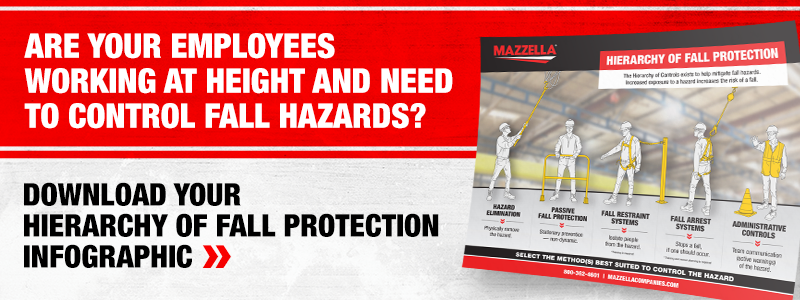
- Hierarchy of Fall Protection [Infographic]
- Top 10 Safety Tips for Working at Height [Infographic]
- Job Safety Analysis & Working at Height Risk Assessment [Bundle]
- Fall Safety 101 Infographic [Poster]
<!–[if lte IE 8]><![endif]–>
 hbspt.cta.load(3336966, ‘43336e9f-4baf-453c-841c-394decc4e070’, {“useNewLoader”:”true”,”region”:”na1″});
Learn More! Articles & Videos
- A Dictionary of Fall Protection Terms
- New Fall Safety 101 Poster…Download Today!
- Suspension Trauma in Fall Protection: What Safety Managers Must Know
- What is a Lifeline Fall Protection System? Different Types & OSHA Standards
- What Is the Uni-Life Track™ Fall Protection System?
- Why Should You Prioritize Fall Protection for Your Workers?
Contact Mazzella
- Schedule Remote or In-Person Training
- Contact Mazzella’s Fall Protection Division
In this video
- 0:00 Intro
- 0:15 Five Key Benefits of the TravSafe System
- 0:53 Installation Requirements and Engineering Support
- 1:06 Closing
Disclaimer:
Any advice, graphics, images, and/or information contained herein are presented for general educational and information purposes and to increase overall safety awareness. It is not intended to be legal, medical, or other expert advice or services, and should not be used in place of consultation with appropriate industry professionals. The information herein should not be considered exhaustive and the user should seek the advice of appropriate professionals.