
What Is Personal Fall Protection and Do You Need It?
Personal fall protection helps protect workers who perform tasks at height and may be exposed to fall hazards. Selecting the appropriate system involves more than simply wearing a harness, it requires understanding the hazard, the work being performed, and how every part of the system works together.
In this video, Kevin Muldoon, Project Manager for Engineered Lifeline Systems and Fall Protection, explains what personal fall protection is and outlines the hierarchy of controls used to reduce fall risks. He also covers when personal fall protection may be needed, the ABCs of a fall protection system, and common oversights that can affect worker safety.
You’ll learn the difference between fall restraint and fall arrest, why anchor points and connecting devices matter, how harness selection can vary by worker and application, and why factors such as swing fall and fall distance need to be considered before work begins.
What You’ll Learn:
- What personal fall protection is and how fall restraint differs from fall arrest
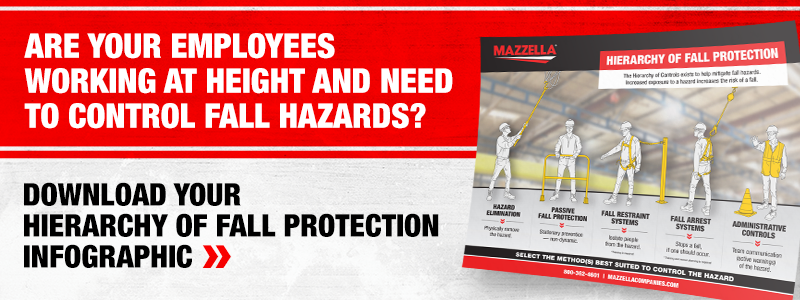
- The hierarchy of fall protection controls, including elimination, passive protection, restraint, arrest, and administrative controls
- When workers may need personal fall protection equipment
- The ABCs of a fall protection system: anchor points, body harnesses, and connecting devices
- Why harness selection should account for body type and the work environment
Who This Is For:
- EHS and safety professionals responsible for working-at-height safety
- Facility, operations, and maintenance managers
- Safety trainers and supervisors supporting employees who work at height
- Anyone involved in selecting, inspecting, or using personal fall protection equipment
Need Help With Fall Protection?
- Contact Mazzella’s Fall Protection Division to discuss your fall hazards, personal fall protection equipment, and working-at-height safety needs.
Transcript
Intro
Today, I’m going to teach you about personal fall protection equipment and whether or not you need it.
My name is Kevin Muldoon, project manager for Engineered Lifeline Systems and Fall Protection, and today, I’m going to teach you about fall protection equipment and whether or not you need it.
What Is Personal Fall Protection?
So, I want to start by talking about what exactly fall protection is. It’s a series of controls that either restrain or arrest you.
And the restraining would be, you never actually get to the hazard, so a fall would never occur. And arrest is actually, if a fall would occur, the arrest portion would stop you from actually hitting the ground.
That’s essentially what fall protection is.
What Are the Different Types of Fall Protection Systems?
Next, I want to talk about the different types of fall protection. There really is a hierarchy of fall protection, and fall protection really is everything we do at height.
The first is elimination. If we can eliminate being at height, that’s the most preferable. But if we can’t, there’s passive.
And passive is basically a guardrail or something preventing you from actually going toward the hazard.
And third would be fall restraint. And so, with restraint, it actually is preventing the worker from going toward the hazard by the use of an anchor point and a connecting device, but a connecting device that is measured to make sure the worker does not reach the hazard.
Next would be arrest. Arrest meaning stopping in the event of a fall, should one occur. It is actually stopping the worker from hitting the ground or any other object below.
Next is administrative controls, which need to be administered by a competent person, and a detailed fall protection plan needs to be in place.
Essentially, the competent person is acting as a safety monitor, monitoring the hazards of the people actually doing the work.
When Do I Need to Wear Personal Fall Protection?
So, when do you need to wear personal fall protection? That would depend on the work that you’re performing and the actual hazard.
If you’re working above four feet, you absolutely need fall protection equipment.
What Are the Components of a Fall Protection System?
So, the next one is actually the ABCs of fall protection, which are the components of a fall protection system.
An anchor point, what you’re connected to. A connecting device. And a body harness, what you’re actually wearing.
Those three, working in conjunction, are components of a fall protection system.
People often ask me, “Does it matter what type of harness that I select or what size?” And it absolutely does.
But two things to take into consideration are your body type and what industry you’re working in. Those two things will help you select what type of harness you’re going to need.
What Do People Get Wrong With Their Fall Protection Systems?
What do people get wrong most about fall protection? And that would be anchor points, actually, what they’re anchored to and whether it is strong enough to hold them.
In identifying hazards, how many hazards are involved when working at height? And also, swing fall. If I actually fall, am I going to swing and hit another object?
And the last is fall distance. Most people don’t really realize the height of themselves, the distance they’re going to travel, and that a safety factor of three feet needs to be considered when calculating fall distance.
Wrapping it up, hopefully I’ve helped you understand more about personal fall protection and whether or not you need it.
For more information, please head to our website or YouTube channel, where you can see more of our fall protection videos.
Please contact us if you have any questions, or if you’re struggling to fill out your job safety analysis or your working-at-height risk assessment. We’d be more than happy to help you out.
Podcast: What is Personal Fall Protection and Do I Need it?
Want to dive deeper? Listen to the podcast.
FREE Downloads!
- Hierarchy of Fall Protection [Infographic]
- Fall Protection Harness Inspection Field Reference [Guide]
- Fall Safety 101 Infographic [Poster]
- Job Safety Analysis & Working at Height Risk Assessment [Bundle]
<!–[if lte IE 8]><![endif]–>
 hbspt.cta.load(3336966, ‘43336e9f-4baf-453c-841c-394decc4e070’, {“useNewLoader”:”true”,”region”:”na1″});
Learn More! Articles & Videos
- What Is a Rigid Rail Fall Protection System? Different Types & Design
- The Best Types of Fall Arrest Systems for Fixed Ladders
- What Does Proper Fall Protection Look Like for Women?
- Suspension Trauma in Fall Protection: What Safety Managers Must Know
- A Buyer’s Guide to Selecting a Fall Protection Harness
- Fall Protection for Roofers: Systems, OSHA Regulations, & Best Fits
Contact Mazzella
- Schedule Remote or In-Person Training
- Contact Mazzella’s Fall Protection Division
In this video
- 0:00 – Intro
- 0:41 – What is Personal Fall Protection?
- 1:08 – What are the Different Types of fall protection systems?
- 2:17 – When do I need to wear personal fall protection?
- 2:34 – What are the components of a Fall Protection System?
- 3:19 – What do people get wrong with their Fall Protection Systems?
Disclaimer:
Any advice, graphics, images, and/or information contained herein are presented for general educational and information purposes and to increase overall safety awareness. It is not intended to be legal, medical, or other expert advice or services, and should not be used in place of consultation with appropriate industry professionals. The information herein should not be considered exhaustive and the user should seek the advice of appropriate professionals.