
Buying a Custom Lifting Device: What to Expect From Need to Quote
Buying a custom lifting device can be a big decision, especially if you have never gone through the process before. A custom below-the-hook lifter may be a significant investment, and it is normal to have questions about how long the process takes, what information you need to provide, how quotes are developed, and how to compare one lifting device supplier to another.
In this video, Dan Sherwood, Below-The-Hook Specialist at Mazzella, walks through the process of buying a custom lifting device from the initial need and consultation through design, estimating, and quoting. You’ll learn what information helps speed up the process and what to look for when reviewing custom lifting device quotes.
Understanding the process before you begin can help you get a safer, more efficient lifting solution for your application. It can also help you avoid delays, missed details, or quote comparisons that focus only on price instead of the full value and function of the device.
What You’ll Learn About Buying a Custom Lifting Device:
- What information you should have ready before requesting a quote
- How the initial design and estimating process works
- How you can speed up the purchasing process
- When to expect a quote after consultation
- How to compare custom below-the-hook lifting device quotes
- What happens after you approve the quote and issue a purchase order
Who This Video Is For:
- Plant managers and operations leaders considering a custom lifting device
- Maintenance managers involved in lifting and handling applications
- Buyers comparing below-the-hook lifting device quotes
- Safety and EHS leaders reviewing lifting equipment decisions
- Anyone purchasing a custom lifter for the first time
Need Help Buying a Custom Lifting Device?
Choosing the right custom lifting device starts with understanding your load, your crane capacity, your lifting environment, and the safest way to move the material through your facility. If you are unsure what type of below-the-hook lifter is right for your application, Mazzella can help.
Our Below-The-Hook specialists can review your application, discuss what you are trying to lift and where you are trying to lift it, and help develop a solution designed for your operation. From consultation through quote, approval drawings, fabrication, and delivery, our team can walk you through the process and help you make a more informed purchasing decision. Contact a Mazzella Below-The-Hook Lifting Device Specialist today!
Transcript
Why Buying a Custom Lifting Device Can Be Confusing
— Purchasing a lifting device can be a big decision. Not only can they be a big investment, but if you have never purchased one before, a completely custom purchase can leave you with questions about the process. How long will it take? How should I gather the quotes? How do I analyze each company?
We’re going to walk you through each step of the process so you know exactly what to expect.
The Custom Lifting Device Buying Process Explained
— My name’s Dan Sherwood. I’ve been working with below-the-hook lifting devices for 15 years and I’d love to walk you through the process of what it takes from start to finish on getting one.
When you’ve made the decision that it’s time to get a new lifting device, you’re gonna go through a series of steps to get that device ultimately delivered to your door.
The first step’s gonna be the consultation phase where somebody’s gonna come out, look at your application, figure out what you guys are trying to do, and give you the best solution for that.
After that, it’s gonna go through a design phase to the point of being able to get it to the next step, which would be estimating.
And once it’s estimated and the pricing’s sent to you and you would issue a purchase order, that would then get the ball rolling on engineering.
Engineering would then produce the approval drawings, which is a set of drawings with all the critical dimensions.
After that, it goes into the fabrication, The fab’s getting done, machining all that is getting done.
After that, you’re gonna be notified the lifter should be shipping to you. You’ll get the lifter and you get to put it into use for the first use.
Consultation Phase
The consultation will take place after you’ve reached out to either your local account manager, filled out a contact form on our website, or called into our shop, we’ll set up a time that an account manager and a specialist can come out and review your application with you.
When we come in for a consultation, the biggest thing for us is understanding what you’re trying to lift and where you’re trying to lift it. Those two things are gonna really determine what type of device we wanna recommend for this application.
We always try to work with your available schedule as well as our account manager and/or specialists’ schedule to get in to make that visit. If we can’t get in right away, we might offer to set up a teams call, go over the application with you, start to get the ball rolling, at least getting all the information we need to get it into the design phase.
What Information Do You Need Before Consultation?
We ask that when we come on site, the customer has a full understanding of their application, really what they’re trying to do, where they’re trying to place the item, pick it from, any obstacles we might be looking at.
If they have drawings of the parts or sample parts we can have at some point during the process. All that type of stuff is gonna be great information for us. Knowing what crane they’re gonna be using it on or cranes they’re gonna be using it on. We need to understand what the capacity of the crane is versus what the weight of the load is you’re trying to pick.
There are certain situations where the weight of that load gets really close to the overall crane capacity and we have to be cognizant of that when designing our lifter ’cause there is gonna be a weight of our lifter that has to go into that total rigging calculation weight.
How Operators and Load Testing Affect the Lifter Design
The one thing to keep in mind as we’re going through the consultation phase, if you have an idea of what you think could work for you, please bring that to the table.
We’d like to talk to the operators, see what they’re doing, how they’re doing it, what they think might work. We might have an idea that the operators may not like, and vice versa, the idea you guys have, we might be able to come up with a more efficient and safer way to do something.
During the consultation phase, the main person you’re gonna wanna work through is your local account manager. If you don’t have a local account manager, the below-the-hook specialist that comes on site to do the consultation with you would be your next main point of contact.
It’s very beneficial if we’re able to get out into the plant, see the application, where we’re gonna be using this lifting device at so we can make our assessments of exactly what type of lifter there may be, see if we see any potential issues with with the lift that’s gonna be going on, as well as just the general application.
All that information is very helpful to us upfront. The more information we can have upfront, the better we’re gonna be able to put something together.
So one thing to note during the consultation phase would be to let us know if your company requires any type of load testing. Now, per the ASME B30.20 standard, load testing is a recommendation. It’s a should not a shall.
So while we try to load test every device we can, there are devices that are sometimes too large for us to test in-house. We do have outside sources to be able to help us load test. Keep that in mind when looking for your device. If your company or your industry requires a load test, please let us know upfront ’cause we may have to build in a cost for that if it’s too large for us to do within our own shop.
Initial Design and Estimating
After the consultation’s done, it’s gonna go back to work on a kind of initial design. It’s going to be the specialists taking the information back to the design engineers, presenting what they’re, they think is going to work, make sure there’s no issues with what they’ve come up with in the field.
It’s very critical that we get as accurate of measurements as we can during the initial design phase. That way it’ll prevent when the approval drawings come out and something’s caught at that point, having to take it from the approval phase back to the initial design phase and potentially a re-quote phase.
If a customer can have drawings or photos, or really as much information as they can on the parts we’re lifting and what we’re lifting in. That’s really gonna help us speed up the process.
It’s important to note that during the initial design phase, no actual engineering drawings are gonna be sent back and forth between the customer and the company. The next set of communications you will see from us is the quote for the lifting device.
As the process moves forward, the account manager is going to be your main point of contact. They’re the person that you would wanna reach out to if you had any questions as far as how the quote’s coming along, if you have any questions after you receive the quote. We always encourage you to work through your local account managers.
You can expect a quote in three to 10 business days after consultation. This is based around the current workflow in the below-the-hook shop as well as the complexity of what the project is.
How to Compare Custom Below-the-Hook Lifter Quotes
One thing to keep in mind, if you are comparing below the hook quotes from company A to company B, you wanna understand exactly what the devices they’re proposing.
Different companies can be quoting different solutions to your application. So you really wanna understand which solution you think would best fit your application as well as your company.
Whether it’s more expensive or cost effective, always looking at what that device is and how it’s gonna work, could improve efficiencies, anything like that.
So buying below the hook on dollar value when it’s a custom device is not always the best thing to do. You always wanna look at what exactly is being quoted and how that’s going to be used.
The biggest thing is to make sure when you’re getting quoted from a on a below the hook lifter is you always want to ask the company if they design to the ASME B30.20 and BTH-1 standards.
As long as the company knows those standards, designs to those standards, you should be safe in proceeding forward with a device from that company.
During the quoting phase, you’re gonna want to continue to keep in contact with your account manager. They’re gonna be your main source for any information, any questions that may come up during this process. Always make the account manager your first point of contact. The account manager or specialist still may reach out with additional questions or or clarification on the application.
What Happens After You Issue a Purchase Order?
So after you’ve reviewed the the quote and determined that you’re ready to move forward with it and issued us a purchase order, there will be a short time where our legal team has to review terms, and if there’s any progress payment terms that need to be discussed during that point in time, that would happen.
After we have all the purchase order information squared away, it’s gonna move over to our engineering team to start the official design.
During this phase, the engineers are gonna take all that information we gather during the consultation, during the quote process, and start putting together what’s known as your approval drawings. These are gonna be fully engineered drawings that is gonna show you the device that we are going to be delivering to you.
You’ll be able to review those drawings, make sure what was discussed during the consultation matches, what is on the drawings, check all the measurements, make sure hole sizes are right, engagement, any clearances that need to be checked, that now is the time to check all that type of stuff as you want to catch that at the approval phase and not when the device is showing up on your floor.
How Mazzella Helps Walk You Through the Process
I know it can be scary when you’re reaching out to get a custom device made. We’re here to alleviate any fears that a custom device necessarily means expensive money with it. It can, but it can also be a lot more cost effective than you might be thinking when you hear the word custom. You also want to keep in mind when you’re ordering that device to leave yourself enough lead time up to that pick.
Mazzella’s gonna stand there with you through the entire process of buying a below-the-hook device, from consultation all the way to delivery. We’re gonna make sure that the application is perfect for the lifter we’re putting in there for you.
We’re gonna talk you through exactly what we’re presenting, how it’s gonna work, how it’s gonna function, how you can use it, where we see efficiencies coming in your process.
We’re here to help you guys get safer and more efficient in your lifting.
— So that’s the first stage of the process. Hopefully you understand a bit more about the process of getting a quote for a below-the-hook lifting device.
In the next video, we’ll walk you through everything you need to know about purchasing a lifter after you sign the purchase order and the engineering begins.
If you are considering making that investment, we have numerous articles, videos, and downloads to help you become a more informed buyer, including our lifting device considerations checklist and design sheet bundle.
Check out the links below to research anything you may need to know before purchasing a below-the-hook lifting device.
If you found this video useful, informative, entertaining, or you just feel like being friendly, hit that like button so we can get this information out to everyone who needs it.
Don’t forget to subscribe so you never miss a video.
Remember, safe rigging is smart rigging. My name is Ben. Stay safe out there.
FREE Downloads
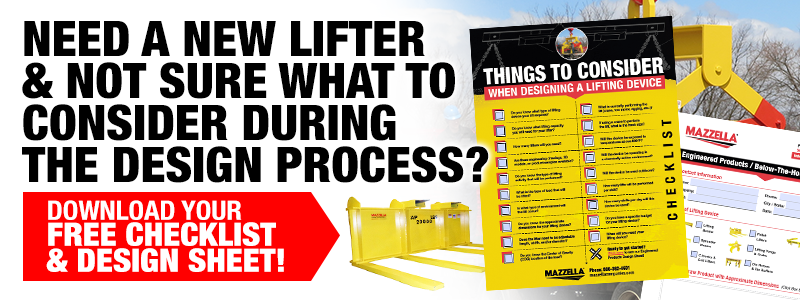
- Things to Consider When Designing a Custom Lifting Device Checklist and Design Sheet
- Below-the-Hook Lifting Devices At A Glance [Guide]
- Rigging Gear Inspection Field Reference [Guide]
- Below-the-Hook Repair Vs. Replace [Guide]
Learn More! Articles & Videos
- 7 Things You Should Know Before Buying a Below-the-Hook Lifting Device
- From Need to Delivery, Everything You Need to Know to Buy a BTH Device
- What Makes My Below-the-Hook Lifting Device OSHA Compliant?
- Why Are Engineered Below-the-Hook Devices Better than Homemade Devices?
- Identification & Markings for Older Below-the-Hook Lifting Devices
- ASME BTH-1: Common Terms Used in Lifting Device Design
- ASME B30.20-2021: Updates & Revisions to the Below-The-Hook Standard
- What is a Below-the-Hook Lifting Device? Definition, Types, and Design
- Spreader Beams vs. Lifting Beams: Definitions, Differences, and Design
- The Difference Between C-Hooks and Coil Lifters: Which One’s Right for You?
- The Positives and Negatives of Using a Forklift Boom
- What Options Exist for Lifting Bundles?
- A Breakdown of Lifting Tongs: 5 Benefits & Important Industry Standards
- What Is a Bearing Lifter for an Overhead Crane?
Contact Mazzella
- Schedule Remote or In-Person Rigging Training
- Contact Mazzella’s Lifting and Rigging Division
In this video
00:00 – Why Buying a Custom Lifting Device Can Be Confusing
00:25 – The Custom Lifting Device Buying Process Explained
01:23 – Consultation Phase
02:02 – What Information Do You Need Before Consultation?
02:45 – How Operators and Load Testing Affect the Lifter Design
04:13 – Initial Design and Estimating
05:30 – How to Compare Custom Below-the-Hook Lifter Quotes
06:42 – What Happens After You Issue a Purchase Order?
07:36 – How Mazzella Helps Walk You Through the Process
Disclaimer:
Any advice, graphics, images, and/or information contained herein are presented for general educational and information purposes and to increase overall safety awareness. It is not intended to be legal, medical, or other expert advice or services, and should not be used in place of consultation with appropriate industry professionals. The information herein should not be considered exhaustive and the user should seek the advice of appropriate professionals.