
Dr. Frankenstein’s Homemade Lifting Devices: A Tale of Non-Compliance
In Dr. Frankenstein’s laboratory, ambition has taken shape in steel. He has created his own lifting devices—and he is certain of their greatness. But a creation that lifts is not necessarily a creation that should.
In this special Halloween episode, Mazzella Below-the-Hook Specialist Dan Sherwood enters the laboratory to examine the doctor’s handiwork. Each unveiling brings new questions about engineering, identification, and the responsibility a creator bears. Will the doctor’s creations withstand scrutiny… or has his ambition blinded him to something he has yet to discover?
What You’ll Learn:
- Why bringing a lifting device to life doesn’t mean it is safe to lift
- Where ambition meets the scrutiny of ASME B30.20 and BTH-1
- Why a capacity label alone cannot absolve a creator of the need for engineering and proper identification
- What a device’s identification should reveal: manufacturer, serial number, rated load, design category, and service class
- Why engineering calculations and known material properties—not blind faith in one’s creation—must establish a lifter’s capabilities
- How a qualified manufacturer can turn a homemade concept into a properly engineered lifting solution, without repeating the mistakes of Dr. Frankenstein
Who This Video Is For:
- Safety and EHS professionals confronting the homemade creations lurking beneath their facility’s crane hooks.
- Maintenance managers and shop supervisors who have inherited another creator’s handiwork—with no record of how it came to life or what it can bear.
- Fabricators and maintenance leads with great lifting ideas who need to know where shop ingenuity ends, and certified engineering must begin.
- Plant engineers and technical leaders tasked with separating a creator’s grand claims from what the calculations actually prove.
- Plant managers and operations leaders determined to banish rogue creations from the shop floor and protect the people working beneath the hook.
Uncertain what lurks beneath your crane hook? Summon a Mazzella below-the-hook specialist to examine your lifting application.
Transcript
A Friendly Word of Warning
— It’s alive. It’s alive. It’s alive.
— How do you do? Mazzella feels it would be a little unkind to present this video without just a friendly word of warning. You see, we are about to unfold a story of non-compliance, of lifting devices made by hand, by a man who sought to create solutions without reckoning upon ASME or any rules of compliance or safety. It is a tale of homemade lifting devices.
I think it will thrill you. It may shock you. It might even horrify you. If you do not feel you should subject your nerves to such a strain, now’s your chance. You’ve been warned.
A Specialist Crosses the Threshold
— Think of it. A lifting device ready to lift, built with my own hands. My own hands. They thought I was crazy, but they’ll see. They’ll see. Igor hoist!
— Yes, master!
— Hoist!
— Hey, what’s goin’ on?
— You. Who let you into my laboratory? Ah, you’re the specialist.
— Oh yeah.
— You’re the one they sent.
— Yeah, I’m Dan Sherwood. I’m from Mazzella. I’m a below-the-hook specialist there.
— They believe that you can find fault in my work, that you can look upon what I have created and tell me that it should not live? Stay then, stay then. Be my assistant.
Creation I: Ambition in Steel
You wish to tell me that it cannot be done, that there are limits, rules, codes, but I have taken steel that was dead, a ring, a clamp, a common hook, and I have given it purpose. It will lift. It will bear the load that no ordinary device would. Stay. Watch. And you’ll see what I can do.
Look at it! I have created the Cylinder Seizer. Now I know what it feels like to be God.
— Is this the C clamp that you cut and welded on?
— Yes.
— Yeah, you can’t do that, man.
Modified Lifting Devices: A Creation Gone Wrong
You have a tag on it, but you have a main piece on here that is just a store-bought item that’s designed to be used as a tool for clamping, not a tool to be used in lifting. You welded on it, you cut it, and you’re using it in a manner that it’s not designed for.
Even though you have a tag on it, this right here makes you non-compliant to what the B30.20, BTH-1 criteria is. This piece, if this were to be compliant, should be engineered. An engineer should have designed it and done it out of either some type of a burnout or machined component as opposed to buying a tool, cutting it apart, and putting it on the device.
You were almost there with having the tag, a serial number, the rated load, a manufacturer, and everything on here. The only place you went wrong on this one was using a store-bought tool that doesn’t have the engineering on it.
— No, but look. See how it lifts the cylinders it could have seized. It was flawed from the beginning. Take it away! It’s horrid! It’s a monster!
Creation II: The Illusion of Compliance
No matter. No matter. The next will be perfect.
Igor hoist!
Behold, The Great Plate Grabber 0117. Heavy. Strong. Steel. You see, I admit, Dan, the first was born in haste, but this, ah, this, I labored over, forged in one piece. True and whole. No seams. No stitches. And I gave it its strength. One ton! It says so right here. Made it with my own label maker. Compliant to your ASME B30.20 standards!
Lifting Device Identification: The Missing Markings
— Not quite. What are you grabbing with this? Something like this, you got to be grabbing on a flange or something where you have to crank this down.
You know, in the last lifter we had, it had a C-clamp on it that was designed for clamping that you were using in the wrong application. This is a great start to get a load-rated C-clamp for lifting, but your manufacturing tag, “Dr. Frankenstein’s lab,” I don’t see that on here.
For a device like this, the manufacturer, design category, service class, serial number, capacity, all that should be somehow etched or stamped into a device like this if there’s not enough room to place a tag to it. So you’re missing all that additional information on this outside of the capacity.
Having a capacity on something does not mean it meets the B30.20, BTH-1. How do I not know that you didn’t just decide you wanted it to be one ton, print your beautiful label here, put it on here, and call it that? You know, we need the engineering behind it or the proper tagging behind it.
— But this one is perfect. I forged it whole. It works exactly as it’s supposed to. Can you find a flaw in its function?!
Rated Load Calculations: Beyond a Creator’s Word
— Now, now just because it works doesn’t mean it’s compliant or safe. Functionality, you’re right. It looks like it could work as it’s designed, but did you run calculations? Are there calculations behind this to show you have the proper Safe Working Load in here with the Safety Factor?
You could go and pick up your one ton, and this could fail at your one ton if you don’t have calculations.
— You do not doubt the iron. You doubt me, my word. A fool! A strip of paper with a capacity was never enough for sufficient compliant identification! Igor, take it away, it’s a monster!
Creation III: Nature Bent to Will
Igor, hoist!
From that fateful day, when the first man lashed timber to a rope and dared to lift what his own arms could not. Our greatest dread has been rated load, the limit, the line beyond which they say we must not go. They came to me with their B30.20, their BTH-1. They spoke of design category B, a design factor of three, as though three times my genius could ever be undone.
They demanded allowable stress, yield strength, a service class, a fatigue life reckoned in load cycles. They told me a below-the-hook lifting device must be forged of prismatic steel, proven, proof tested to 125% it’s rated load, examined by a so-called qualified person!
But tonight we mock the modulus of elasticity. Tonight, we defy the load spectrum, the impact factor, the reliability index by which small minds measure genius, the proof of load itself. They bind their steel with rules. I have bound the very grain of nature itself, and I have bent it to my will, and it shall lift!
— Yeah, man, this is made of wood.
— Very strong wood and metal in some places.
Unknown Material Properties: What Lurks Beneath
— All right, so watch yourself over there.
It’s made of wood. We don’t have any mechanical properties of this, so engineering’s not able to determine how much this specific piece of wood can lift. It looks like you got some old formed steel in here, which is all right if you knew what grade or material it was. But the biggest thing I’m seeing on this is, again, you’re not having a tag or anything that meets the B30.20.
— So you’re telling me this cannot lift?
— No, it unfortunately, it cannot lift. This is not compliant. This doesn’t meet any of the standards.
— Wood. I built a thing to lift men’s burdens and never once asked if I could be trusted to.
— Take it away, Igor! Take all these monsters away!
The Cure: Engineering Over Alchemy
— Since you have me here, I should just tell you, here at Mazzella’s, we can take your existing device that may not be compliant, get the critical measurements off of it, take it back to our engineering team and provide you with something that does meet the standard that is designed properly and is going to lift in the same manner and same way as your existing devices.
Your ideas are great. The way you do it is great. You just got to finish that execution part and that’s where we can help you in making sure that what you’re lifting with and what we’re making is compliant and safe.
— Let me show you the rest of my devices. Bring your tape measure. Let me take you to my dungeon.
Overhead Lifting Safety: What Keeps You Up at Night
— You’ve just seen a tale of non-compliance. Creation’s never intended to be monsters, but monsters all the same. Somewhere out there, someone is still building them and one may be hanging in your shop right now.
Bring the knowledge of your lift to a qualified manufacturer. Mazzella can help engineer a device suitable to your application. What should keep you up at night is not the device you’ve created, but the people working below it. My name is Ben. Stay safe out there.
Freakishly FREE Downloads!
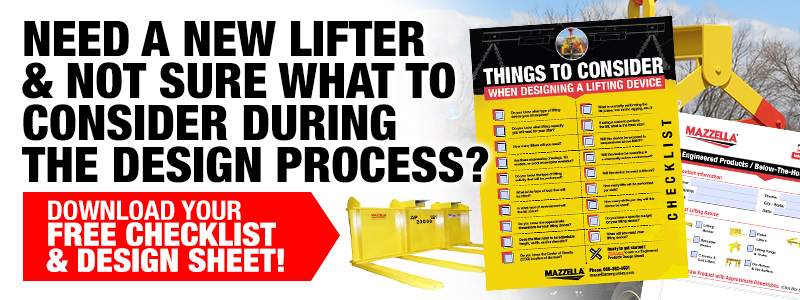
- Custom Lifting Device Considerations and Design Sheet [Bundle]
- Below-the-Hook Lifting Devices At A Glance [Guide]
- Below-the-Hook Lifting Device Repair Vs. Replace [Guide]
- Lifting and Rigging Site Assessment [Guide]
From the Crypt: Articles & Videos
- Engineered vs. Homemade Below-the-Hook Lifting Devices: Why Engineering Matters
- What Makes My Below-the-Hook Lifting Device OSHA Compliant?
- How to Purchase a Custom Below-the-Hook Lifting Device
- Identification & Markings for Older Below-the-Hook Lifting Devices
- What is a Below-the-Hook Lifting Device? Definition, Types, and Design
- 7 Things You Should Know Before Buying a Below-the-Hook Lifting Device
- From Need to Delivery, Everything You Need to Know to Buy a BTH Device
- ASME BTH-1: Common Terms Used in Lifting Device Design
- ASME B30.20-2021: Updates & Revisions to the Below-The-Hook Standard
- How To Choose the Correct Clamp for Your Lifting Application
- How to Perform a Lifting Clamp Inspection per ASME B30.20
Contact Mazzella
- Schedule Remote or In-Person Rigging Training
- Contact Mazzella’s Rigging Division
In this video
0:00 – A Friendly Word of Warning
1:25 – A Specialist Crosses the Threshold
2:46 – Creation I: Ambition in Steel
4:46 – Creation II: The Illusion of Compliance
8:01 – Creation III: Nature Bent to Will
10:55 – The Cure: Engineering Over Alchemy
11:44 – What Keeps You Up at Night
Disclaimer:
Any advice, graphics, images, and/or information contained herein are presented for general educational and information purposes and to increase overall safety awareness. It is not intended to be legal, medical, or other expert advice or services, and should not be used in place of consultation with appropriate industry professionals. The information herein should not be considered exhaustive and the user should seek the advice of appropriate professionals.